

Would you like more images?


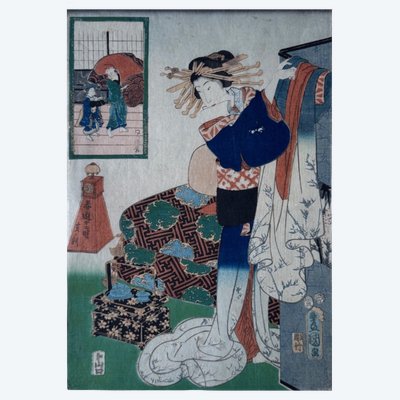
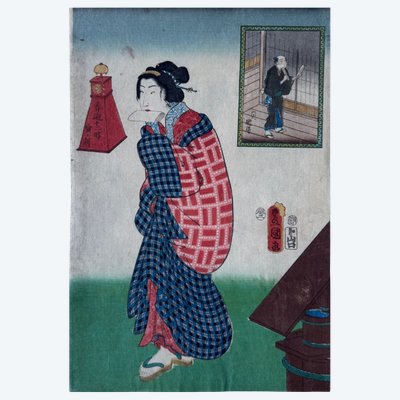
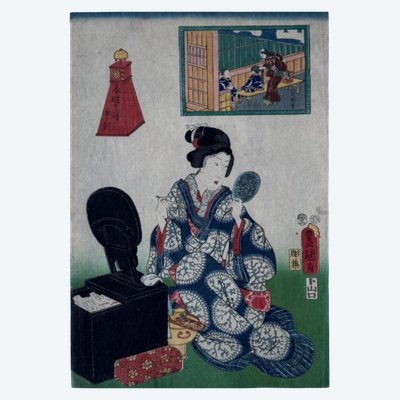
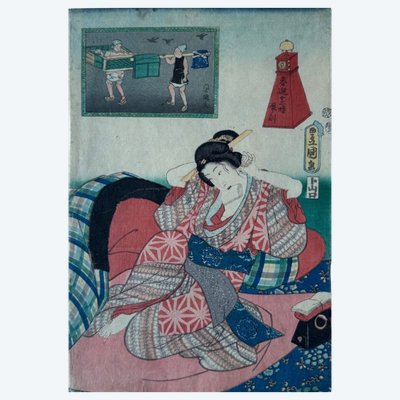
Japanese woodblock print depicting a parody of "The Killing of the Nue," from the E-kyōdai series, after the original by Kitagawa Utamaro (1753-1806) published in 1798.
See description below.
Note some damp stains and slight fading of the red color.
Pitch pine frame.
19th century.
Frame dimensions: H 51 x W 39 x D 1.5 cm; print dimensions: H 41.8 x W 30.5 cm
This print features the Nue, a fantastical creature from the world of Yōkai, a universe populated by spirits, monsters, and ghosts that nourishes the Japanese imagination.
The series title, inscribed in the cartouche in the upper left corner, E-kyôdai, which can be translated as "sister images," evokes a sense of kinship or correspondence between the scenes depicted. Through this series, Kitagawa Utamaro explores a play of mirrors between two situations.
Here, a young boy has just captured a rat whose tail still protrudes from the trap. This everyday scene echoes that of two samurai subduing a harmful, long-tailed creature, likely an allusion to a legend well-known to the 18th-century Japanese public. The composition underscores this analogy down to the smallest details: one of the samurai brandishes a torch, while a young woman illuminates the scene with a single flame.
Through this juxtaposition, Utamaro employs a subtle technique, akin to parody, frequently used in Japanese printmaking: contrasting a familiar, almost trivial scene with a more noble subject drawn from history or mythology. This play of echoes, both erudite and humorous, particularly appealed to the bourgeois and merchant clientele targeted by print publishers.
Examples are held in American museums (Portland and New York) as well as in Warsaw.
Kitagawa Utamaro (1753-1806) is one of the great masters of Japanese prints from the Edo period (18th century). Famous for his portraits of women (bijin-ga), through elegant and refined compositions, he manages to capture subtle expressions, delicate gestures, and moments of intimate life. His work is distinguished by its great finesse of line and attention to the details of everyday life. Highly regarded during his lifetime, he left his mark on the history of ukiyo-e and influenced many artists, both in Japan and in Europe, particularly during the rediscovery of Japanese art in the 19th century. Even today, his prints are among the most iconic and sought-after works of Japanese art.
Ref: MEUODNRLHK
| Condition | As is |
| Style | Asian Arts (Engravings, Prints of Asian Arts Style) |
| Period | 19th century (Engravings, Prints 19th century) |
| Country of origin | France |
| Width (cm) | 39 |
| Height (cm) | 51 |
| Depth (cm) | 1.5 |
| Materials | Paper, Wood, Glass |
| Shipping Time | Ready to ship in 4-7 Business Days |
| Location | 37230, Luynes, France |
4 commitments to buy with confidence

 English
 Français
 Italiano
 Deutsch