This description has been translated and may not be completely accurate. Click here to see the original
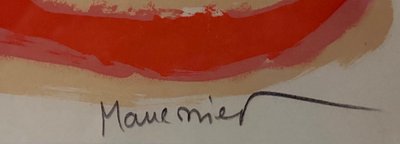
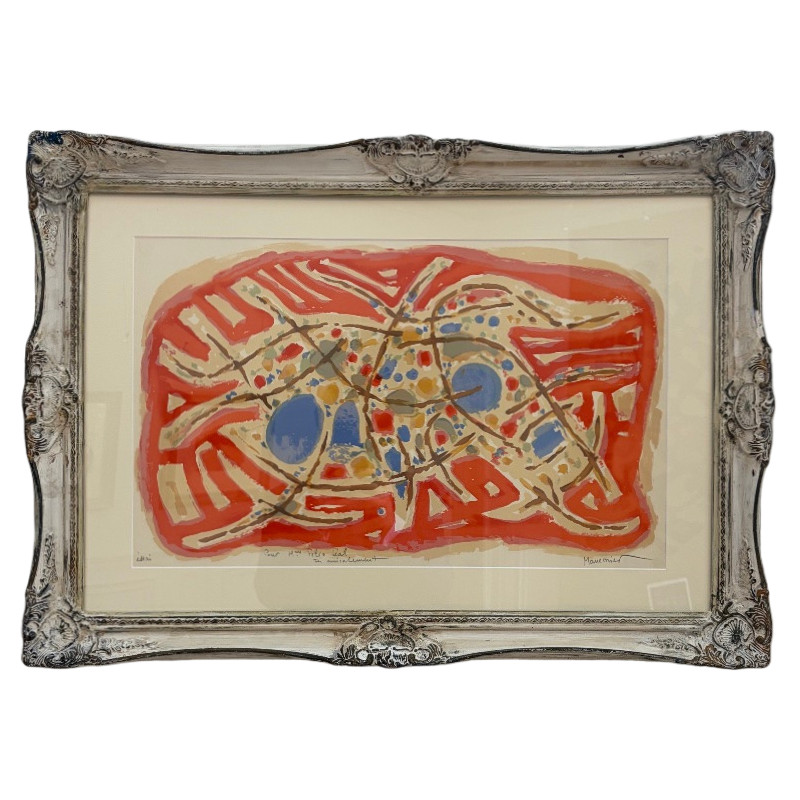
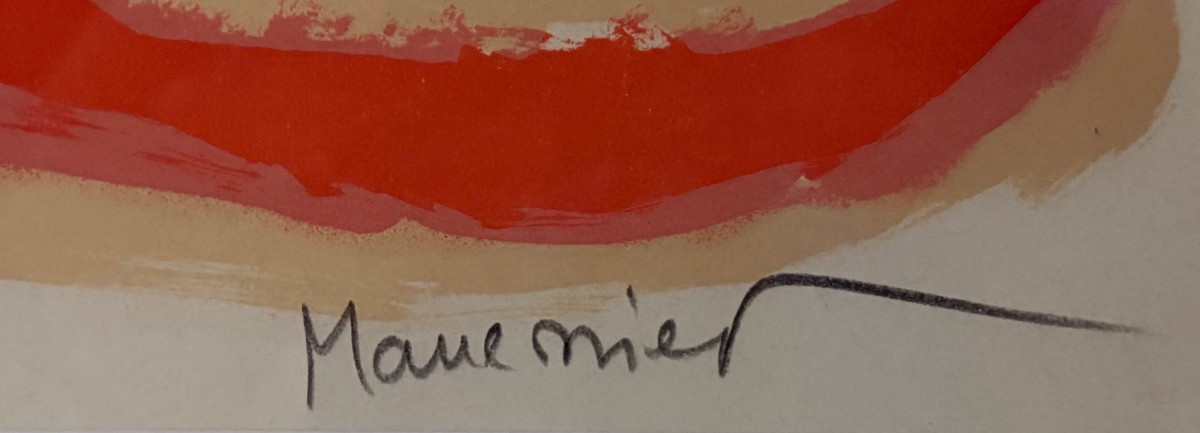
Alfred Manessier (1911–1993)
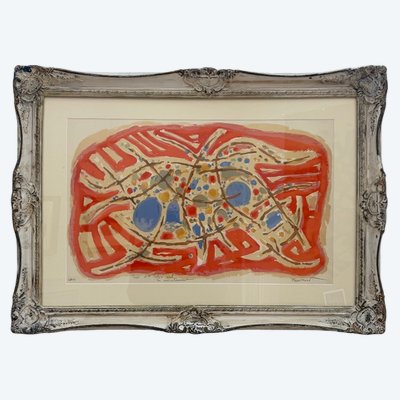
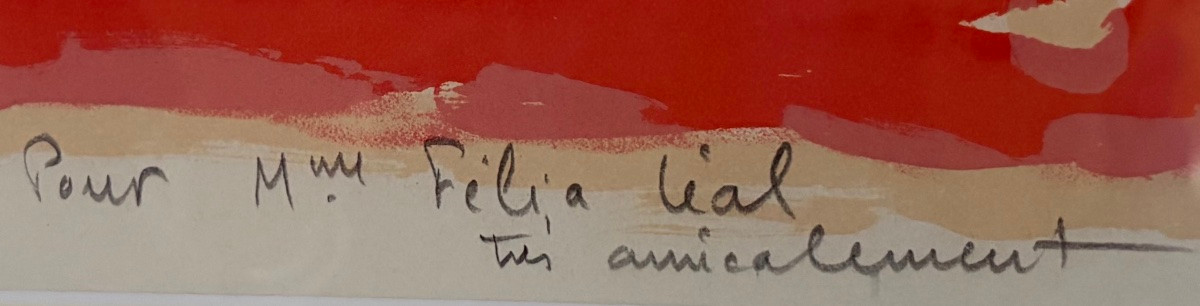
Alleluia of the Fields, 1964
Color lithograph
Image: 39 x 63.5 cm; Sheet: 41 x 64 cm
Lithograph commissioned to mark the publication of the illustrated book *Présentation de la Beauce à Notre-Dame de Chartres* by Charles Péguy, printed in 1964, to accompany certain limited-edition copies.
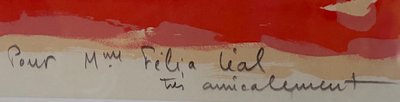
Publisher: Félia Léon Léal for the Société des Bibliophiles de l’Union
française, Paris
Printer: Mourlot, Paris
ALFRED MANESSIER (1911–1993)
When Alfred Manessier’s father left for the front, his grandparents took care of him and introduced him to the misty landscapes of the Bay of Somme. At the age of thirteen, he painted his first watercolors and enrolled at the Amiens School of Fine Arts in 1924.
In 1930, Manessier was admitted to the École des Beaux-Arts in Paris in the architecture department, where he discovered a new way of approaching color. He participated in the Salon des Indépendants for the first time in 1934. In 1937, under the direction of Robert and Sonia Delaunay, he collaborated with Bertholle, Le Moal, Bissière, and some fifty other painters to create monumental decorations for the railway pavilion at the International Exhibition of Arts and Techniques in Paris.
In 1939, Manessier moved to Paris, not far from Gustave Singier, with whom he formed a close friendship. In 1941, he participated in the exhibition *Twenty Young Painters of the French Tradition*, alongside Singier, Bazaine, and Bertholle. Two years later, Manessier exhibited at the Galerie de France in a show titled “Twelve Painters of Today,” which also featured Singier and Bazaine. A brief stay at Trappe de Soligny had a lasting impact on his life and work: he experienced a true mystical revelation and eliminated all figurative elements from his paintings. In 1945, he exhibited at the Salon de Mai, of which he was one of the founders along with Despierre and Singier.
In 1947, Manessier was chosen to create two stained-glass windows for the Church of Saint-Michel des Bréseux; later, the Dominicans of Le Saulchoir commissioned him to create a tapestry for their oratory. The following year, in 1949, Manessier held his first solo exhibition at the Jeanne Bucher Gallery in Paris.
In 1949, Manessier returned to the Baie de Somme to paint. The theme of northern landscapes plays a major role in his work. Starting in 1955, a “Dutch” period followed. He brought back canvases in a very different style—more colorful and cheerful. In 1955, the artist received the Carnegie Institute’s Grand Prize for Painting.
Starting in the 1960s, his critical success led to a flood of requests. He was invited to Rome to serve, alongside Alberto Giacometti, on the jury for the Prix de Paris.
The painter received many commissions for set designs and costumes. He was awarded the International Grand Prize for Painting and the Prize of the Catholic Liturgical Institute. Selected for the Venice Biennale in 1950, he was awarded the Grand Prize for Painting in 1962.
In 1976, he founded, along with Bazaine, the Association for the Preservation of French Stained-Glass Windows. He created stained-glass windows for Essen Cathedral, the Church of Saint Pantaléon in Cologne, the cathedrals of Fribourg and Saint-Dié-des-Vosges, the Church of Saint Bénigne in Pontarlier, and the Church of Saint Ronan in Locronan, among others. His work reached its pinnacle with the stained-glass windows of the Church of the Holy Sepulcher in Abbeville, on which he worked from 1982 to 1993. He was buried there that same year. His works reflect his fascination with light and his desire to render the intangible, as demonstrated by the retrospective exhibition at the Grand Palais in 1992.
His works are held in the Musée d’Art Moderne in Paris, as well as in Amiens, Colmar, Dijon, Grenoble, Lille, Lyon, Metz, and Nantes, and also in Berlin, Brussels, Rio, Madrid, New York, London, Oslo, Zurich, and Luxembourg, among other places.
Ref: 39LDC7C8BA

 English
 Français
 Italiano
 Deutsch
 Louis XIV Norman writing table
850 € EUR