This description has been translated and may not be completely accurate. Click here to see the original
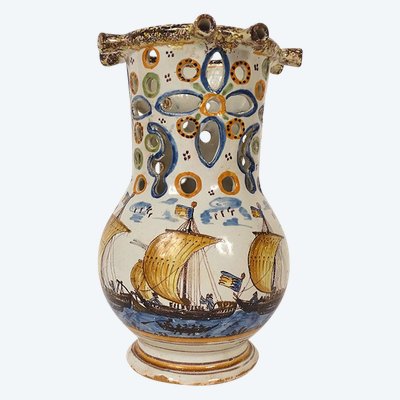
A Marseille earthenware spice box (Saint-Jean du Désert), signed AC for the Antoine Clérissy factory*, with a rich polychrome decoration of figures moving heavy objects (rocks, a cannon barrel, etc.), as well as boats sailing in landscapes of the South of France (Provence), dating from the 18th century.
This box is in good overall condition. Signed on the underside.
Please note: some chips on the rim of the lid, traces of a previous restoration on the lid, minor chips on the base, enamel flaws, and signs of age. Please examine the photos carefully (see red arrows).
* Antoine Clérissy Factory:
Marseille earthenware was first produced from 1677 onwards in the Saint-Jean du Désert district, in the east of the city. At the beginning of the 18th century, a growing number of new earthenware factories were established in the districts of the Porte d'Aix, in the north of the city, and of the Porte de Rome and Porte de Paradis in the south. The earthenware factories of Saint-Jean-du-Désert: it is to the banker Joseph Fabre (1634-1717) that the credit goes for having created the first earthenware factory in the territory of Marseille in 1674. These lands being rich in clay, Joseph Fabre decided to have an earthenware factory built there and, to ensure its operation, brought in in 1677, from Moustiers-Sainte-Marie, a master earthenware maker Joseph Clérissy (1643-1685), eldest son of Antoine Clérissy (1599-1679). After the death of Joseph Clérissy in 1685, his widow Anne Roux married the highly talented painter François Viry (1659-1697), who ran the workshop and developed an exceptional output by broadening the sources of inspiration. Three apprentices worked alongside him: Antoine Clérissy (1672-1750), his wife's son; then Étienne Arnaud; and finally Joseph II Clérissy (1675-1758), Antoine Clérissy's brother. Upon François Viry's death in 1697, Antoine Clérissy took over the factory: a dish in the Adrien Dubouché Museum in Limoges bears the inscription "Antoine Clérissy, 1697, Saint-Jean-du-Désert" on its reverse, confirming that this twenty-five-year-old was indeed the head of the business. Its production is easier to authenticate, as it bears a small monogram, AC, on the pieces until the mid-18th century.
Dimensions
Dimensions: 8.5 cm x 9 cm
Height: 7 cm
Reference: 500 914
All photos are available at:
www.antiques-delaval.com
Ref: D33QEVURJD

 English
 Français
  Italiano
  Deutsch
  Napoleon marble inkwell, 19th century
450 € EUR
Napoleon marble inkwell, 19th century
450 € EUR