This description has been translated and may not be completely accurate. Click here to see the original
Zambian Emerald and Diamond Daisy Ring — GemParis Certified
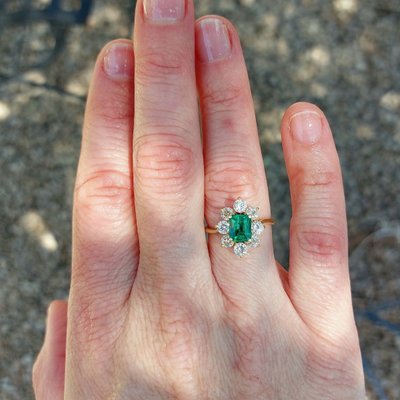
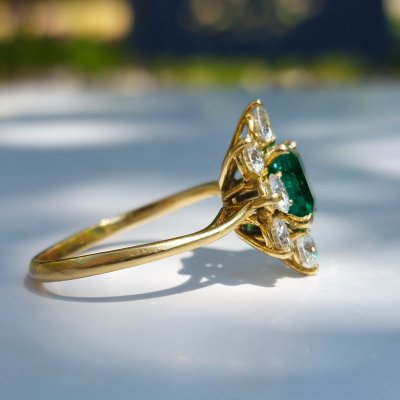
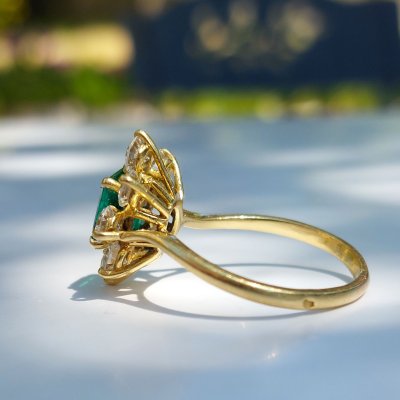
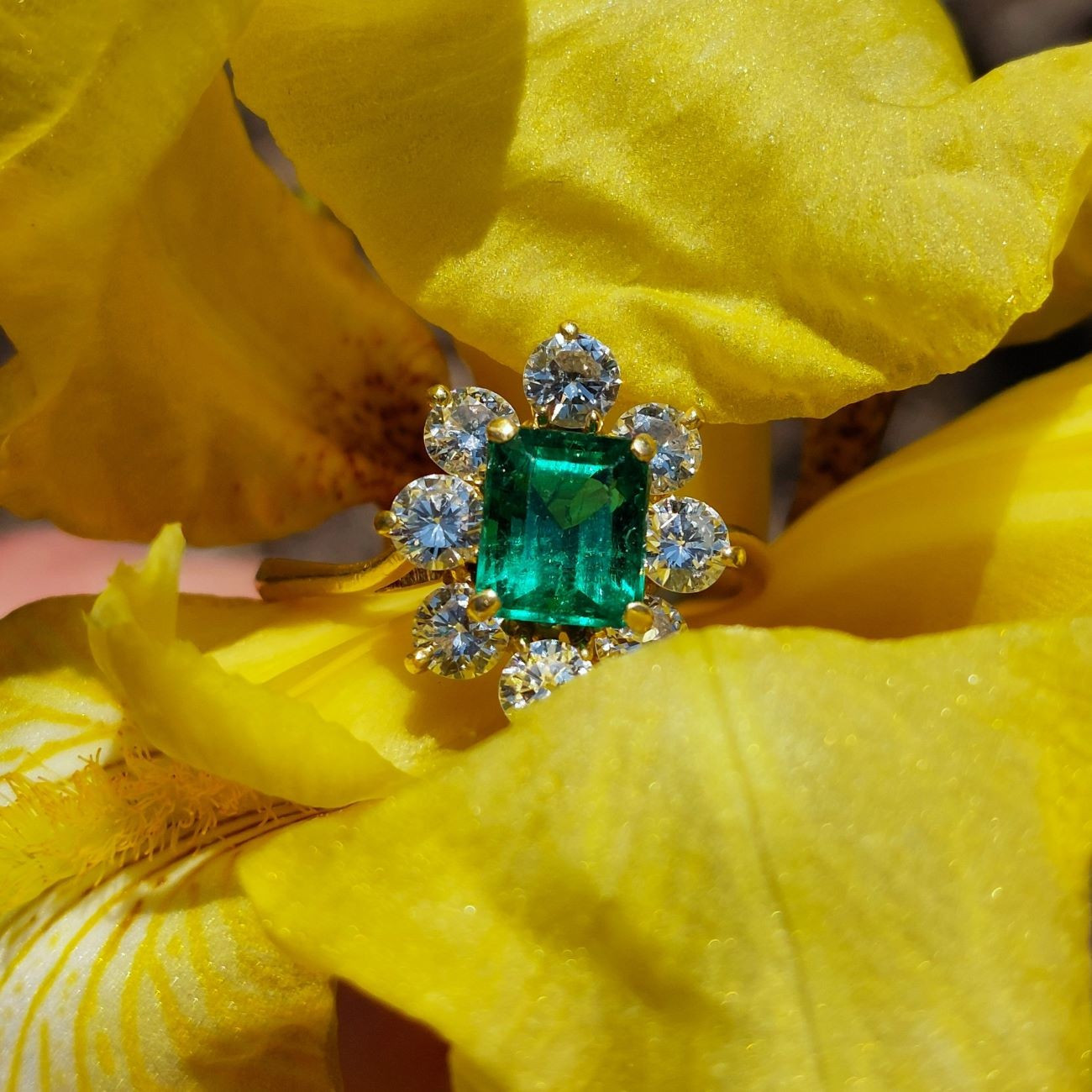
18k yellow gold emerald daisy ring, centered with a beautiful rectangular-cut Zambian emerald—known as an emerald cut—weighing approximately 1.70 ct, set in a bezel setting within a gold frame. It is flanked by eight brilliant-cut diamonds, arranged in a staggered pattern, weighing approximately 0.17 ct each, alternating between high and low settings, creating a structured play of light around the central stone. The intentionally slender band features a slight curve at the shoulder, which lightens the overall look and draws the eye to the stones.
The emerald is accompanied by a certificate from the Gem Paris laboratory (April 2026) attesting to its Zambian origin and moderate oil impregnation treatment.
Characteristics
Emerald dimensions: approximately 7.11 × 6.12 × 4.62 mm
Ring size: 57 (resizing possible)
Weight: 3.9 g
Metal: 18k gold – 750/1000
Hallmark: Eagle's head
Condition
Very good overall condition.
The emerald shows slight wear on the edges—normal traces of a worn piece of jewelry, which bear witness to its history without affecting its structure or beauty. No cracks or chips are apparent. The cut is meticulous despite a relatively deep pavilion, which contributes to the stone's rich color. The green is intense, uniform, and luminous. Inclusions are remarkably rare for an emerald—the transparency is exceptional for this category.
The diamonds have visible inclusions and a slight haze on the lower stones, but their staggered arrangement—the whitest at the top, the warmest at the bottom—is clearly deliberate: it structures the light and emphasizes the depth of the emerald's green rather than competing with it.
The very thin band and the slight curve at the shoulder give the ring a lightness on the wrist that belies its visual presence.
History & Style
Zambia has established itself in just a few decades as one of the world's major emerald-producing regions. The mines of the Ndola Belt, discovered in the 1970s and exploited on a large scale from the 1980s and 1990s, produce deep green, slightly bluish stones with a chromatic density that distinguishes them from Brazilian production and brings them close—sometimes very close—to the great emeralds of Colombia. Muzo and Chivor remain absolute benchmarks, but their deposits are dwindling; Zambia is now emerging as their natural successor in the market for high-quality gemstones.
Oil impregnation treatment is a centuries-old practice, documented as early as the Renaissance. It consists of introducing an oil with a refractive index close to that of emerald into the stone's natural fissures, reducing the visibility of inclusions and enhancing transparency. More than 95% of emeralds sold worldwide have undergone this treatment to some degree. The term "moderate" in the GemParis certificate indicates a measured treatment that does not compromise either the value or the gemological integrity of the stone.
Ref: VPN3FTIOJL

 English
 Français
  Italiano
  Deutsch
  Mahogany Travel Case – Late 19th Century
1.100 € EUR
Mahogany Travel Case – Late 19th Century
1.100 € EUR