This description has been translated and may not be completely accurate. Click here to see the original
Daimyō samurai complete armour
Japan
Edo period (1603-1868)
17th century
Iron, lacquer, silk, horsehair, brass
Kabuto suji type, tehen chased with a stylized chrysanthemum, hachi with thirty suji, lacquered leather shikoro with three blades, iron mabizashi with three rivets, red silk agemaki, crescent-shaped maedate called golden tsuki, mon from the Okudaira family; kuwagata in the shape of a stylized antler.
Mempo of the me no shita men type, with horsehair moustache, red lacquered upper lip and gilded teeth; mengu composed of two lacquer strips.
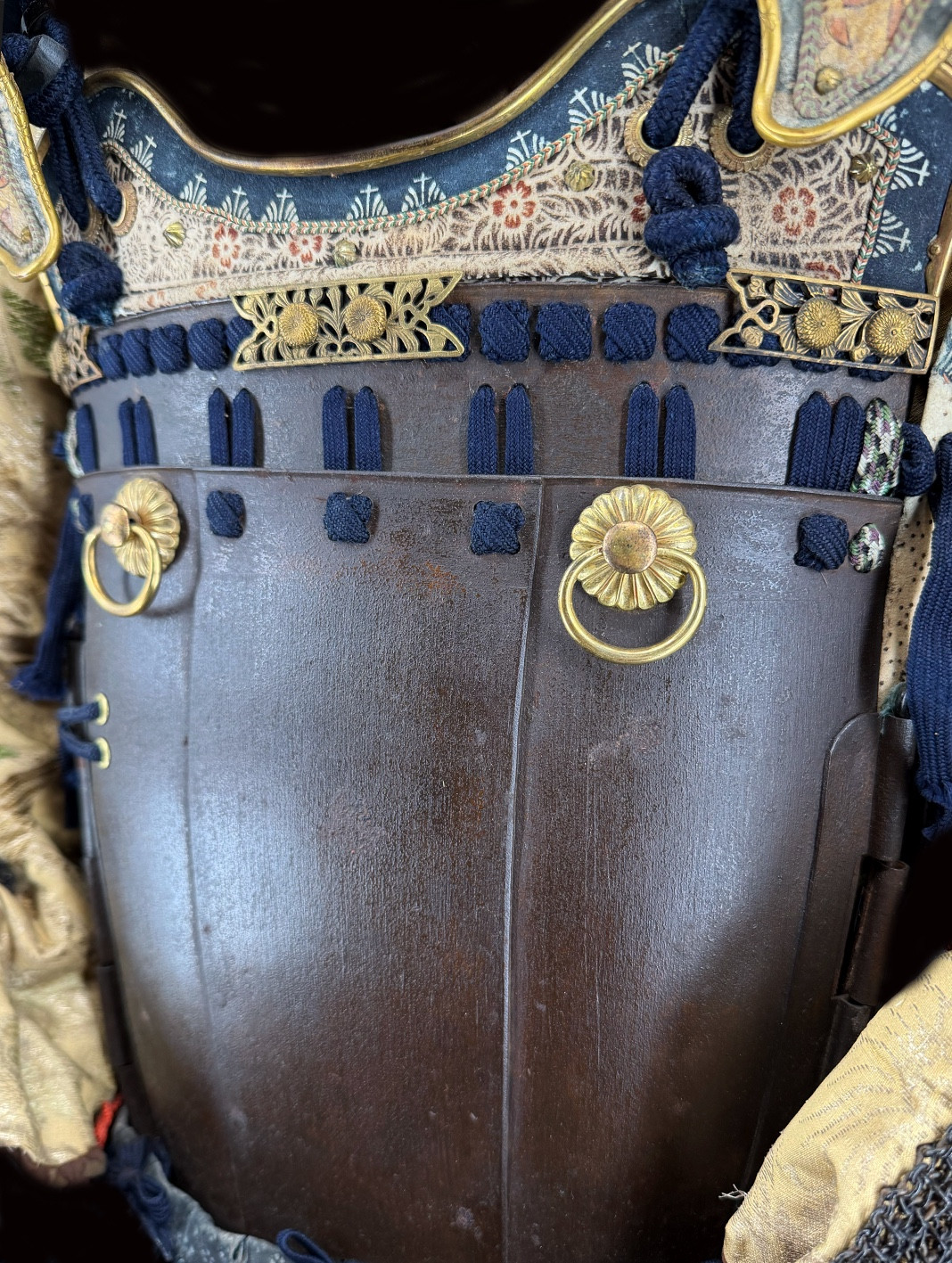
Two-part C decorated with two ringed chrysanthemums, silk-covered takahimo embellished with age-ha no chô (butterfly with raised wings) - jô-mon (primary coat of arms) of the Taïra clan, Ikea-da of Fuku-moto, Kata-no, Naga-tani, Shi-ba, Tani, Tsuchi-mi-kado ; kaye-mon (secondary coat-of-arms) of the Ten-dô O-ta of Kashiwa-bara, Shiba-mura and Yagi-moto and Séki.
Oshitsuke no ita and wakilta decorated en suite
Beige silk kote with chiseled hito-yé ume (plum blossom) tekko, Soya-shima jô-mon; lacquered iron shino.
Kusazuri in lacquer with six strips, hishinui no ita in silk.
Haidate with chikara-gawa in beige and blue patterned silk, ieji decorated with clouds and the Ryū dragon, Iyo in lacquered iron with four slats.
Suneate in black lacquered iron.
The daimyō (大名, literally "great name") is a Japanese noble title designating the principal provincial lords from the warrior class, who ruled Japan under the authority of the shogun between the Muromachi (1336-1573) and Edo (1603-1868) periods.
Similar pieces can be found at the Tokyo National Museum, the Kyōto National Museum and the Metropolitan Museum of Art.
Ref. : 6569
Text and photos © FCP CORIDON
Ref: ELAQW2H4MO

 English
 Français
  Italiano
  Deutsch
  Cubist Nude – Marcel Caron
6.800 € EUR
Cubist Nude – Marcel Caron
6.800 € EUR