



Would you like more images?
JAPAN - Edo Period (1603-1868).
Complete samurai armor.
This armor is in the Kaga style, a province renowned for the technical skill and elegance of its armorers during the Edo period, and likely from the Kojima workshop, which was the preferred workshop of the powerful Maeda clan.
The Kaga school was heavily influenced by the Haruta lineage of armorers.
The breastplate (dō) seen here is a Yukoshita-dō (or a variant of hotoke-dō with exposed rivets), typical of their production.
The patina is of a deep and even burnishing of the iron.
The domed rivets (byō) are very well made and characteristic of the attention to detail in the Kanazawa region.
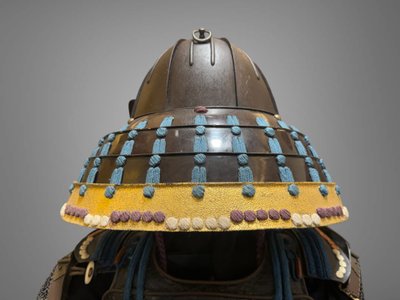
KABUTO is an eight-slat suji bachi (headgear) made of raw iron from the Kaga school.
THEHEN NO ANA (opening at the top) is made of raw iron with three intricately worked tiers depicting chrysanthemum petals.
SHIKORO (neck guard) is a three-tiered design of glossy black lacquered iron with blue silk braiding; the uppermost tier is lacquered in gold with a texture imitating gold lacquered buffalo leather and braided with purple and white silk.
FUKIGAESHI (wings) are made of iron covered with gold lacquered buffalo leather.
MABI SA SHI (visor) is made of lacquered iron covered with gold leather.
MAETATE is made of carved wood lacquered in gold and white horsehair, depicting a grimacing oni head. This gilded mythical creature with very fine details is a classic example of Kaga taste, which favored combining a warrior aesthetic with ostentatious luxury. The MEMPO is a fine Edo piece from the Myochin workshop.
Made of raw iron with a boar bristle mustache and a very prominent, particularly well-crafted chin.
Very fine work.
This mempo (half-mask) is made of wrought iron with a glossy brown lacquer finish, a pronounced chin, a movable nose, white horsehair mustaches, pierced nostrils, sweat holes under the chin, and a red lacquered interior.
The YODARE-KAKE (gorget) has three tiers, lacquered in glossy black with blue silk braiding, the uppermost tier in textured gold lacquer imitating leather.
The DO (breastplate) is made of four elements assembled with blue silk braiding, the largest consisting of four wrought iron plates riveted together, the top covered in black leather.
On the top of the breastplate, there is a small heraldic emblem. Although not the famous Ume-bachi (plum blossom) of the Maeda, it resembles a variant of Omodaka (water plantain) or Kajinoha. Many vassal families of the Maeda used specific variations from the local armory school for their KOTE (arm guards) made of chainmail and wrought iron plates, with the top hinges depicting butterflies with outstretched wings.
KUSAZURI (skirt) with five rows of glossy black lacquer and braided blue, orange, and white silk.
HAIDATE (underskirt) made of chainmail, wrought iron plates, and quilted fabric.
SUNEATE (greaves) made of glossy black lacquered iron plates, chainmail, and brown leather.
Dimensions of the armor in a seated position: 135 x 64 x 50 cm.
Sold with its display stand and its wooden and metal-reinforced GUSOKU BITSU (carrying case).
Additional photos and details available upon request.
Ref: 6K56ASO4TB
| Condition | Good |
| Style | Asian Arts (Uniforms, armor of Asian Arts Style) |
| Period | 18th century (Uniforms, armor 18th century) |
| Country of origin | Japan |
| Shipping Time | Ready to ship in 2-3 Business Days |
| Location | 93400, saint ouen , France |
| Shipping Information | Careful and insured shipping, fast shipping |
4 commitments to buy with confidence

 English
 Français
  Italiano
  Deutsch