This description has been translated and may not be completely accurate. Click here to see the original
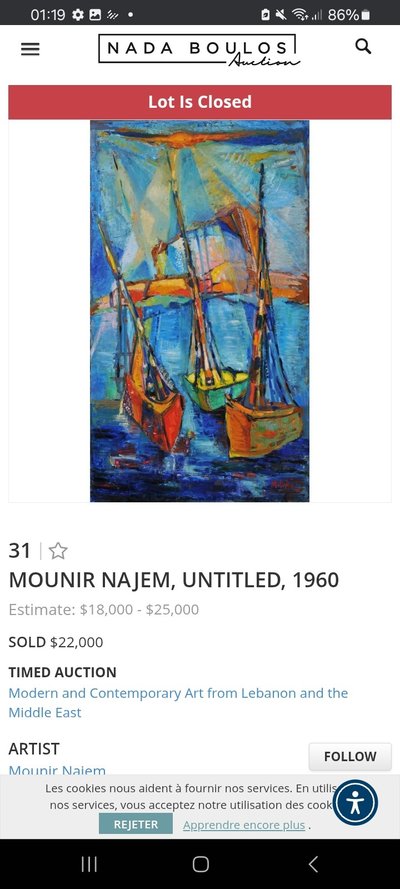
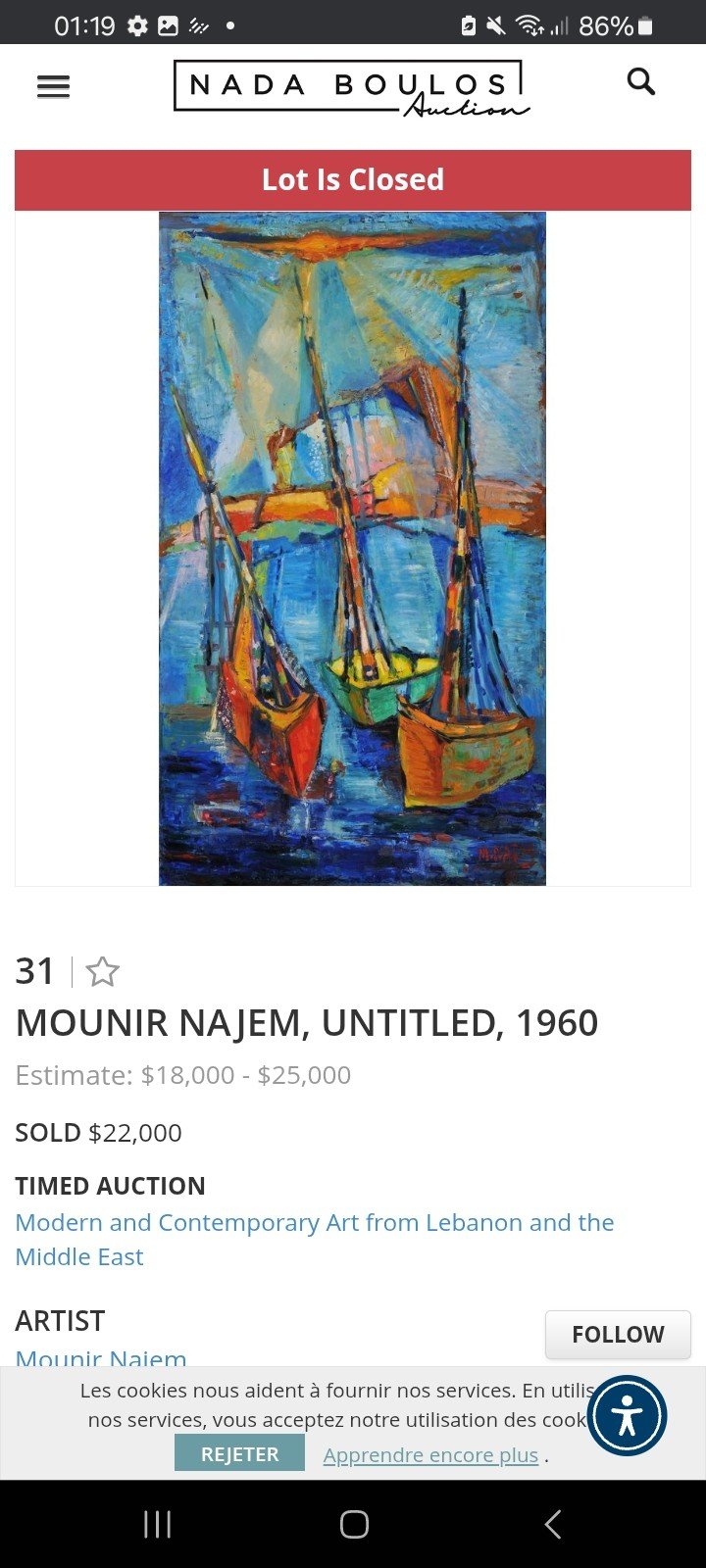
SUPERB AND EXCEPTIONAL WORK OF THIS GREAT LEBANESE ARTIST.
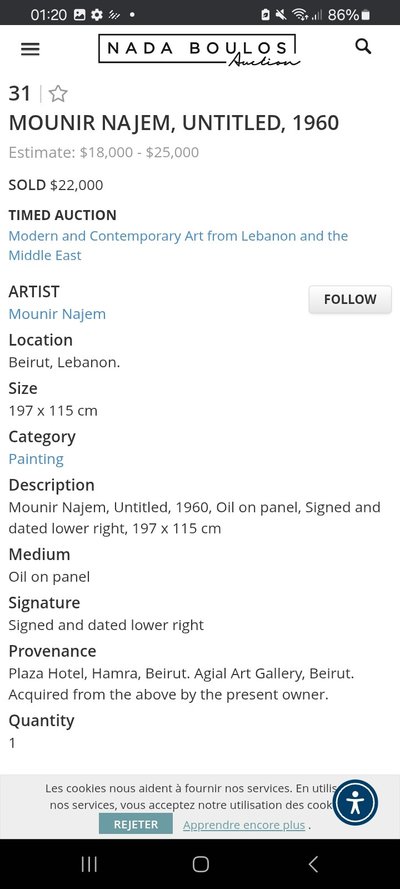
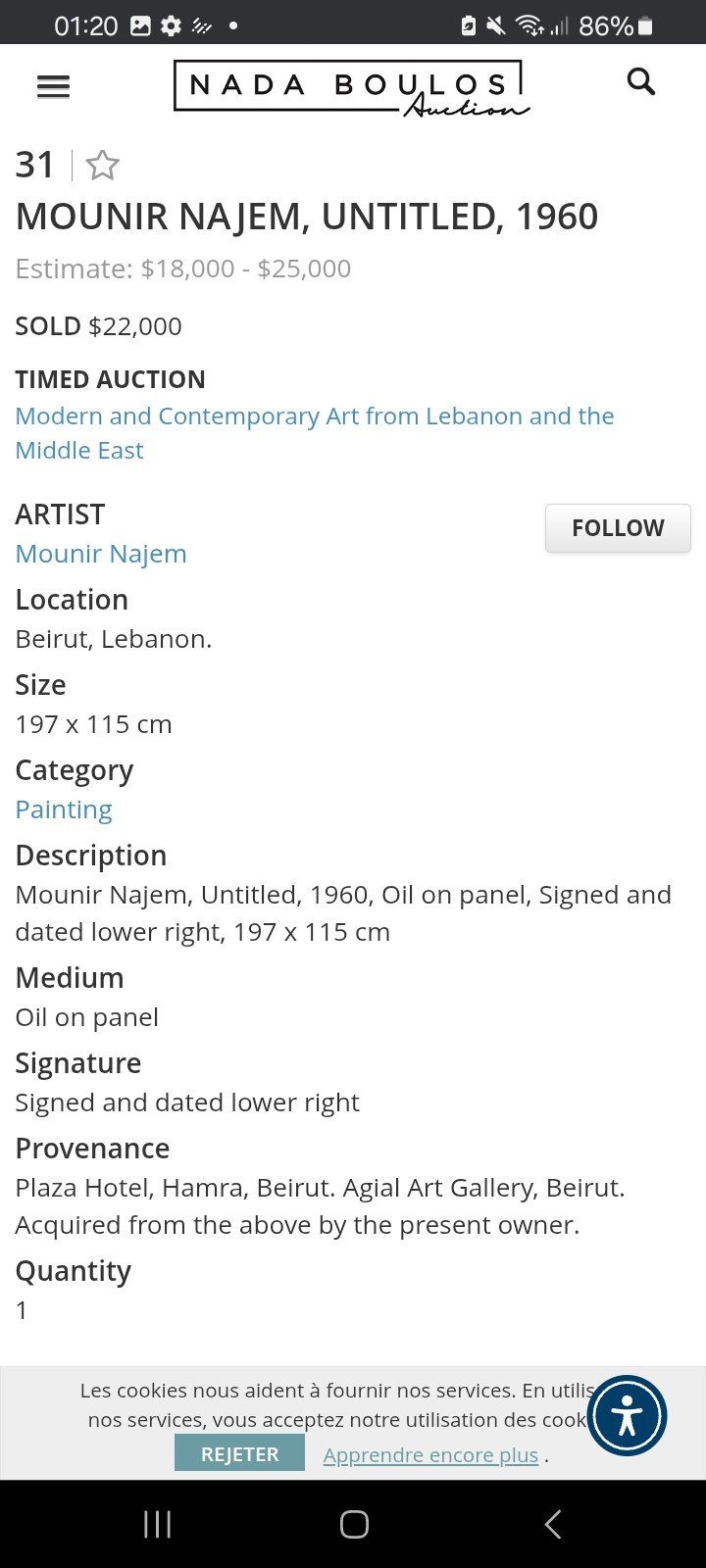
OIL ON CANVAS 100X65CM CIRCA70
Born in Deir El Kamar, December 24, 1933. Died in Paris in 1990. Mounir Najm spent the years 1951 – 1952 in the workshop of César Gemayel, before enrolling at L'ALBA from 1952 to 1955. From 1955 to 1959, he studied in Paris successively at the Ecole nationale supérieure des beaux-arts (1955-1956) at the Grand Chaumière academy (1956-1959) and with André Lhote from 1957 to 1959.
All the Lebanese who followed the teachings of Lhote, Léger, Metzinger and Goetz received, in a striking way, an incitement to modernity and to an abstract sensualism which found a perfect echo in their oriental sensibility. This helped them to distance themselves from local Lebanese figures and, most often, from the teaching of ALBA from which they came and which had led them towards abstract painting. Abstract painting seen as a natural language, and about which only technical questions were asked, inherent to the canvas itself, and not the initial problem of choosing between one style and another.
This development was very far from the Beirut approach or, at least, very different from that of the time when, as young students, these painters struggled with the alphabet of the figure, even if it was outside of any historical approach, and Having no conscience, they only had to choose between the “touch impressionism” of César Gemayel and the Cézannism tempered with Italianness of Fernando Manetti.
Najm confronted the deconstruction of the figure by Cubism in Paris, in which he saw Western representation destroyed by its own means. Certainly, Lhote's teaching had a lot to do with it, and that was what he needed. The teaching of the aging Lhote was no longer just post-cubism, but intelligence in the plastic grasp of the painting, and the decomposition of its elements: a moment of a European pedagogy which was floundering in the reconstruction of the post-Cubism era. war and which found a point of support in the revival of Cubism. Lhote was, moreover, a much greater teacher than painter.
This reconstruction corresponded, for the Lebanese, to the birth of demands linked to their own vision: the Orient, identity, other shapes, other colors, another light, and the expression of all this on the cloth. Historically, the question was not immediately posed in these terms. There was indeed, until the beginning of the sixties, an academicism of the abstract whose strength was to pose the problem outside of a figurative-abstract conflict, but it was strangely placed in the perspective of an enriched figurative language by the contributions of the abstract. This is why an experience like that of Cyr was both an absence of historical time and a misunderstanding.
In Paris, the issue became all the more clear as the distancing had been more rapid, and as it had been necessary to reconstruct, while the language of the West was being dismantled, its own vision. Cyr, at the end of the forties, had gone through a crisis relating essentially to his place in the history of painting and the way in which he could integrate his thirty years of painting in Lebanon and the painting that was being done in post-cubism into post-cubism. Paris.
What Najm saw around him was the experience of the first generation of ALBA students, from whom he was only a few years apart. It seemed to him a headlong escape and an impossible recourse.
Najm pursued form, but only to include color. This is not an easy destination for designers and colorists. What Najm undertook, once the historical gap with Europe was put aside, was a theoretical grasp, an attempt at theorization, a way of constituting his own history of art with the data he had in hand: ALBA, the experience of Paris, Gemayel, the Lebanese painters living in Paris (Abboud, Aouad, El bacha) and his friends from Beirut (Scamanga, Saghir, Achkar). He wanted to replace the shift in historical perception with the demand for the foundation of another reading, of a history of art which was his own, at least which justified his pictorial practice. This lacked neither didacticism nor literal simplifications, but the step, once taken, allowed him to continue painting without this tension of a shift in a terrain which would never have been his if he must have only worked in relation to Paris.
Najm went further than the abstract and gradually built a vocabulary which, at best, owed its plastic expressiveness only to itself, without ignoring the irregularity of its production. Indeed, at the end of the sixties, the elements of this vocabulary perfectly covered the field of formal sensitivity since they were borrowed from Klee or Macke. But if, for them and for the German school of pictorial orientalism,
Ref: B33YN76EZE

 English
 Français
 Italiano
 Deutsch
 Oak sideboard, 1950
1.100 € EUR