This description has been translated and may not be completely accurate. Click here to see the original
Emmanuel de La VILLÉON (1858-1944)
"The cottage under the snow
Oil on canvas,
Signed lower left,
Exhibition number "110" lower left,
Titled on the stretcher: "Chalet sous le neige / Chalet au printemps",
Various exhibition and reference numbers on the stretcher,
A catalog raisonné on the artist will be supplied with the work.
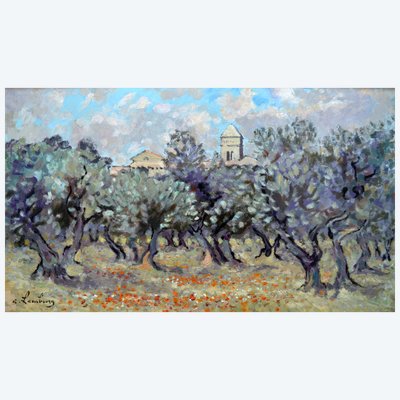
Beautiful work by Fougères-born post-impressionist painter Emmanuel de La Villéon, depicting a view of a chalet under the snow, most likely in Bel-Air, Switzerland, where the artist liked to paint.
A figure can be seen walking along the path to the wooden chalet, as the last snowflakes of Spring in Switzerland fall in the park and accumulate on the tree branches.
The artist uses a palette of light, colorful shades of blue, pink and violet, playing on the play of light projected by the sun and the reflections in the snow.
Born into an aristocratic Breton family, Emmanuel de La Villéon devoted his life to painting. He left Fougères in 1880 for Paris, where he entered the Académie Julian. He trained in plein-air painting alongside his friends Alfred Roll (1846-1919) and Emmanuel Damoye (1847-1916). Very early on, he adopted the practice of walking with his easel, setting up his studio wherever the landscape offered itself to him: by the side of a path, a pond or in a field. He worked either directly on canvas, or from annotated sketches made on the spot, which he then reworked in the studio.
An avid traveler, he mainly stayed with family members: in Brittany, with his brother, at Château de Montmuran (Ille-et-Vilaine); in Normandy, with a cousin; in Switzerland, with his parents-in-law, at Chalet Bel-Air near Yverdon-les-Bains (Vaud); and in Central France, with his sister-in-law, at Château de Pesselières near Sancerre (Cher). From the 1920s onwards, he divided his time between the homes of his three daughters: in Mainz (Rhineland-Palatinate, Germany), Grenoble (Isère) and Castelnaudary (Aude).
A trip to Holland in 1889 marked a decisive turning point: he discovered moving light and changing skies. His palette brightened; he abandoned black in favor of colored contrasts. From 1900 to 1936, he owned a house in Salvar, near Saint-Vérain, in Puisaye (Nièvre), where he stayed regularly from 1915. He also painted landscapes in the Hautes-Pyrénées (1905) and on the Côte d'Azur (1921), transforming his familiar apple trees into dazzling palms.
His constant quest was for light: its brilliance on a lake, its reflections through the trees, the vibrant heat of a summer field. To capture these fleeting sensations, he adopts the impressionist touch - rapid juxtapositions of pure colors. He often worked in series, painting the same motif at different times or seasons (notably the Vaud plains). Snow-covered landscapes give him the opportunity to explore the subtle nuances projected by the sun on the ice: blues, pinks, purples.
From 1890 to 1934, he exhibited regularly at the Salon des Indépendants and the Société Nationale des Beaux-Arts, of which he became a member in 1940. He also took part in the Salon d'Automne, from its creation in 1903 until 1933.
In 1909, he co-founded the Société Moderne alongside Impressionist, Symbolist and Expressionist artists. He exhibited there until 1914, and again between 1920 and 1922. His palette then became more poetic, close to that of Odilon Redon (1840-1916). Nevertheless, La Villéon remained a solitary painter, deeply attached to nature and the landscapes of his childhood.
He also exhibited in the provinces and abroad: the United States and Canada (1918), Denmark (1925), Japan (1927). Several one-man shows were organized in France, the last of which in 1943 at the Galerie La Boétie in Paris.
In 1976, his family donated 120 works to the town of Fougères. They are exhibited in the museum that bears his name, housed in the 16th-century Maison du Porche.
Dimensions: 50 x 61 cm unframed and 75 x 86 cm with its original gilded wood frame.
For further information, please contact us.
Ref: 65GLGPB6OB

 English
 Français
  Italiano
  Deutsch
  Ring, Gold And Amethyst.
680 € EUR
Ring, Gold And Amethyst.
680 € EUR