

Would you like more images?

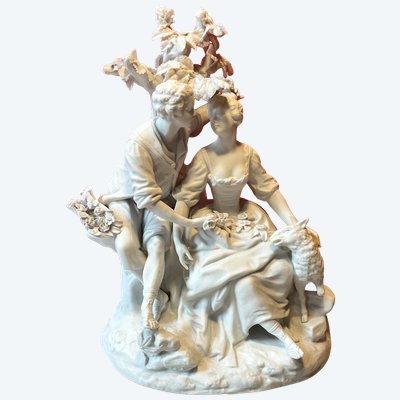
Biscuit porcelain group, composed of a representation of Mars atop a column, at the foot of which stand a shepherd and shepherdess holding garlands of flowers, accompanied by their dog and a sheep. On the column, a medallion depicts Jean-Jacques Rousseau.
Paris porcelain, probably Locré
Late 18th century
Usual restorations, some minor losses
H. 25 cm
At the end of the 18th century, sculpture played a significant role in Parisian porcelain manufactories. Many of them employed important sculptors such as Laurent Russinger. In the 1780s, biscuit porcelain became very fashionable, leading these manufactories to employ even more sculptors. Biscuit porcelain production offered decorative pieces for apartments or for the table. Patrons then arranged these decorative pieces as they wished on the table. The subjects are diverse, ranging from classical antiquity and allegories to pastoral themes.
Several factories sprang up in the capital, with Locré (1772-1824) being the most famous. It was founded by a textile merchant, Jean-Baptiste Locré de Roissy. In 1772, he rented a house on Rue Fontaine-au-Roi, where he established the factory. The following year, he registered his trademark, consisting of two crossed torches. In 1787, the modeler Laurent Russinger, whom he had hired several years earlier, bought the factory. The decorations were often white and gold on a blue background, or sometimes made of numerous biscuit porcelain pieces.
Ref: NUEN2S17G7
| Condition | As is |
| Style | Louis XVI (Groups, Figurines, Biscuits of Louis XVI Style) |
| Period | 18th century (Groups, Figurines, Biscuits 18th century) |
| Country of origin | France |
| Shipping Time | Ready to ship in 4-7 Business Days |
| Location | 78 000, Versailles, France |
4 commitments to buy with confidence

 English
 Français
 Italiano
 Deutsch