




Would you like more images?

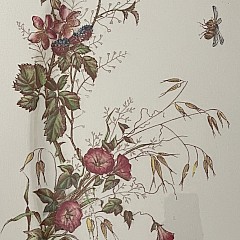
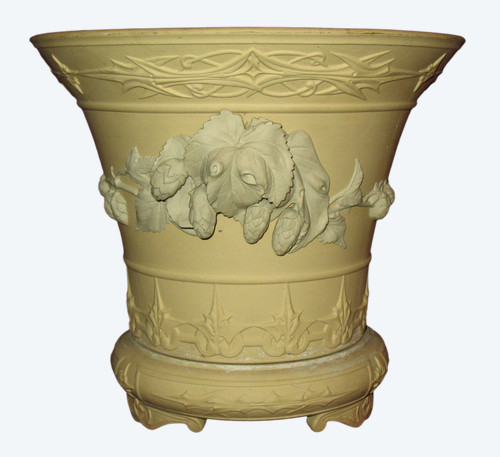
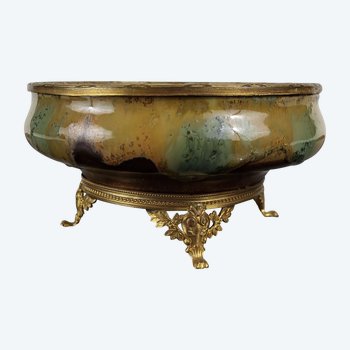
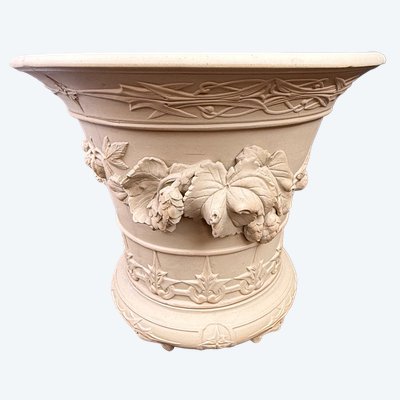
Important fine stoneware cachepot
Decorated in relief with hop leaves and flowers
Imperial eagle mark bearing the number 40 under the base
Mid-19th century manufacture
Total height 24 cm
Diameter 28.5 cm
Note: one leaf is slightly damaged (photo number three, top left)
and three tiny chips on the base (invisible when the pot is placed on it)
A bit of history:
In the history of the Sarreguemines earthenware factory (1790-2007), stoneware production developed from the 1800s onwards, with pieces still present and visible at the Château de Fontainebleau and Trier Cathedral... It then became more popular, exploring various techniques and compositions to become a fairly significant production at the end of the 19th century, continuing into the beginning of the 20th century.
Stoneware is a hard-paste ceramic made of clay and sand, fired at a high temperature (1200/1300°C). This process results in natural vitrification, making it impermeable.
In Sarreguemines, polished stoneware was produced around 1800, imitating hard stones such as jasper, porphyry, and marble. Later, from 1827 onward, fine stoneware (copies of English Wedgwood productions) was produced, followed by black stoneware (known as Smearblack around 1837), brown stoneware (known as Terre d'Égypte) between 1820 and 1840, fine glazed stoneware, so-called Umbrian stoneware, so-called Tuscan stoneware, and finally, salt-glazed stoneware from the 1860s-80s.
Ref: MVR7157BDK
| Condition | Good |
| Style | Second Empire style, Napoleon III style (Sandstone shape pieces of Second Empire style, Napoleon III style Style) |
| Period | 19th century (Sandstone shape pieces 19th century) |
| Country of origin | France |
| Height (cm) | 24 |
| Diameter (cm) | 28.5 |
| Materials | Stoneware |
| Shipping Time | Ready to ship in 4-7 Business Days |
| Location | 68530, MURBACH, France |
| Shipping Information | All items will be carefully packaged and shipped via Colissimo registered mail or Chronopost. If the items are large (furniture, very large earthenware pieces, or extremely fragile objects), appropriate packaging and transport arrangements will be necessary; therefore, a specific quote will be required. |
4 commitments to buy with confidence

 English
 Français
  Italiano
  Deutsch