This description has been translated and may not be completely accurate. Click here to see the original
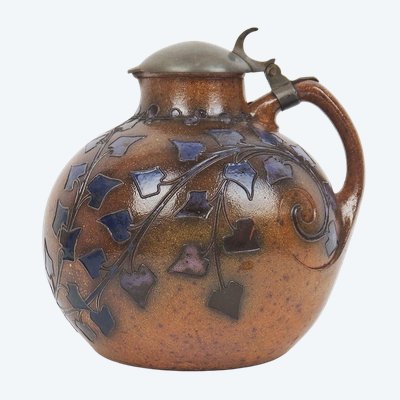
Superb covered pitcher from the Sarreguemines pottery factory.
Made of fine stoneware with a pewter lid featuring an enameled medallion of an edelweiss flower.
Decorated in bas-relief with figures dancing, toasting, flirting, and playing around a table.
Marked Sarreguemines under the base with the number 17, indicating a second-half 19th-century manufacture.
This pitcher with a lid is available in different versions: in fine stoneware tinted brown, or tinted light ochre, or in a version without a lid...in majolica…
A little history:
In the history of the Sarreguemines earthenware factory (1790-2007), stoneware production developed as early as the 1800s, with pieces still present and visible at the Château de Fontainebleau and Trier Cathedral. It then became more popular, exploring various techniques and compositions to become a fairly significant production at the end of the 19th century, continuing into the beginning of the 20th century.
Stoneware is a hard-paste ceramic, made of clay and sand, fired at a high temperature (1200-1300°C). This process results in natural vitrification, making it impermeable.
In Sarreguemines, polished fine stoneware was produced around 1800, imitating hard stones such as jasper, porphyry, and marble. Then, from 1827 onwards, fine stoneware (copies of English Wedgwood productions) was produced, followed by black stoneware (known as Smearblack around 1837), brown stoneware known as Terre d'Égypte between 1820 and 1840, fine glazed stoneware, so-called Umbrian stoneware, so-called Tuscan stoneware, and finally, salt-glazed stoneware from the 1860s to the 1880s.
Ref: NR6H6NXR4W