This description has been translated and may not be completely accurate. Click here to see the original
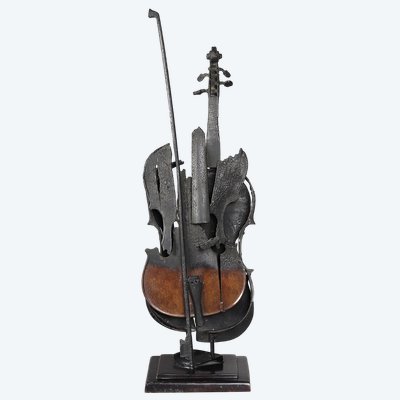
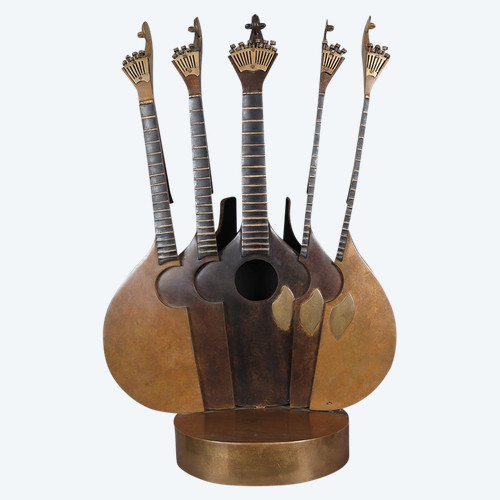
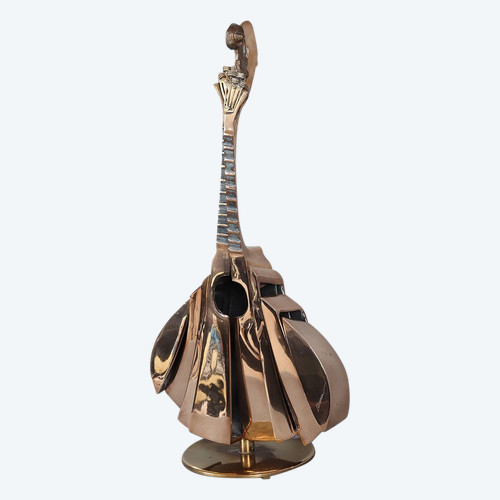
ARMAN 1928/2005, Bronze, 72 cm, Burnt Violin
Artwork sold with certificate
Bronze no. 12/100
Foundry: Bocquel
Bronze with a wood patina and burnt wood effect, in excellent condition,
Signed and numbered in the bronze,
Subject: Burnt Violin
Dimensions: Height: 72 cm, Width: 20 cm, Depth: 18 cm
Biography:
ARMAN 1928/2005
Arman, or Armand Fernandez, born November 17, 1928, in Nice, and died October 22, 2005, in New York, was a French artist, painter, sculptor, and visual artist, known for his "accumulations."
He was one of the first to directly use manufactured objects as pictorial material, seeing them as the natural and multifaceted extensions of humankind, subject to a continuous cycle of production, consumption, and destruction.
The only son of Antonio Fernandez, a furniture and antique dealer of Spanish origin who had lived in Algeria, and Marguerite Jacquet, from a family of farmers in the Loire Valley, young Armand showed an early aptitude for drawing and painting.
After graduating from high school, he studied at the School of Decorative Arts in Nice (now the Villa Arson), then at the École du Louvre. He met Yves Klein and Claude Pascal at the judo school they both attended in Nice in 1947. He hired Elena Palumbo Mosca as an au pair to look after his children. With these two friends, he briefly explored Eastern philosophies and Rosicrucian theory.
In late 1957, Armand, who signed his works with his first name as a tribute to Van Gogh, decided to drop the "d" from his name and officially adopted his artist's signature in 1958, at an exhibition at the Iris Clert Gallery.
In October 1960, he held the exhibition "Le Plein" (The Fullness), filling Iris Clert's gallery with discarded objects and the contents of selected garbage cans. This exhibition served as a counterpoint to the exhibition "Le Vide" (The Void), organized two years earlier at the same gallery by his friend Yves Klein.
That same month, under the guidance of art critic Pierre Restany, Arman, along with Yves Klein, became one of the founding members of the Nouveau Réalisme group (which Restany proclaimed as "new perceptual approaches to reality"), alongside François Dufrêne, Raymond Hains, Martial Raysse, Daniel Spoerri, Jean Tinguely, and Jacques Villeglé, later joined by César, Mimmo Rotella, Niki de Saint Phalle, Gérard Deschamps, and, in 1963, Christo.
From 1961 onward, Arman developed his career in New York, where he lived and worked half the time, alternating with his life in Nice until 1967, and then in Vence until his death. In New York, he initially stayed at the Chelsea Hotel until 1970, then in a loft in the SoHo neighborhood, and, from 1985, in his own building in TriBeCa. In late 1989, Arman received the Legion of Honour from President François Mitterrand.
Three years after his death in New York, some of his ashes were returned to Paris in 2008 for burial in Père-Lachaise Cemetery (division 11, a few meters from Frédéric Chopin).
Throughout his life, Arman was also a passionate collector of everyday objects (watches, weapons, pens, etc.) and works of art, particularly traditional African art, of which he was a respected and recognized expert.
To create the work "Les Revolvers" (The Revolvers), he used the etching technique.
In 1960, he used Plexiglas for the first time.
He is represented by the Templon Gallery in Paris and Brussels.
The Work:
Arman was interested in the status of the object and the relationship that modern societies maintain with it, between sacralization and overconsumption-destruction. His works can be classified into different categories.
His "accumulations" of objects, following a quantitative logic that erases their singularity, convey an image of profusion, while simultaneously highlighting the perishable nature of the products of the affluent society.
In the logical continuation of these accumulations, he began the "Trash" series in 1959: he exhibited household garbage, refuse found in the street, and waste.
Destruction of Objects:
In 1961, he began the "Angers" series: destruction of objects (the "Cuts" of violins, pianos—like Chopin's Waterloo—double basses, etc.) reassembled on pedestals or wall supports. In the "Combustions" (1963), these same objects are burned.
Public Commissions:
Arman has commissioned monumental works in public spaces in nearly one hundred cities worldwide.
1971: Musical Accumulation, a concrete and iron structure, Parco Sempione, Milan.
1976: Divisionis Mechanica Fossilia, an accumulation of gears and metal parts embedded in concrete, installed at the University of Burgundy in Dijon.
1982: Long Term Parking on the site of the former Cartier Foundation in Jouy-en-Josas, a 19.50-meter tower made of actual cars stacked on top of each other and cast in concrete.
1984: at the
Ref: F9K6HINC85

 English
 Français
 Italiano
 Deutsch
 Jean PIAUBERT
12.700 € EUR