

Would you like more images?

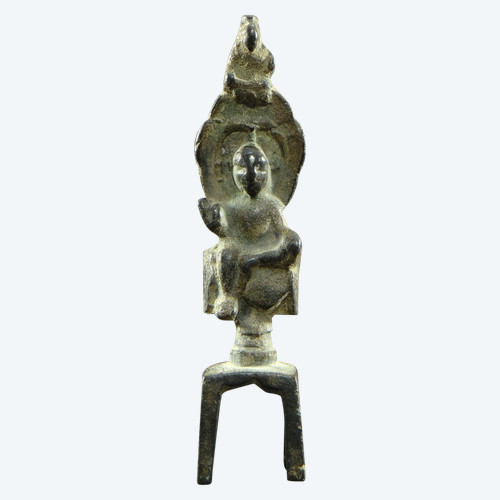
Small bronze altar - Upper Volta (Burkina Faso)
Bronze - Length: 10 cm Height: 5 cm Weight: 200g
Probable cultural provenance: Lobi / Gan / Gurunsi (according to the metallurgical traditions of southwestern Burkina Faso)
Estimated dating: early-mid XXᵉ century
This small bronze altar, measuring approximately 10 cm, is a piece cast using the lost-wax technique, a process characteristic of Burkina Faso bronzemakers. The object consists of three clearly defined elements:
A circular dish, with a thick, irregularly scalloped rim, showing a brown patina and traces of green corrosion (cuprite and malachite), confirming its authentic age. The inner surface is marked by numerous spots of oxidation, attesting to repeated contact with ritual materials (oil, flour, powder, sacrificial blood...).
A central shaft supporting the dish, extended downwards by a circular ring decorated with striations, probably serves as a pedestal or ritual anchor.
A zoomorphic figurine, probably representing a frog, a highly symbolic animal in the region's animist traditions. It is depicted in a crouched position, front legs raised, snout slightly open. The frog is associated with fertility, water, rain and the spirits of ancestors linked to rivers.
The ensemble forms a miniature altar for domestic offerings, placed in a corner of the house, in a family attic or in a small private sanctuary.
Ritual function
In the cultures of Upper Volta, small bronze altars were used :
To deposit liquid offerings (water, millet beer, oil),
For libations to protective ancestors,
for agricultural and family fertility rituals,
Or as an apotropaic object, placed in an enclosure or house to attract protection and blessings.
The presence of the frog reinforces the hypothesis of a use linked to rain, soil fertility or family prosperity.
Stylistic analysis
The scalloped rim of the dish evokes certain Lobi and Gan models produced in southwest Burkina Faso in the XXᵉ century.
The frog figurine is a frequent motif in Gurunsi silversmithing and ritual fonts.
The natural patina, the irregularity of the bronze and the green concretions show a piece cast by hand, without modern intervention.
These highly personal objects are rarely signed and were often buried, handled or exposed to the elements: visible alterations are consistent with prolonged use.
State of preservation
Old patina, mixture of dark brown and verdigris.
Very oxidized inner surface, typical of real ritual use.
Well legible, despite advanced corrosion on the reliefs.
Solid structure: no major cracks or apparent weakening.
Overall condition: good, with an interesting patina for ethnographic study.
Comparisons and museum references
Museums
Musée du Quai Branly - Jacques Chirac (Paris): several Lobi and Gan bronzes, including votive dishes and small domestic altars.
National Museum of African Art - Smithsonian Institution (Washington): Lobi and Gurunsi bronze cult objects, with symbolic animals.
Musée National du Burkina Faso (Ouagadougou): collections of ritual fonts, including numerous similar zoomorphic figurines.
Bibliography
Christopher D. Roy - Art of the Upper Volta Rivers, University of Iowa, 2010.
Daniel Biebuyck - The Arts of Central Africa, New York, 1969 (sections on Burkina Faso bronziers).
Jean-Baptiste Bacquart - The Tribal Arts of Africa, Thames & Hudson, 1998 (chap. on Lobi and Gurunsi).
Roy Sieber & Arnold Rubin - African Art in the Cycle of Life, Smithsonian, 1988.
Ref: YSAG4H0D5B
| Condition | Good |
| Style | Tribal Art (Bronze sculptures of Tribal Art Style) |
| Period | 20th century (Bronze sculptures 20th century) |
| Country of origin | Burkina Faso |
| Length (cm) | 10 |
| Height (cm) | 5 |
| Weight (Kg) | 0.200 |
| Materials | Bronze |
| Internal reference | SVBE09B5162-80 |
| Shipping Time | Ready to ship in 2-3 Business Days |
| Location | 06460, Saint-Vallier-de-Thiey (06460), France |
| Shipping Information | Shipping within France and Europe via Colissimo within 1 to 2 working days. |
4 commitments to buy with confidence

 English
 Français
  Italiano
  Deutsch