This description has been translated and may not be completely accurate. Click here to see the original
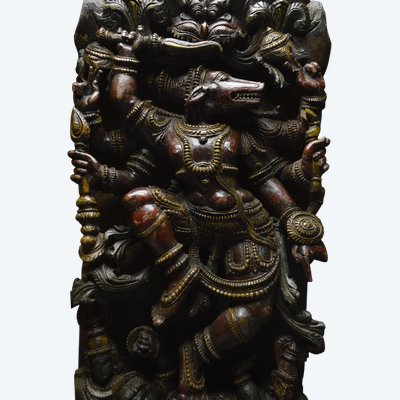
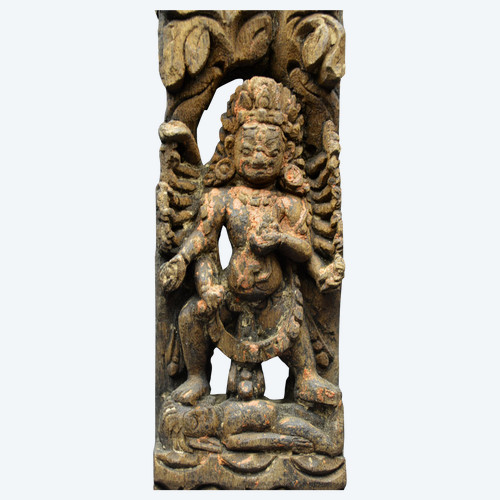
Important polychrome wooden processional chariot panel depicting Maha Vishnou
South India, State of Tamil Nadu
Late 19th century – Early 20th century
The deity is depicted seated in a posture of royal ease, or
maharajalilasana. He is seated upon the coils of the cosmic naga Ananta, the latter sheltering him with its seven-headed hoods, thus forming a protective canopy. Vishnou is endowed with four arms and holds his classical attributes, the discus (chakra) and the conch (panchajanya). Represented here as a universal sovereign, he is dressed in a simple dhoti tied with an elaborate belt and is adorned with numerous ornaments on the arms and ankles, as well as multiple richly decorated necklaces.
The face is characterized by large arched eyebrows meeting at the base of an aquiline nose overhanging a mouth highlighted in red, the latter positioned above a small prognathous chin. The ears are adorned with circular pendants, the forehead marked with the
tilkat sign, the head crowned with a tall, richly worked
mukuta and backed by a radiant halo (
prabhamandala), symbols of his divine omnipotence.
The upper register is embellished with a head of
kirtimukha with a fearsome appearance, intended to repel evil forces: an open mouth from which stylized scrolls emerge, bulging eyes, visible teeth and a protruding tongue. At each extremity stand two
vidyadharis, the winged celestial nymphs, resting upon the hoods of the naga. The base of the composition is adorned with a kneeling female devotee in a posture of devotion, hands joined in
anjalimudra. The whole rests on a frieze decorated with wave motifs surmounting stylized lotus petals.
Our piece depicts an emblematic scene from Hindu mythology. It represents Vishnou as the immutable cosmic principle, resting in eternity while the universe is born, sustained and dissolves under his authority. The serpent Ananta embodies infinite time and cosmic continuity, serving as the support of the god. It is not to be confused with the primordial ocean but unfolds within it, the latter constituting the original framework of creation. Vishnou thus appears as the divine presence that maintains the balance of the cosmos, dominating time while remaining immutable at the heart of the cycles of creation and destruction of the world.
Our carved panel depicting Vishnou resting on Ananta belongs to the tradition of processional chariot decorations from Tamil Nadu, called
ther. These monumental wooden chariots are used during major religious festivals to transport the image of the deity outside the temple, thus allowing devotees to come into direct contact with it through
darshan. The carved panels that adorn them, like this one, depict immediately recognizable and meaningful mythological scenes, serving as supports for devotion while transmitting sacred narratives. They fully participate in making the divine present in public space, transforming the chariot into a true mobile temple and making the procession a central moment in religious and communal life.
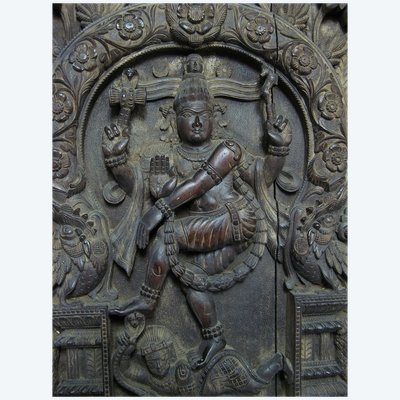
The final image shows Vishnou seated on the naga Ananta in cave number 3 at the site of Badami, State of Karnataka, South India.
Dated 578 CE.
Polychrome wood
103 x 43.5 cm excluding base
Surface wear, otherwise very good overall condition
From a French private collection
Contact us: culturesetcivilisations@orange.fr
Ref: TGDPKJJRDF






 English
 Français
 Italiano
 Deutsch