This description has been translated and may not be completely accurate. Click here to see the original
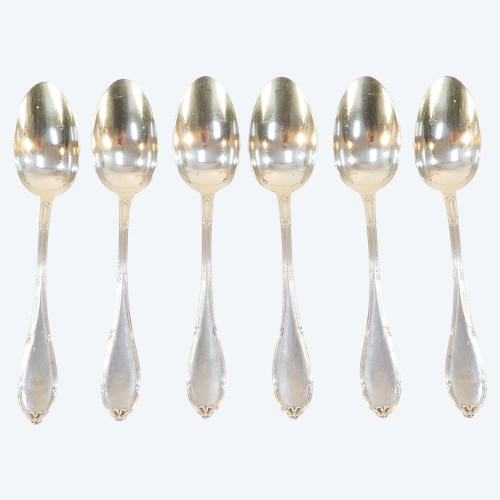
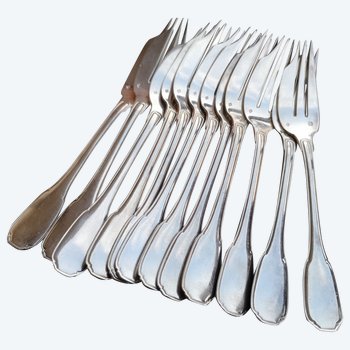
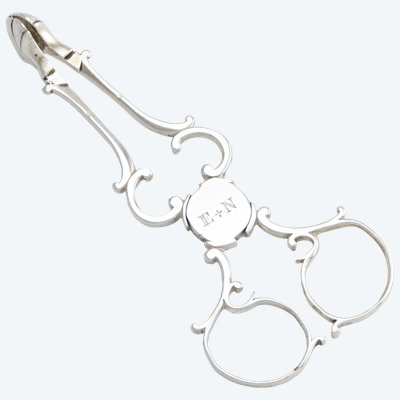
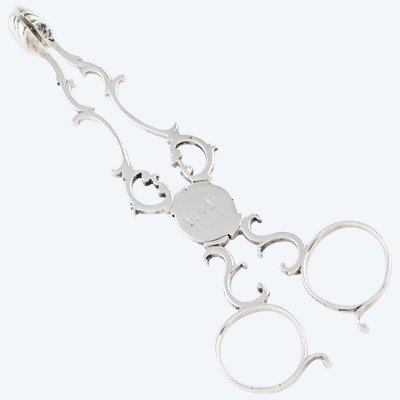
Six violin-shaped cantaloupe melon forks in finely chased solid silver with lines, clasps, foliate scrolls, cut leather, and naturalistic flowers.
Applied monogram of intertwined double Ls in solid rose gold.
Hallmarks:
Minerva 1st standard (950/1000).
Makers:
Ernest CARDEILHAC for 4: a crowned cross of honor, a crescent below, 1885-1904.
Amélie CARDEILHAC for 2: a crowned cross of honor, a crescent below, 1904-1920.
Weight: 513 g.
Late 19th/early 20th century.
CARDEILHAC (1804-1951)
The CARDEILHAC company was established in 1804 by Antoine-Vital CARDEILHAC. Specializing in cutlery and tableware, it was located at 4 rue du Roule and 91 rue de Rivoli.
Producing pieces in a variety of styles, all remarkable for the delicacy of their design and the quality of their engraving, the company quickly received numerous awards: a bronze medal at the 1823 Exhibition, and silver medals in 1827 and 1834.
From 1851 to 1885, it was managed by Armand-Édouard CARDEILHAC, Antoine-Vital's son. It won another silver medal at the 1867 Paris Universal Exposition and a gold medal at the 1878 Universal Exposition, further cementing the prestigious firm's reputation.
In 1885, Ernest CARDEILHAC[1], son of Armand-Édouard, took over the management of the firm.
Ernest had apprenticed with the goldsmith HARLEUX.
It was with him that the CARDEILHAC firm began producing gold and silver pieces. He organized his workshops for this purpose and acquired the stock of the LEBON firm.
Assisted by three artists—the draftsman Lucien-Hugues BONVALLET[2], the sculptor Ernest AIGUIER, and the engraver Frédéric VIAT—he presented his first works in 1889 at the Universal Exposition and won a silver medal. At the 1900 Universal Exhibition, where he presided over the cutlery jury, he achieved great success with pieces combining metal with materials such as wood, ivory, and patinas.
Upon his death in 1904, his widow, Marie-Amélie Cardeilhac, took over the business before passing it on to her two sons, Jacques and Pierre. She continued the business from 1904 to 1913 at 24 Place Vendôme, producing gilded and silvered items, and from 1904 to 1920 at 91 Rue de Rivoli, specializing in silverware.
In 1951, the Cardeilhac company was acquired by its main competitor, Christofle.
[1] Paris, 1851 – Chatou, 1904.
[2] Paris, 1861; Paris, 1919. A former student of the École nationale des Arts décoratifs (1878-1885), he began by creating industrial design drawings. During his collaboration with CARDEILHAC, he revitalized metalwork by introducing the Art Nouveau aesthetic, inspired by the observation of nature while simultaneously celebrating the material itself. He received numerous awards and honors, including the Legion of Honor, and was celebrated during his lifetime in 1913 with a retrospective exhibition of his entire body of work at the Musée des Arts décoratifs in Paris.
MUSEUMS AND PUBLIC INSTITUTIONS
MUSÉE D'ORSAY, Paris, CARDEILHAC Ernest and BONVALLET Lucien, "Modern Art" Tea Fountain, silver and ivory, Paris, 1894-1899. Model designed for the 1900 Universal Exhibition in Paris.
MUSÉE D'ORSAY, Paris, Ernest CARDEILHAC and Lucien BONVALLET, "Modern Art" Coffee Pot, "Poppy" motif, silver and ivory, Paris, 1894-1899. Model designed for the 1900 Universal Exhibition in Paris.
MUSÉE D'ORSAY, Paris, Ernest CARDEILHAC and Lucien BONVALLET, "Modern Art" Teapot, "Bloodflower" motif, silver and ivory, Paris, 1894-1899. Model designed for the 1900 Universal Exhibition in Paris.
Musée d'Orsay, Paris, Ernest Cardeilhac and Lucien Bonvallet, Teapot "Modern Art", "Columbine" motif, silver, ivory, Paris, 1894-1899. Model designed for the 1900 Universal Exhibition in Paris.
Musée d'Orsay, Paris, Ernest Cardeilhac and Lucien Bonvallet, Oil and vinegar set, silver, crystal, Paris, 1894-1899.
Musée d'Orsay, Paris, Ernest Cardeilhac and Lucien Bonvallet, Powder Box, gouache on paper, Paris, circa 1900.
Musée d'Orsay, Paris, Ernest Cardeilhac, Paper Knife, silver, horn, Paris, circa 1900.
Musée d'Orsay, Paris, Ernest Cardeilhac, Small Oval Renaissance Basket with Garlands, silver, horn, Paris, circa 1900.
Musée d'Orsay, Paris, Ernest Cardeilhac and Lucien Bonvallet, Thistles, silver, gold, ivory, Paris, before 1904.
Musée d'Orsay, Paris, Ernest Cardeilhac and Lucien Dammouse, Bowl with Mount, silver, paste Glass, Paris, 1905.
MUSÉE D'ORSAY, Paris, CARDEILHAC Ernest, Buttons (4), silver, Paris, circa 1905.
MUSÉE DES ARTS DÉCORATIFS, Paris, CARDEILHAC, House, Button, silver, Paris, late 19th or early 20th century.
MUSÉE DES ARTS DÉCORATIFS, Paris, CARDEILHAC Ernest and BONVALLET Lucien, Vase mount, silver, Paris, 1900.
MUSÉE DES ARTS DÉCORATIFS
Ref: GAQ39Y1VW4

 English
 Français
 Italiano
 Deutsch
 19th century mahogany burr veneer box
160 € EUR