

Would you like more images?
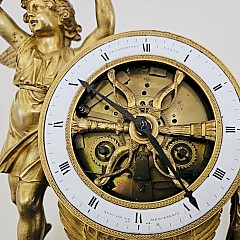
A rare and prestigious clock in patinated bronze and mercury-gilded bronze, depicting the famous sculptural group “La Réconciliation,” an iconic work by the bronze castor Claude Galle (1759–1815), one of the greatest masters of bronze casting during the Empire period.
The composition depicts an ancient couple in an embrace, rendered with remarkable modeling and great anatomical finesse. The flowing drapery, natural poses, and expressive faces lend the work a powerful emotional impact, directly inspired by Neoclassical statuary and ancient sculpture.
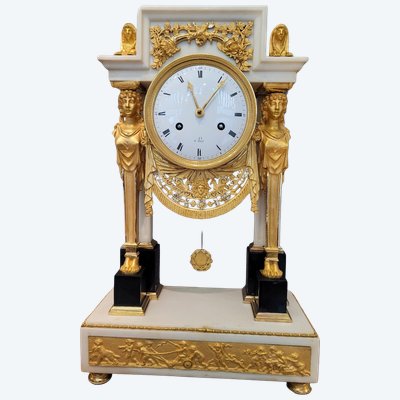
The group is set against a monumental architectural backdrop forming the clock’s case, richly decorated with lyres, imperial eagles, palmettes, foliage scrolls, and friezes of foliage, surmounted by a circular white enamel dial with Roman numerals. The ensemble rests on a dark green, veined marble base, adorned with gilded elements featuring a laurel wreath and foliage motifs.
This model is among Claude Galle’s most famous creations, featured in major public collections and in specialized literature on Empire-style bronzes.
Claude Galle was the most prestigious bronze artist of the Napoleonic era. Based on the Quai de la Monnaie in Paris, he was an official supplier to Napoleon I, the Imperial Court, and the great European aristocratic houses. His works are distinguished by: exceptional quality of chiseling, mercury gilding of great depth, and a perfect mastery of Neoclassical sculpture.
Galle’s pieces are now housed in numerous major institutions: the Louvre Museum, the Mobilier National, the Château de Fontainebleau, the Château de Compiègne, the Marmottan Museum, and others. A clock of museum-quality craftsmanship, perfectly embodying the aesthetic and technical excellence of the great Parisian productions of the Empire period.
The “La Réconciliation” model is considered one of Claude Galle’s iconographic masterpieces, both for the power of its sculptural composition and for its historical significance in the evolution of French art bronzes.
Ref: 5G8H73QW48
| Condition | As new |
| Style | Empire Style, Consulat (Table Clocks and Desk Clocks of Empire Style, Consulat Style) |
| Period | 19th century (Table Clocks and Desk Clocks 19th century) |
| Country of origin | France |
| Artist | CLAUDE GALLE |
| Length (cm) | 39 |
| Height (cm) | 59 |
| Depth (cm) | 18 |
| Shipping Time | Ready to ship in 4-7 Business Days |
| Location | 75015, paris, France |
| Shipping Information | Delivery At Hirsch Antiques, we understand that finding the perfect piece of art isn't always easy. Our shipping and delivery services ensure your items arrive wherever and whenever you want them. Appraisals |
4 commitments to buy with confidence

 English
 Français
  Italiano
  Deutsch