This description has been translated and may not be completely accurate. Click here to see the original
Ibibio Panel (Nigeria)
People: Ibibio
Region: Southeast Nigeria (Cross River, Akwa Ibom)
Probable Date: Early–Mid-20th Century (circa 1930–1960)
Dimensions: H. 80 cm – W. 42 cm – D. ± 2.5 cm
Technique: Carved wood, natural pigments (red, white, blue, green, yellow), plant fibers, cowrie shells.
This panel belongs to the Anang/Ibibio iconographic tradition, linked to Ekpo society masks.
It features:
✔ Typical ovoid faces with a fixed expression and half-closed eyes.
✔ Foreheads marked with colored bands (blue/red/white).
✔ Mouths with visible teeth, sometimes outlined in white.
✔ The large solar disk behind the masks, painted with polychrome triangles (red, yellow, blue, green).
✔ Attached with flat fibers and traditional nails.
The presence of a large central mask, surrounded by eight smaller masks, refers to ritual panels intended:
– to protect the entrance to initiation sites,
– to serve as sanctuary panels,
– or to accompany Ekpo funeral ceremonies.
The Ibibio often used these multiple compositions to symbolize the community of ancestors, protective spirits, and initiatory figures of the cult.
General Structure
An old wooden frame, painted with geometric patterns (interlocking triangles, circles).
The masks are attached with worn, traditional-looking strips of plant fiber.
At the top: an assemblage of cowrie shells (symbol of luck, wealth, contact with the spirit world).
The Masks
Individually carved, mounted on polychrome radiating disks. Old pigments dulled by use, cracked, consistent patina, and old dust embedded in the crevices—signs of long storage in a traditional setting.
Teeth made of fragmented cowrie shells or white-painted wood (depending on the faces).
The colors:
Red: blood, energy, initiation
Blue: spirit world
Yellow: light, protection
Green: fertility, growth
White: purity, connection to ancestors
Conservation status: Overall stable, but:
Embedded ritual dust.
Some cracks on the colored discs.
Consistent wear on the frame's wood (traditional, unrestored cabinetmaking).
Some tearing of the plant fibers.
Very slight pigment loss (normal and even expected).
It remains in "excellent ethnographic condition."
Ritual Function
The Ibibio are known for their cults:
Ekpo: masks of the afterlife, spirits of the dead
Ekoon/Anang: symbolism of ancestors and protection
This type of panel—rarely found in Europe—is typically a shrine object, often:
Placed in a community hut,
Used for spiritual protection,
Linked to initiation rites,
Or to prestigious funerals where the community invokes the ancestors.
It symbolizes the collective presence of protective spirits.
Dating
1930–1960 (early to mid-20th century)
Arguments:
✔ Old, dry, non-artificial patina
✔ Traditional, non-industrial mineral pigments
✔ Naturally aged organic fibers
✔ Typical pre/post-colonial assemblage
✔ Absence of modern tourist markings (gloss, plastic paint, recent nails)
Museum & Bibliographic References
Museums exhibiting comparable pieces:
Metropolitan Museum of Art, New York (Ekpo Society Masks, Ibibio)
Brooklyn Museum, New York (Ibibio ancestral boards & masks)
Musée du Quai Branly – Jacques Chirac, Paris (Ekpo masks, Anang panels)
British Museum, London (Ibibio puppet heads & masks)
Hampton University Museum, USA – extensive Ibibio/Anang collection
Bibliography:
Nigerian Arts – Roy Sieber & Arnold Rubin, 1968
Art of the Ibibio People – Douglas Fraser, African Arts Journal (1960s)
African Masks: Ibibio and Anang Traditions – Museum of Primitive Art, New York
Masks of Africa – Jacques Kerchache, 1995
Art of Southern Nigeria – Philip Dark
Ekpo Society Masks – African Arts Magazine, vol. 7–12
Ref: ESCOLSJBSD

 English
 Français
 Italiano
 Deutsch
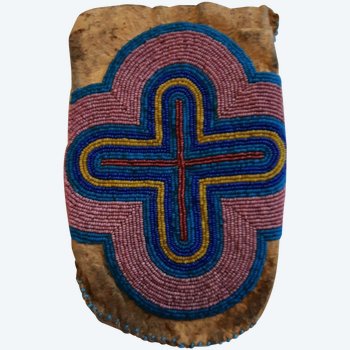
 Crow pouch
800 € EUR