This description has been translated and may not be completely accurate. Click here to see the original
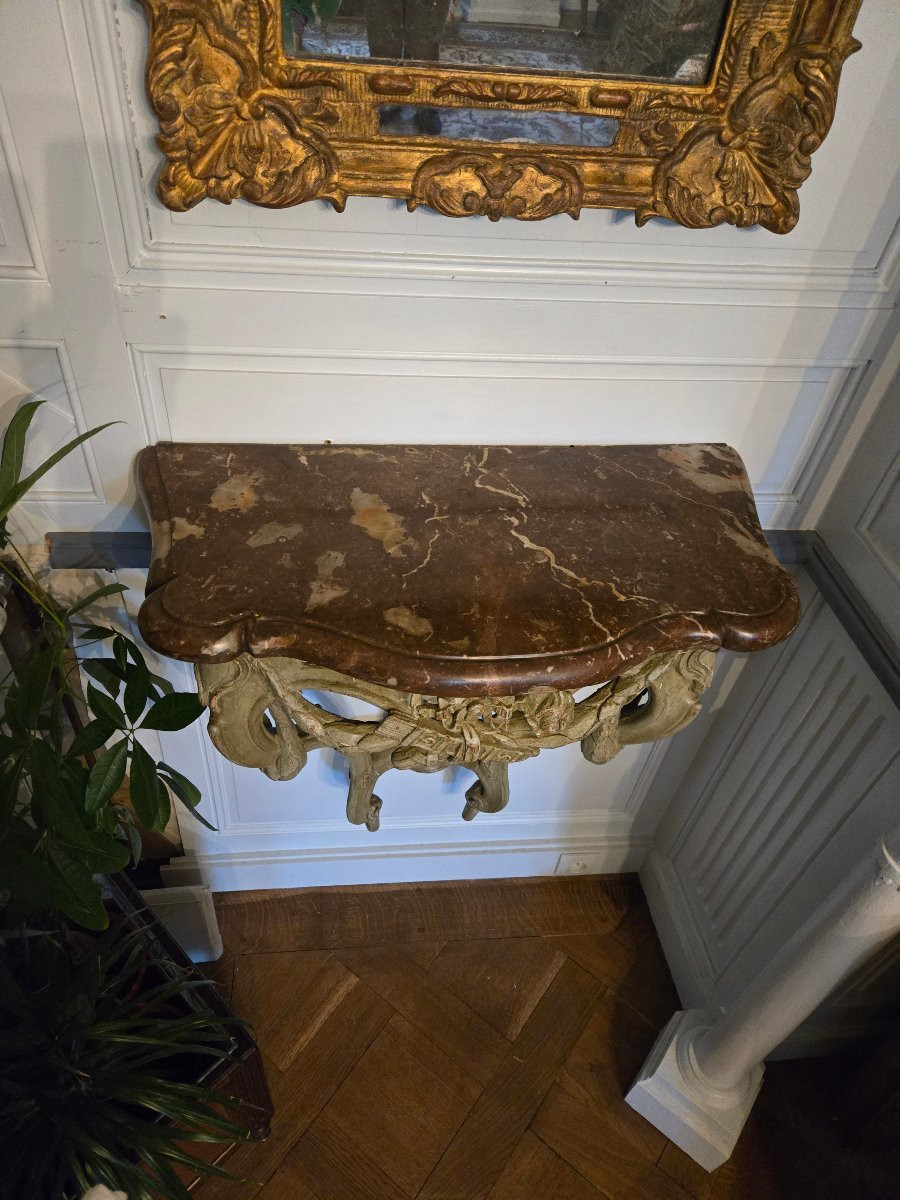
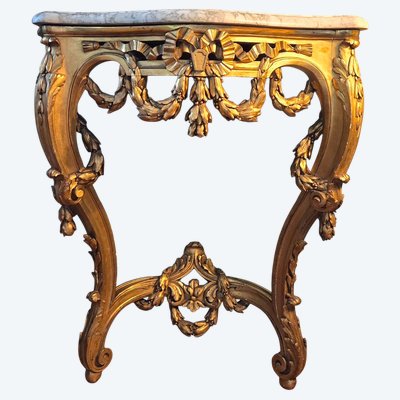
Designed to be fixed to a wall, this console table in the entre-deux format features balanced proportions, making it easy to place in a décor, notably between two windows, under a trumeau or topped with a mirror. Closely linked to interior architecture, this type of furniture played a key role in the composition of 18th-century elevations and decorative ensembles.
Its elegantly curved structure is still deeply rooted in the vocabulary of the Louis XV style, with a flowing waistband and supple uprights. It is, however, part of the so-called "transition" movement characteristic of the years 1760-1775, during which rocaille forms coexisted with decor inspired by Antiquity.
Far from a linear evolution, this period saw the juxtaposition of two decorative languages: on the one hand, the curves and movement of the Louis XV style, and on the other, an emerging neoclassical repertoire, more ordered and structured. This stylistic tension is clearly evident here.
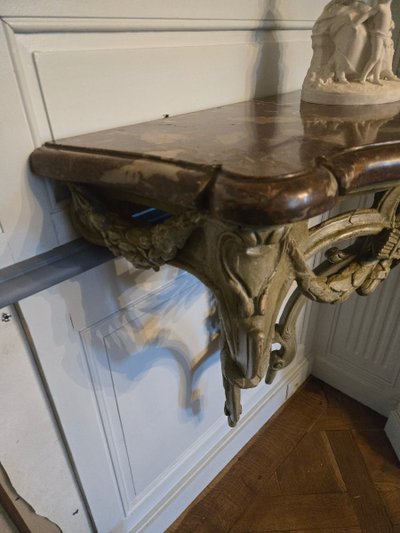
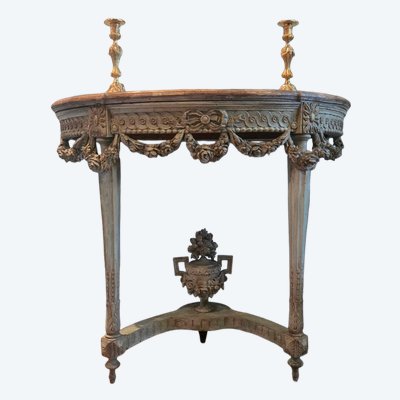
The wide-open belt features a central motif of a quiver and flaming torch, attributes of Love, held in place by a knotted ribbon. From this knot, laurel leaf garlands extend laterally to join the front jambs.
The latter feature heart-shaped cartouches at the corners, while their curves are underlined by laurel leaf falls, reinforcing the coherence of the decor.
The sides, also openwork, are adorned with garlands of foliage punctuated with flowers, testifying to the care taken with all visible surfaces.
The two uprights are joined by an openwork spacer decorated with a fire pot, a motif emblematic of the antique repertoire.
All of these elements - quiver, flaming torch, ribbon bow, laurel leaves, plant garlands and fire pot - belong fully to the neoclassical vocabulary that gradually took hold from the 1760s onwards. Applied to a structure that is still Louis XV, this decoration is a perfect illustration of these so-called "transitional" productions, where new ornaments are superimposed on older forms, without making them disappear.
The frame is made of softwood, a material frequently used in 18th-century provincial production, particularly for furniture designed to be painted and integrated into decorative ensembles. This characteristic, combined with the furniture's typology and sculptural treatment, points to provincial workmanship.
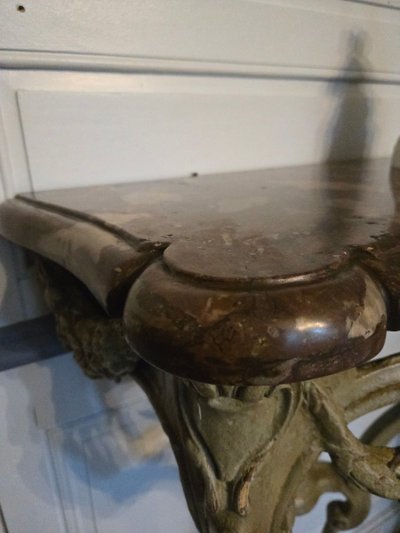
The console retains its polychromy in muted green tones, with an old patina of wear and tear, contributing to the readability of the carved relief and the harmony of the whole.
It is topped by a thick, warm-brown Rance marble from Belgium, with contrasting veins. The top, molded with a corbelled beak, follows the movement of the belt and underlines the quality of the composition.
Marble dimensions:
Height: 72.5 cm
Width : 73 cm
Depth: 38 cm
Marble thickness: 3.5 cm
Ref: A7ZIYNI45A