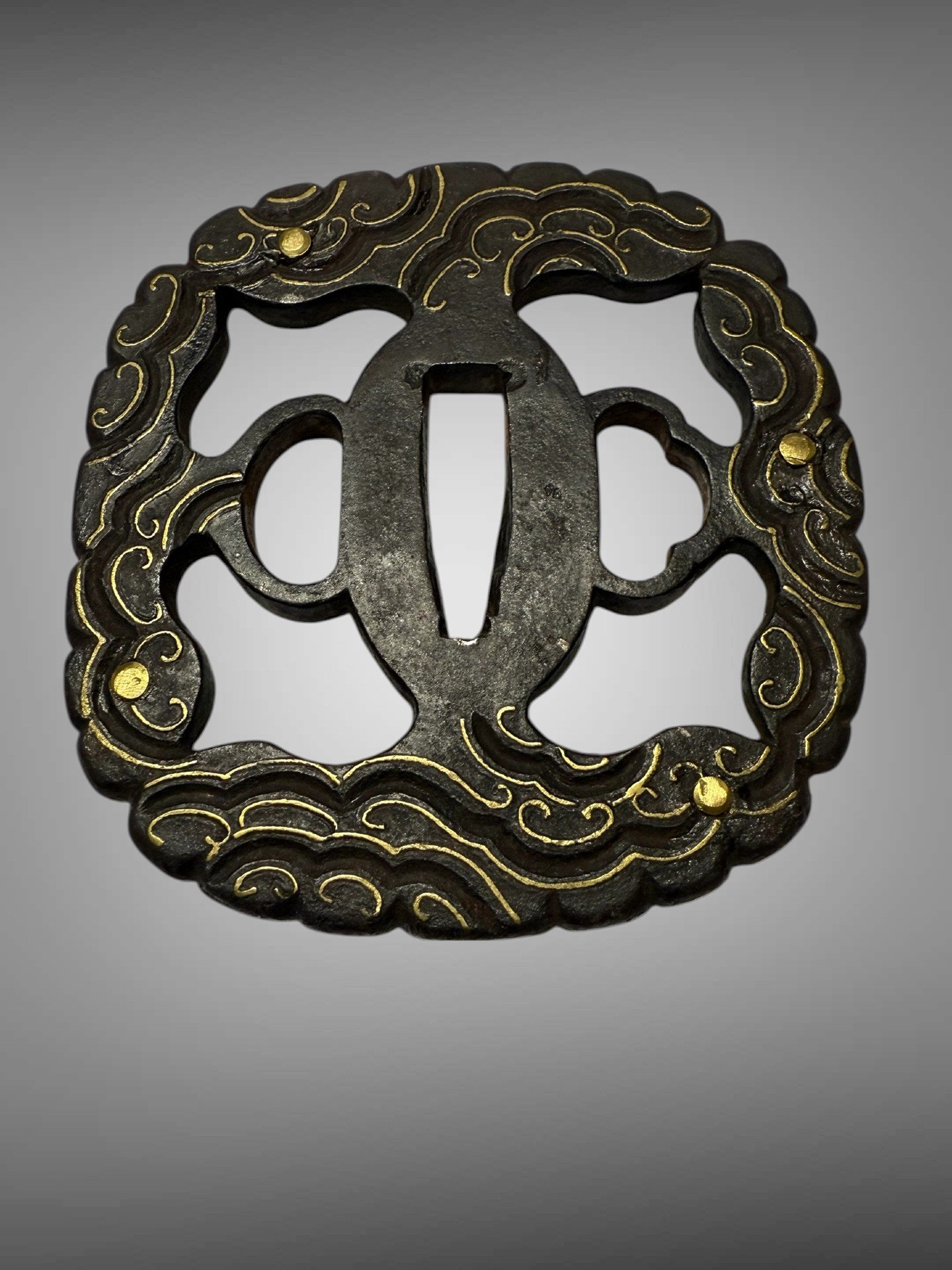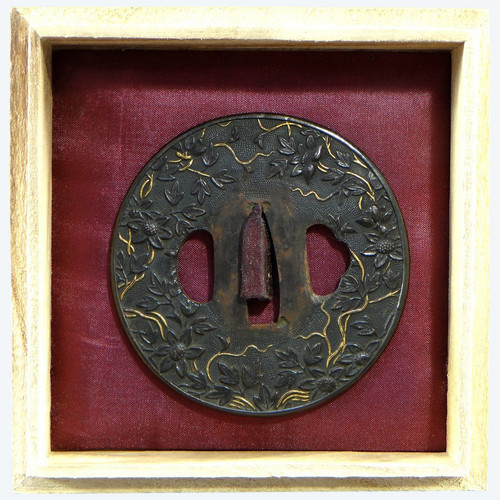
Iron tsuba aori gata with scrollwork decoration - Edo period
slider-bg
more images

Would you like more images?

Iron tsuba aori gata with scrollwork decoration - Edo period

19th century
Asian Arts

Item offered for sale by

See the gallery
This description has been translated and may not be completely accurate. Click here to see the original

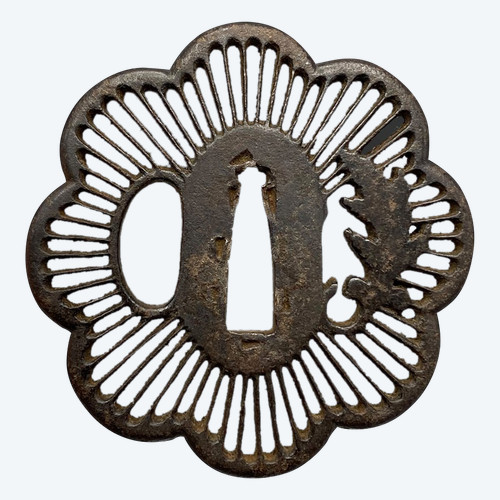
Object: Tsuba (鍔) – Japanese sword guard
Sword type: Katana
Shape: Mokko-gata (four-lobed melon shape)
School/Tradition: Heianjō-zōgan → Kaga or Aizu Shōami
Period: Late Edo period (circa 1750–1850)
Geographic origin: Japan, Kaga region (Kanazawa) or Aizu (present-day Fukushima Prefecture)

Main material: Wrought iron (tetsu) with a deep brown-black patina

Decoration: Gilded brass inlays (nunome-zōgan) forming a network of stylized clouds and waves (kumo-nami-zu)
Special ornaments: Small raised brass discs (hira-zōgan), probably symbols of celestial bodies or water droplets

Dimensions: Height: 80 mm — Width: 74 mm — Thickness: 4–5 mm Weight: 121 grams
Openings: Nakago-ana (central): trapezoidal, slightly worn; Ryōhitsu (lateral): symmetrical, elongated oval

Edge (mimi): Rounded and slightly molded, continuous decoration; hammered appearance and homogeneous patina

Seppa-dai (mounting area): Flat surface with slight wear marks, consistent with actual mounting on a blade

The cloud and wave motif (雲波, kumo-nami) belongs to the classical Japanese vocabulary.

It symbolizes:
the perpetual movement of the natural world,
the duality of heaven and water,
sometimes divine protection or fluid power (often associated with dragons).

This decoration was particularly popular in the Kaga and Aizu provinces, regions renowned for their ornamental tsuba with elegant and peaceful themes.

The Heianjō-zōgan school (Kyōto, 15th century) was the first to introduce the use of brass and copper inlays on iron.

Their style was passed on:
to the Kaga-zōgan school (Kanazawa), which refined the technique in the 17th century,
and to the Aizu Shōami school (late Edo period), where the motifs became more decorative and symmetrical.
This tsuba thus belongs to this decorative lineage, at a time when the defensive function of the hilt was overshadowed by its aesthetic and status-related role for the samurai.

Ref: VZ2FNV2MIJ

Condition Good
Style Asian Arts (Swords, Bladed weapons of Asian Arts Style)
Period 19th century (Swords, Bladed weapons 19th century)
Country of origin Japan
Width (cm) 7.7
Height (cm) 8.1
Weight (Kg) 0.121
Shipping Time Ready to ship in 2-3 Business Days
Location 93400, saint ouen , France
Shipping Information Careful and insured shipping, fast shipping
Antikeo Buyer Guarantee

4 commitments to buy with confidence