

Would you like more images?
Nils Forsberg (Riseberga, Sweden, 1842 - Helsingborg, 1934)
Kermesse, street scene in Versailles 1882
Oil on panel
26.8 x 36 cm
37 x 44 cm with frame
Situated "Versailles", signed and dated "N. Forsberg 1882" lower right
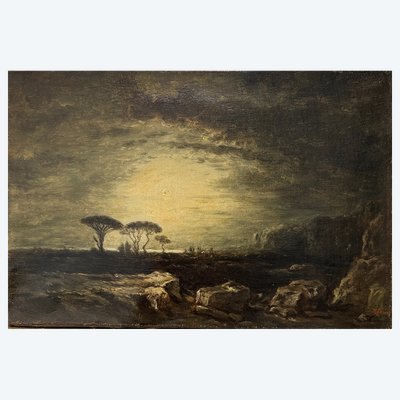
Born in Riseberga, a small village in the Swedish province of Skåne, Nils Forsberg grew up in a peasant family, working first as a farmhand. While still a teenager, he completed an apprenticeship as a house painter in Gothenburg, which providentially steered him towards a more artistic path. In 1867, supported by a government grant obtained thanks to a sculpture of Minerva created during his apprenticeship, Forsberg went to Paris, where he joined Léon Bonnat's studio at the École des Beaux-arts. In addition to solid drawing skills, he quickly acquired Bonnat's painterly touch, inherited from the Spanish masters. In 1870, Forsberg found himself stranded in the capital during the siege of Paris, and decided to enlist as an ambulance driver. This experience, close to a particularly bloody episode, provided lasting inspiration for his painting, which, like that of his master, subsequently took on a dramatic and baroque character, leading the critic Richard Muther to describe Forsberg in 1896 as "the Swedish Bonnat[1]". A regular exhibitor at the Salon from 1872 onwards, Forsberg won a first-class medal in 1888 for La Fin d'un héros (cat. no. 1014), a historical painting inspired by the Franco-Prussian war, now in the Nationalmuseum in Stockholm. The following year, the painting won a silver medal at the World's Fair, further cementing the artist's critical and official recognition as a historical painter. Procheted by Akseli Gallen-Kallela, Forsberg asserted his Scandinavian patriotism and made a splash at the 1897 Salon with a large-scale composition, Gustave-Adolphus, King of Sweden, exhorting his army before the enemy, commanded by Wallenstein, at Lutzen, November 6, 1632 (cat. no. 659). Presented again at the 1900 World's Fair in the Swedish section (cat. no. 30), this emblematic work subsequently entered the collections of the Gothenburg Museum. Having become one of his country's most eminent artistic figures, he returned to Helsingborg in 1904 to take an active part in the reform of academic teaching, while pursuing a career as a portrait painter and decorator. Dated 1882, our small oil on panel belongs to the more intimate and resolutely modern part of Nils Forsberg's work. Depicting a nocturnal Kermess in Versailles, a subject far removed from his great historical compositions, it conveys a sensitive and rapidly sketched vision of urban life, rich in movement and luminous chiaroscuro. The dark silhouettes of passers-by crowding around illuminated stalls stroll between the square's tall black trees. The night sky, streaked with clouds and animated by a partially veiled moon, contrasts with the brightly lit, warm ribbon of fairground tents below, creating a decorative, theatrical effect in this picturesque scene. Using a restrained palette and vibrant brushstrokes, the painter excels in rendering the movement of a crowd reduced to a few shadowy figures parading before the electric lights of the festival. Although modest in size, our delicate work reveals the particular way in which Forsberg manages to combine the documentary realism of his observation of everyday life with a certain poetry of his own. [1] Muther, R., The History of Modern Painting, London, Henry and Company, 1896, p. 355.
Ref: BAHTA1PDKF
| Condition | Very good |
| Style | Second Empire style, Napoleon III style (Landscape Paintings of Second Empire style, Napoleon III style Style) |
| Period | 19th century (Landscape Paintings 19th century) |
| Country of origin | France |
| Length (cm) | 36 |
| Height (cm) | 26 |
| Internal reference | 1770444 |
| Shipping Time | Ready to ship in 4-7 Business Days |
| Location | 75014, Paris, France |
4 commitments to buy with confidence

 English
 Français
  Italiano
  Deutsch