This description has been translated and may not be completely accurate. Click here to see the original
French school, circa 1750, circle or follower of Jean-Marc Nattier, portrait of a lady in Franciscan habit, holding an open copy of La Chasse du Cerf. Oil on canvas presented in a very rich Louis XV rocaille frame with wood and stucco gilded with gold leaf (the frame dates from the 19th century).
Our beautiful portrait depicts an aristocrat in a half-body pose, slightly turned to the right, in a columned architectural setting. She wears a brown habit with a wide hood, ample pleats and a heavy fall, fastened at the waist with a knotted braided cord - an explicit evocation of Franciscan dress. His right hand rests on a large volume placed on a table covered with a blue-green drapery. The book is open to a printed page showing a theatrical text, clearly identifiable as Marc Antoine Legrand's ballet comedy La Chasse du Cerf (first performed at the Comédie-Française in 1726).
It's a commissioned work with a double meaning tinged with irony: the lady is depicted in a garment clearly evoking the dress of Franciscan tertiaries: loose brown dress and rope belt. This choice of dress does not belong to the worldly register, but to the representation of penitence, humility and renunciation, typical of portraits of noblewomen who have embraced a life of piety after widowhood, a moral crisis or a late conversion. The identification on the title page of the open book, the comédie-ballet La Chasse du Cerf (1726), belongs to galant literature. Marc Antoine Legrand's play features an entertainment that combines comic and mythological episodes to celebrate pleasure. The presence of this book is a deliberate iconographic antithesis to the Franciscan habit, a symbol of austerity and conversion, revealing a personality between two states: a woman who has withdrawn from the world without having left it entirely, or a penitent whose gallant past remains perceptible.
Our painting is thus representative of the lightness of 18th-century libertinism, a subtle irony on the part of the painter or the commissioner, in the way she depicts proclaimed virtue and internalized intimate pleasures.
It's an amusing work with a double meaning, ideal for rounding out an 18th-century collection and introducing visitors to an anecdote.
The painting is beautiful, well done and the colors are fresh. It is presented in a beautiful, rich 19th-century frame. A spectacular large-format work.
The painting has been cleaned, formerly lined. The frame has been gilded with gold leaf and cleaned by our gilder.
Frame dimensions: 106cm x 90.4cm
Canvas dimensions: 81cm x 64cm
Ref: DQ82Z9JC1K

 English
 Français
  Italiano
  Deutsch
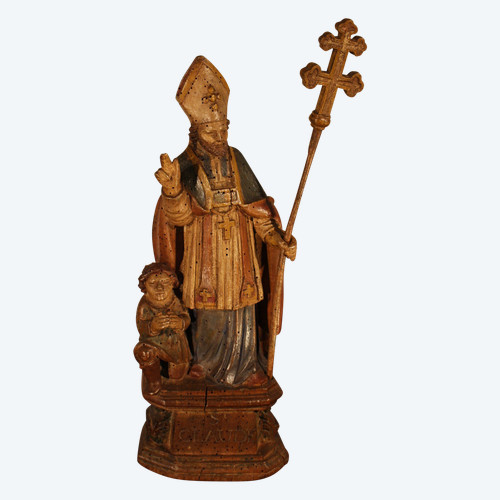
  Saint-Claude 17th century
1.100 € EUR
Saint-Claude 17th century
1.100 € EUR