










Would you like more images?


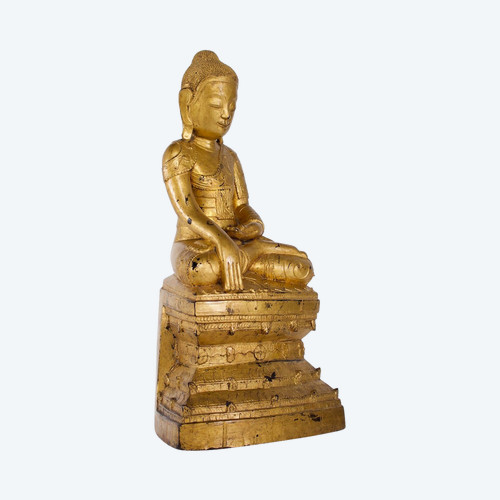
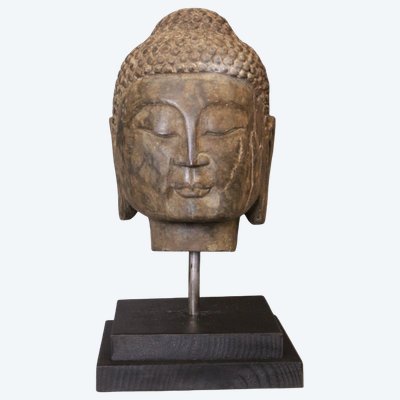
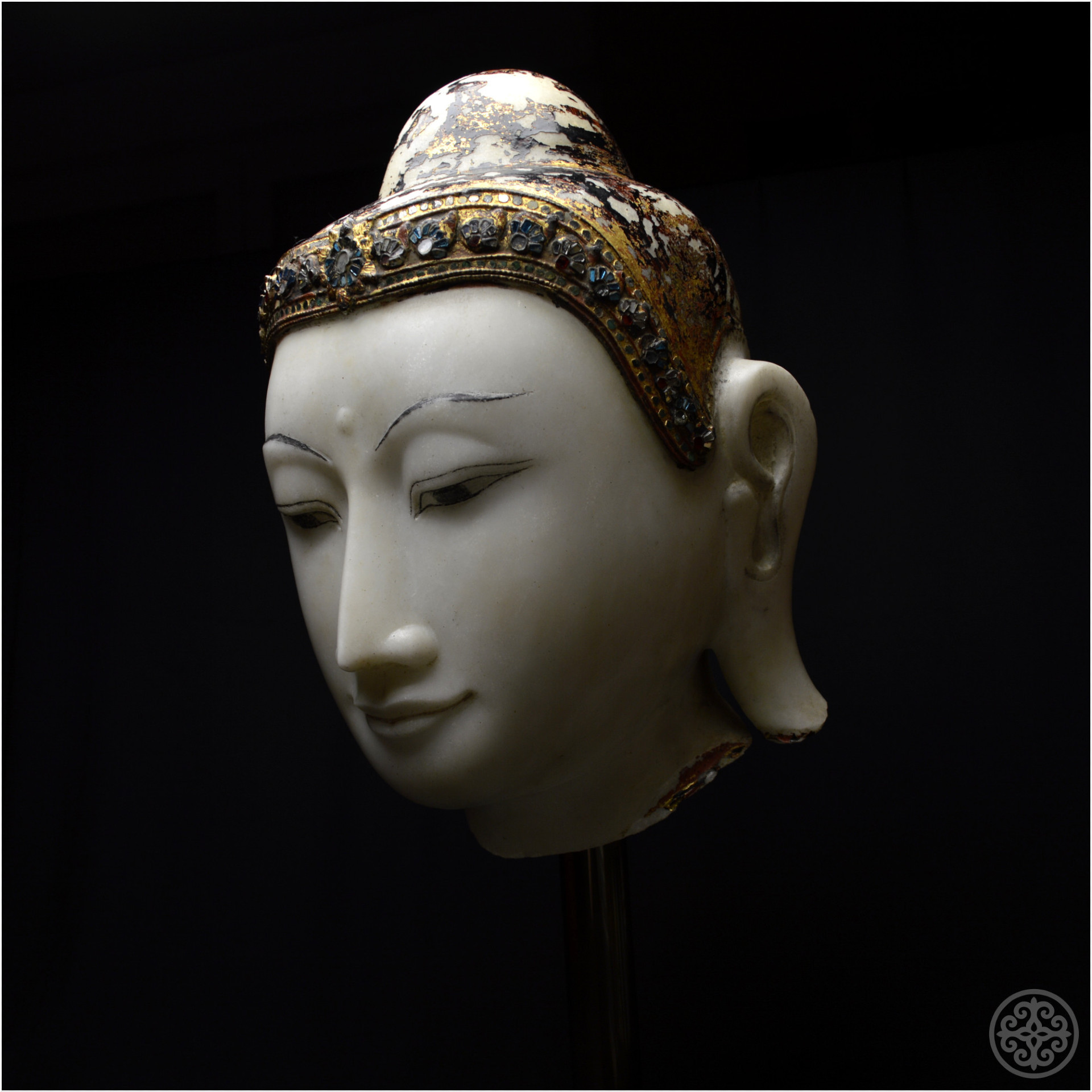
Important marble head of Shakyamuni Buddha
Burma
Mandalay style
Konbaung dynasty (1752 - 1885), 19th century
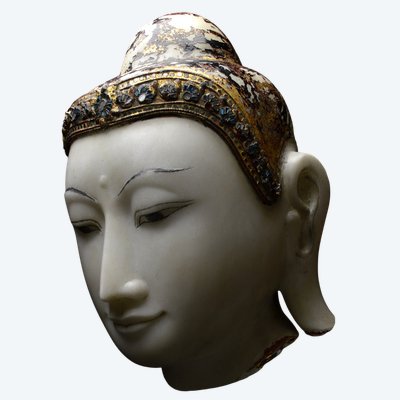
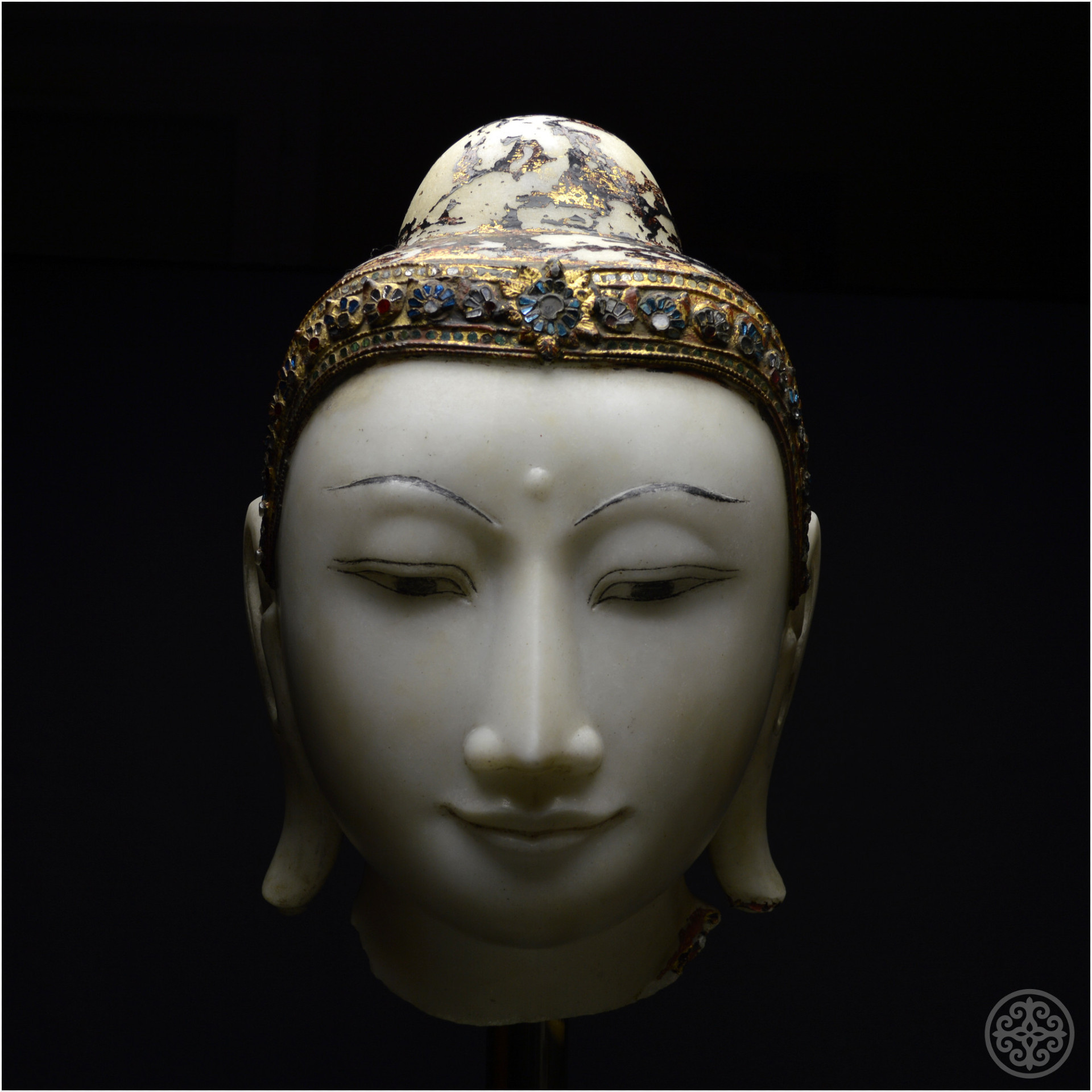
The face, with its youthful, gentle appearance, is set in a harmonious oval. It is distinguished by fine curved eyebrows, outlined in black, framing a small urna in slight relief. The half-closed, downward-facing eyes feature thick eyelids marked with a fine black border. The pupils, also emphasized, convey a meditative attitude imbued with interiority and serenity, detached from earthly contingencies.
The particular treatment of the eyes is characteristic of the Mandalay style. Called kye min ye thauk (literally 'the king of the water-drinking birds'), they are characterized by a tapering shape, tapering towards the ends in a fluid movement reminiscent of a beak or stretched line. This design captures a lowered gaze with sharp, delicate contours, reinforcing the expression of calm. Beyond its aesthetic effect, this shape conveys a state of deep meditation and an orientation towards the inner rather than the outer world. It also expresses gentleness and compassion, in keeping with a general aesthetic of serenity typical of Burmese Buddhist representations in Mandalay.
The nose, fine and straight, with slightly dilated nostrils, surmounts a mouth with delicate lips, whose corners show a slight smile.
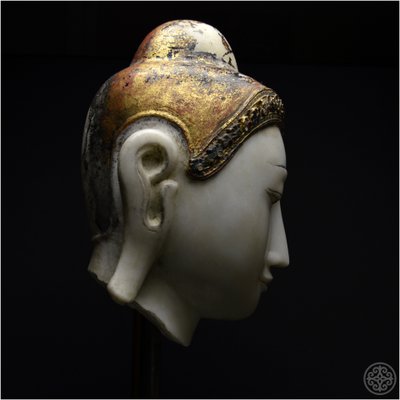
The forehead is adorned with a wide band decorated with verrored floral motifs. This ornament, known as thin kyit, appeared in Buddhist image sculpture as a thin line during the Ava period (1364-1527), before gradually widening over time. Placed between the face and the hair, it symbolically marks the Buddha's state of awakening and contributes to the image's preciousness and devotional dimension. Rich patrons used to decorate it with elaborate floral motifs and precious stones, notably rubies, to exalt the Buddha's splendor and express their devotion.
The top of the skull is topped with a broad, high ushnisha, while the arched ears feature distended lobes, symbols of the Buddha's past worldly life.
The Mandalay style, which developed between the late 18th and 19th centuries in the eponymous region, corresponds to the apogee of Burmese court art under the Konbaung dynasty (1752-1885). It is part of a tradition closely linked to Theravada Buddhism and an idealized representation of the Buddha.
He developed an image of the Buddha that was not a portrait, but a codified figuration of spiritual perfection. The face, oval and smooth, reflects a form of controlled abstraction: softened features, fine eyebrows, straight nose and discreet smile make up a figure detached from individuality. The eyes, half-closed and turned inward, express a state of deep meditation and serenity, reinforcing the idea of a spiritual presence rather than a human reality. Compared to Ava's earlier, more expressive and naturalistic style, the Mandalay style marks a shift towards a more strictly codified aesthetic. The figure becomes less narrative and more iconic, oriented towards a religious ideal of stability and harmony.
The use of marble for sculpting Buddhist images only really began to develop during the Ava period (1287-1752). In this context, while powerful Buddhist kingdoms succeeded one another in Ava, Amarapura and Mandalay, Sagyin, a village north of Mandalay, was renowned for the exceptional quality of its marble and gradually established itself as the main extraction center. With the growing importance of marble in Buddhist material culture in Burma, the so-called Mandalay style of creating images of Buddha began to emerge in the late 18th century.
Marble with gilding and lacquer, glass inlaid
Wear and tear, visible accidents
43 x 25.5 cm excluding base
Former collection of Mr. B., aesthete and great collector of Asian art
Contact us: culturesetcivilisations@orange.fr
Ref: V75PGXGOJO
| Condition | Very good |
| Style | Asian Arts (Marble and Stone Sculptures of Asian Arts Style) |
| Period | 19th century (Marble and Stone Sculptures 19th century) |
| Country of origin | Myanmar |
| Shipping Time | Ready to ship in 8-15 Business Days |
| Location | 38090, Villefontaine, France |
4 commitments to buy with confidence

 English
 Français
  Italiano
  Deutsch