






Would you like more images?


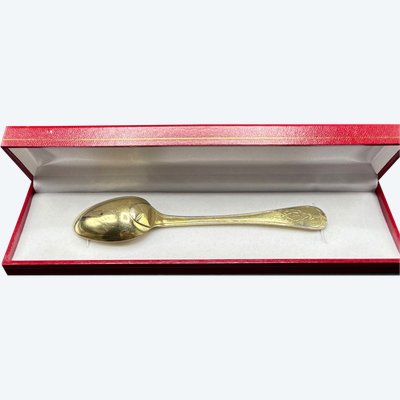
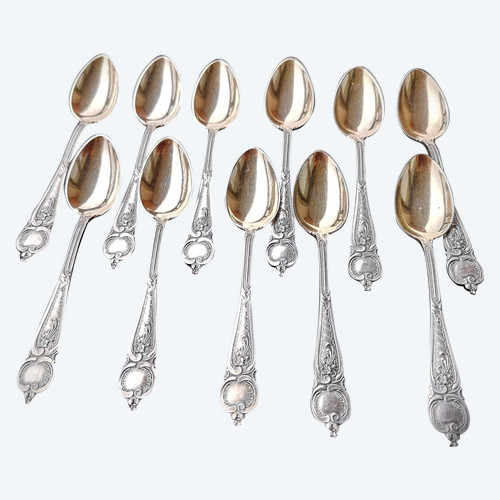
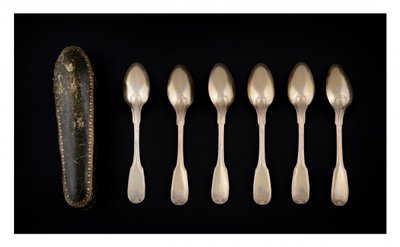
A set of six small gilt silver spoons, with a ribbed pattern.
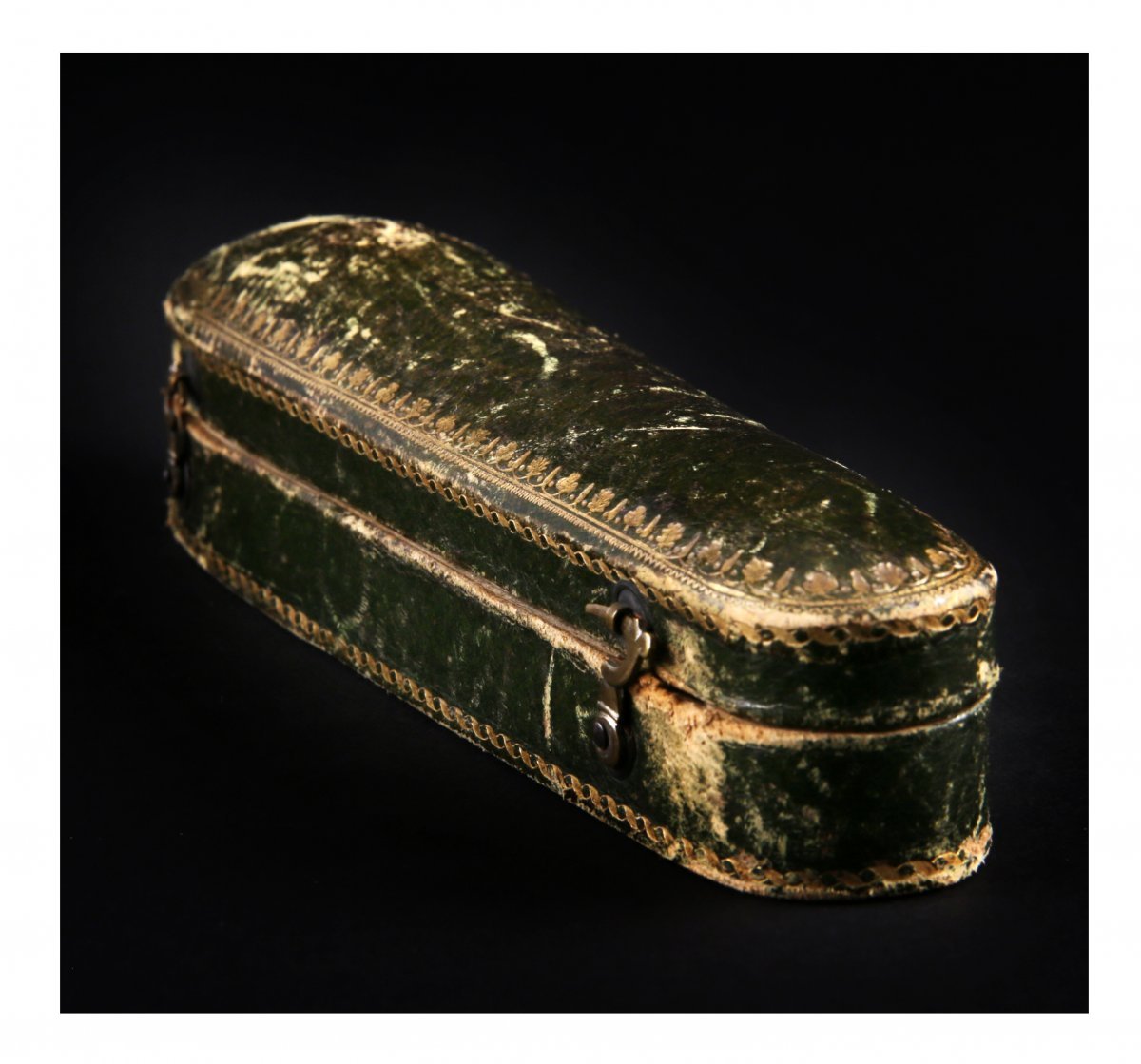
In their original green morocco leather travel case with gilt edges and brass locks.
By François-Daniel Imlin, admitted to the guild in 1780.
Strasbourg 1780-1784.
Weight: 172 grams.
A similar set in its case was sold at Pierre Bergé et Associés: Furniture and Decorative Arts, Wednesday, December 10, 2008, lot 168.
FRANÇOIS-DANIEL IMLIN (1757-1827, admitted to the guild in 1780)
François-Daniel Imlin was an 18th-century silversmith from a dynasty of Strasbourg silversmiths.
In the 18th century, Strasbourg was an important center for silver production. It was then renowned throughout Europe for the quality and beauty of its silver-gilt. The brilliant gilding, combined with the rich ornamentation of the pieces, appealed to the taste of the aristocratic clientele who at that time adopted the etiquette of "service à la française" (French-style service). Prominent German families such as the Hanau-Lichtenberg, the Landgraves of Hesse-Darmstadt, and the Dukes of Palatinate-Zweibrücken placed significant orders, but production also included pieces for liturgical use, destined for England and the rest of Europe.
The Imlin family constituted one of the most celebrated dynasties of Strasbourg goldsmiths, their name inextricably linked to 18th-century Strasbourg goldsmithing. They supplied pieces to all the most important patrons. Several pieces from the IMLIN workshops are listed in the General Inventory of Cultural Heritage, classified as Historical Monuments, and are preserved in museums, notably the Museum of Decorative Arts in Strasbourg. François-Daniel IMLIN, along with Jacques-Frédéric KIRSTEIN, a descendant of another illustrious dynasty of goldsmiths, created the keys to the city of Strasbourg and their display stand.
Imlin Street in Strasbourg commemorates the IMLIN family's prominent role in the city's artistic life.
François-Daniel IMLIN produced objects in a neoclassical style characterized by sobriety and elegance. Examples include two candelabras and a covered bowl featured in the catalog of the exhibition "Two Centuries of Goldsmithing in Strasbourg" (2004).
Following in his family's footsteps, the goldsmith crafted a large number of travel cases for his wealthy, aristocratic clientele. The objects were almost always made of gilded silver (vermeil), and the cases contained various items essential for life during long journeys, such as the spoons shown here. This craftsmanship is illustrated, for example, by the important service created by Imlin for the Landgrave of Hesse-Darmstadt.
MUSEUMS, PUBLIC INSTITUTIONS, AND LISTED OBJECTS
MUSEUM OF DECORATIVE ARTS, Strasbourg – Pair of candlesticks in the form of a tripod Athenian woman – 1809.
MUSEUM OF DECORATIVE ARTS, Strasbourg – Covered vermeil bowl and its stand – 1784.
MUSEUM OF DECORATIVE ARTS, Strasbourg – Oval vermeil goblet – Formerly in the César Winterhalter collection.
Museum of Decorative Arts, Strasbourg – Pair of oval salt cellars – 1798.
Museum of Decorative Arts, Strasbourg – Pair of candlesticks in the form of a tripod obelisk – 1809-1819.
Historical Museum, Strasbourg – Keys to the city of Strasbourg and their display stand – silver-gilt, circa 1805.
Print and Drawing Collection, Strasbourg – Bouillon bowl – goldsmith's design, 1790-1810.
Saint-Maurice Church, Besançon – Silver chalice – 1784. Listed as a Historical Monument.
Saint-Aphrodisius Church, Béziers – Silver-gilt chalice – Strasbourg, 1784, listed as a Historical Monument.
SAINT-APHRODISE CHURCH, Béziers – Repoussé silver cruet basin – Strasbourg 1784-91, listed as a Historical Monument.
CHURCH, Charezier – Silver chalice – late 18th century, listed as a Historical Monument.
SAINT-MARTIN CHURCH, Daschtein – Vermeil ampulla for holy oils – hallmarks of Jean-Louis IMLIN II and François-Daniel IMLIN.
SAINT-MARTIN CHURCH, Flassigny – Vermeil chalice and paten – listed as a Historical Monument.
SAINT-GEORGES CHURCH, Haguenau – Louis XVI style silver chalice and paten – 1788, public property.
VICTORIA & ALBERT MUSEUM, London – Vermeil chalice – Strasbourg, 1779.
BIBLIOGRAPHY
ALEMANY-DESSAINT, Véronique, French Goldsmithing, 1988.
DENNIS, Faith, Three cent. of fr. dom. silver, 1960 (no. 540).
FARGES-MÉRICOURT, Account of the Journey of His Majesty Charles X to Alsace, 1829.
HAUG, Hans, Connaissance des Arts no. 151, 1964 (ill. p. 107).
HAUG, Hans, Strasbourg Goldsmithing in French Public Collections, Éditions des Musées Nationaux, Palais du Louvre, 1978.
HAUG, Geneviève, Strasbourg Goldsmithing from its Origins to the 19th Century, Revue d'Alsace, 110, 1984, p. 113-140 (p. 133).
LOMAX, James, "Huguenot Goldsmiths in England," in *Seeing Beyond the Word: Visual Arts and the Calvinist Tradition*, Hugenot Heritage, Paul Corby Finney, 1999, p. 100.
LOTZ, François, *Alsatian Painters of an Ancient Time, 1800-1880*, no. 156.
LUDMANN, Jean-Daniel, *New Dictionary of Alsatian Biography*, vol. 18.
MARTIN, Étienne, *Two Centuries of Goldsmithing*
Ref: J647GTB3P0
| Condition | Good |
| Style | Louis XVI (Silver Cutlery set of Louis XVI Style) |
| Period | 18th century (Silver Cutlery set 18th century) |
| Goldsmith / Silversmith | François-Daniel IMLIN |
| Country of origin | France |
| Artist | François-daniel Imlin |
| Length (cm) | 15 |
| Weight (Kg) | 0.172 |
| Materials | Vermeil |
| Shipping Time | Ready to ship in 4-7 Business Days |
| Location | 75016, Paris, France |
| Shipping Information | Shipping: We take special care when shipping all orders to ensure their safety during transit. Each item is carefully packaged with high-quality protective materials to prevent damage. We use reliable, trackable delivery services to guarantee fast and secure shipping. Delivery Times: Shipping Costs: International Shipping: Checking Upon Receipt: Insurance and Liability: |
4 commitments to buy with confidence

 English
 Français
 Italiano
 Deutsch