This description has been translated and may not be completely accurate. Click here to see the original
Important clock in finely chased and gilded bronze Complication movement signed Ferdinand Berthoud, Paris, circa 1870 Case attributed to Alfred Beurdeley
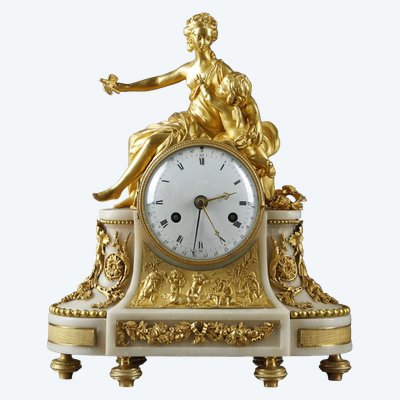
An important and remarkable clock in finely chased and gilded bronze, circa 1870, vividly illustrating the revival of Louis XVI taste under the Second Empire. This work combines two exceptional elements: a complication movement signed Ferdinand Berthoud in Paris, and a case of exceptional sculptural quality, attributed to Alfred Beurdeley.
The composition depicts an unusually large winged Cupid, treated with great anatomical mastery and refined expressiveness. The cherub, particularly developed in size and presence, displays powerful modeling and remarkably precise chasing. The finely-ribbed wings, delicately worked hair, animated drapery and natural movement reflect first-rate craftsmanship. The balance of the volumes and the nobility of the subject give the whole a spectacular dimension.
The enamelled dial, set in a rich neoclassical frame, houses a complication movement featuring a simple calendar, indicating the date from 1 to 31. This calendar function, relatively rare on a mantel clock of this period, testifies to a technical determination and high-end positioning. The movement is signed "Ferdinand Berthoud à Paris", circa 1870. Although the great master of the XVIIIᵉ century passed away in 1807, his name was perpetuated by his successors, remaining in the XIXᵉ century a pledge of high Parisian watchmaking quality.
The case displays particularly marked stylistic affinities with the productions of Alfred Beurdeley, whose models depicting the same subject with an almost identical cherub are known. The vigor of the relief, the precision of the chasing, the richness and thickness of the gilding, as well as the extreme care given to secondary details, enable us to propose a coherent and well-founded attribution to this great Parisian bronzemaker and publisher, a major figure in the neoclassical revival of the Second Empire.
The gilding, luminous and deep, offers remarkable homogeneity and a quality of application characteristic of the best Parisian productions of the XIXᵉ century. The overall condition is very satisfactory and in keeping with the age and nature of the work.
We are in the presence of a clock of the very highest order, combining a complication movement with calendar and a case attributable to one of the most important bronzemakers of the XIXᵉ century. A rare and spectacular piece, destined for a demanding collection or a prestigious interior.
Ref: J5S6MLVC3M

 English
 Français
 Italiano
 Deutsch
 Oak sideboard, 1950
1.100 € EUR