This description has been translated and may not be completely accurate. Click here to see the original
The Rabiat Brothers – Exceptional Large Lyre Clock with Jupiter – Gilt Bronze – Paris, circa 1816-1818
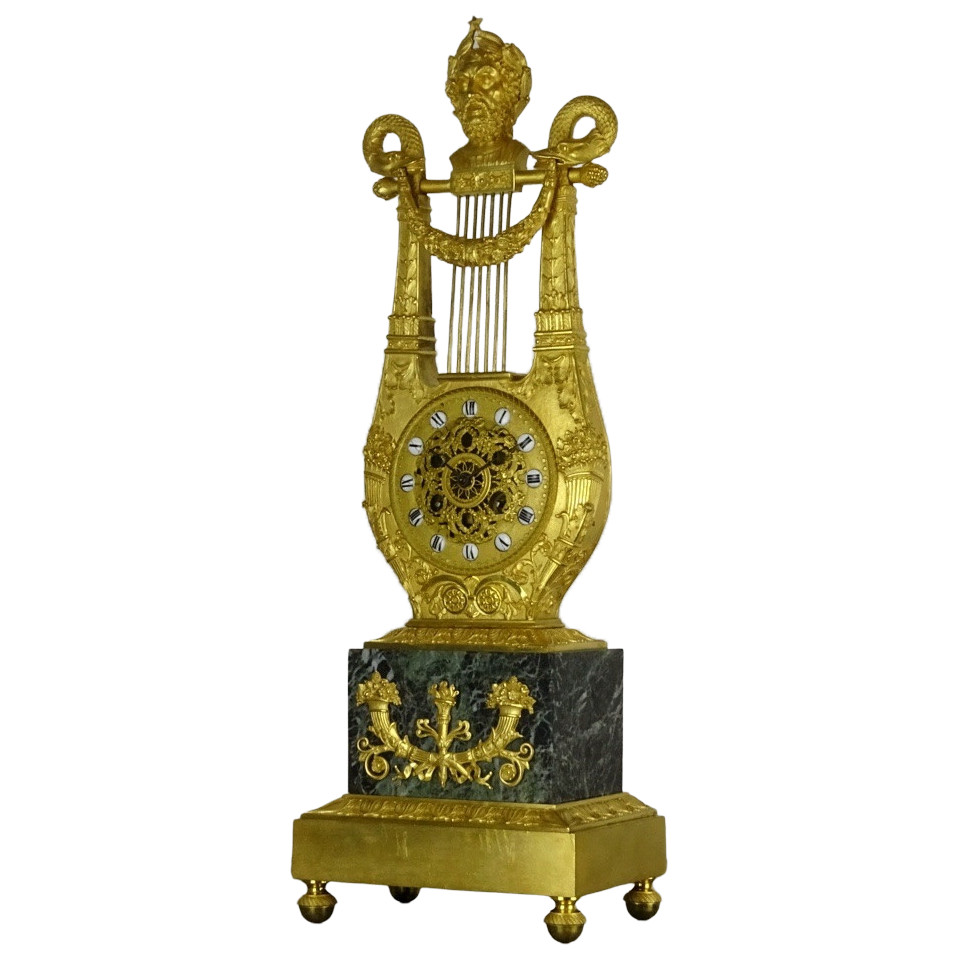
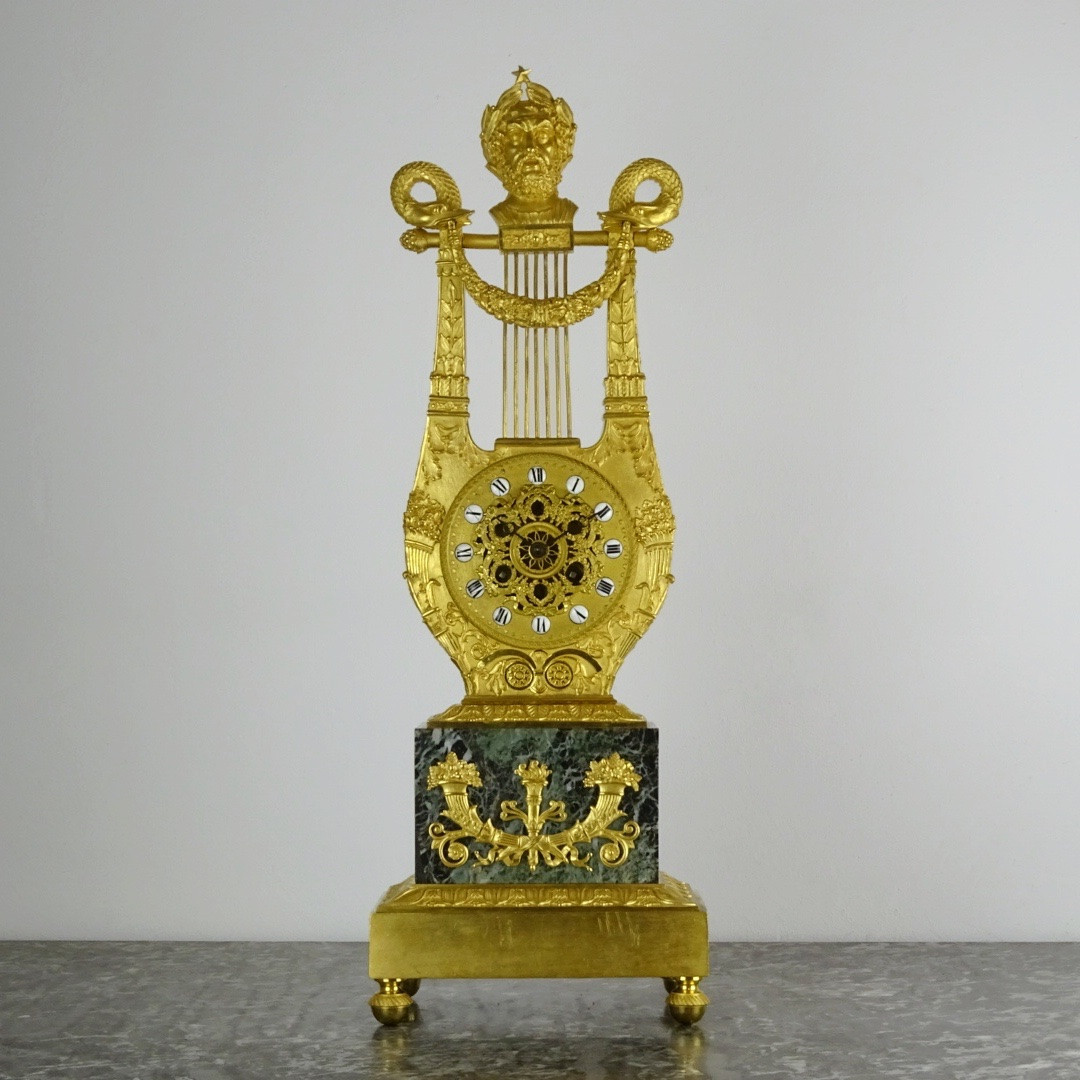
An exceptional large lyre-shaped clock in finely chased and gilt bronze, resting on a green marble base and bearing the signature "LES FRÈRES RABIAT".
Paris, circa 1816-1818.
Standing 53 cm tall, this remarkable clock is distinguished by the elegance and originality of its design, the richness of its neoclassical vocabulary, and, above all, by the exceptional quality of its bronzes, both in the finesse of the casting and chasing and in the execution of the gilding.
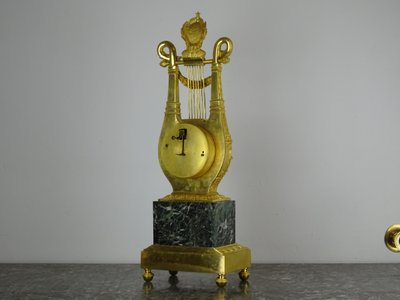
The case takes the form of a majestic antique lyre. Its two slender uprights, joined by the instrument's strings, are entirely decorated with palmettes, foliage, and finely chased motifs. Despite its abundant decoration and large dimensions, the composition retains a remarkable lightness and perfect harmony of proportions.
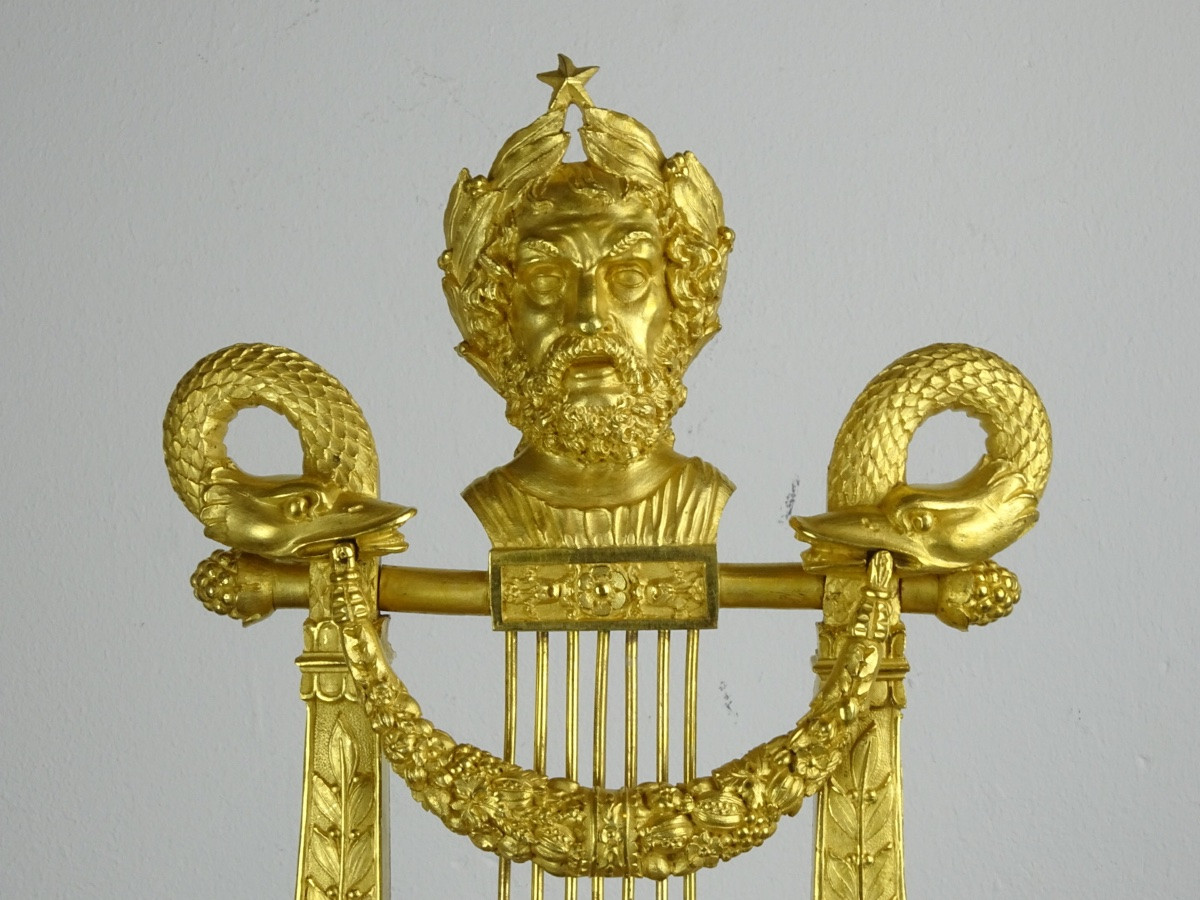
At the top appears a spectacular head of Jupiter, ruler of the Olympian gods, recognizable by his powerfully bearded face and abundant hair. Rendered with true sculptural vigor, the mascaron dominates the whole and is one of the most striking elements of the clock.
On either side are two coiled serpents, positioned symmetrically at the ends of the crossbar. A delicate garland of flowers and foliage unfolds beneath Jupiter between the two arms of the lyre, adding a touch of lightness to the architectural rigor of the composition.
A remarkable openwork dial
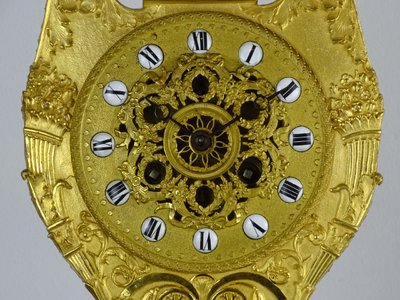
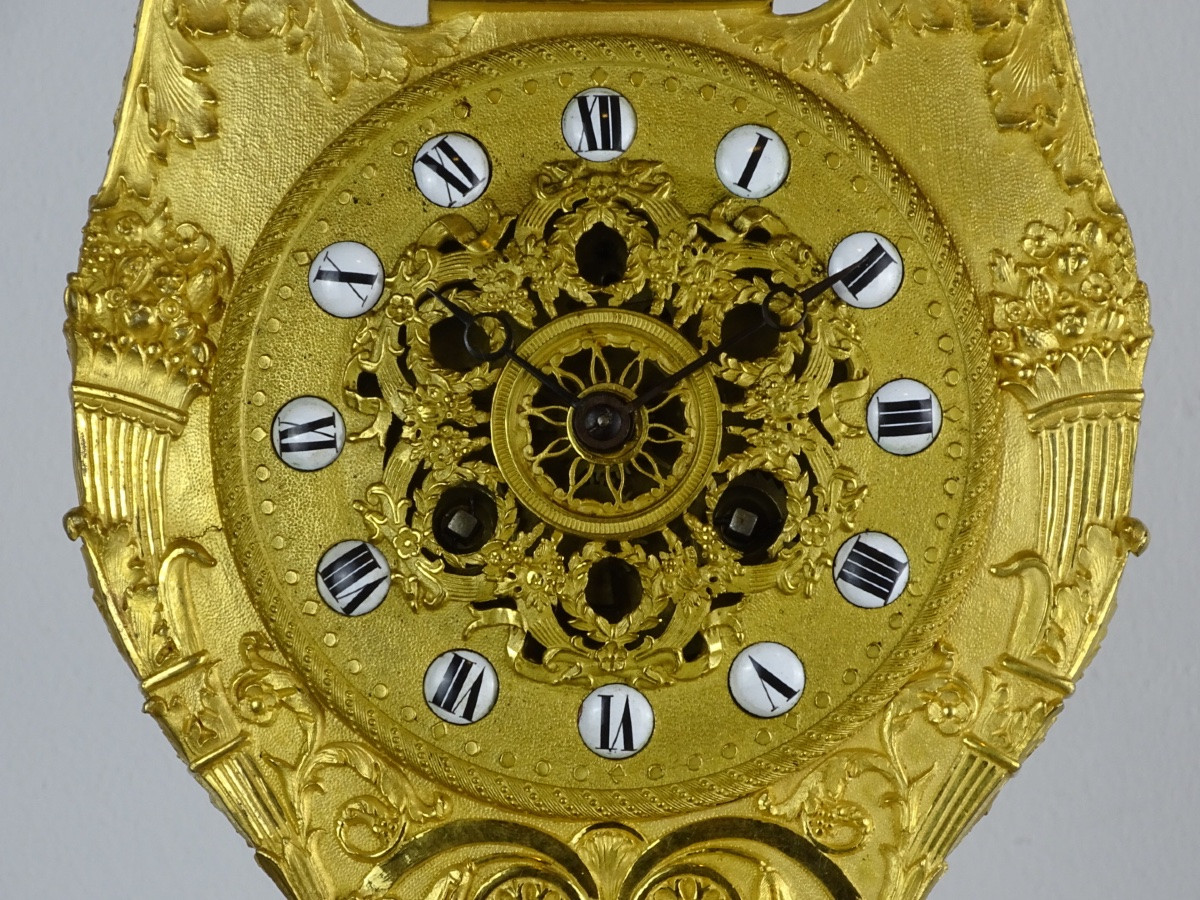
At the center of the lyre is a very beautiful openwork dial, whose subtle design allows a glimpse of some of the movement's gears without fully revealing the mechanism. The hours are indicated by twelve individual white enamel cartouches with Roman numerals, set against a rich, finely chased and openwork gilt-bronze background.
This interplay of openings creates remarkable depth: the movement appears intermittently behind the decoration, contributing to the clock's aesthetic without becoming, as on a true skeleton clock, the dominant subject of the composition.
The lower part of the lyre is equally richly crafted. Scrolls, palmettes, rosettes, and foliage unfold with great precision, demonstrating meticulous attention to detail.
The entire piece rests on an elegant green marble base, its front adorned with a substantial gilt-bronze appliqué composed of facing, flowering cornucopias arranged symmetrically around a central vegetal motif.
A rectangular gilt-bronze base, highlighted by a finely chased frieze and supported by four spherical feet, completes this exceptionally accomplished composition. The Rabiat Brothers, Heirs of Claude-François Rabiat
The signature “LES FRÈRES RABIAT” (The Rabiat Brothers), borne by the clock, is a particularly interesting element and allows us to place the piece within a very brief episode in the history of one of the great Parisian bronze workshops of the early 19th century.
Claude-François Rabiat (1756-1815), who became a master in 1778, ran a large workshop in Paris specializing in bronze furniture. Active from the end of the Ancien Régime until the Empire, he notably supplied bronzes to several of the leading manufacturers and clockmakers of his time.
Upon his death in 1815, his three sons, trained in the workshop environment, continued its business. They joined forces in 1816 under a common business name, before their partnership was dissolved at the end of 1818. The signature "LES FRÈRES RABIAT" (The Rabiat Brothers) thus allows us to link this clock to this particularly brief period in the workshop's history and to propose a more precise date, around 1816-1818.
Even more remarkable, the documentation relating to Claude-François Rabiat's workshop reveals in its model collection clock cases in the shape of a lyre, as well as compositions adorned with antique heads, notably of Jupiter.
This piece, precisely combining the shape of the lyre and the figure of Jupiter, therefore fits with particular coherence into the repertoire developed by Claude-François Rabiat and passed on to his sons when they took over the workshop.
As such, it stands as a remarkable testament to the continuity of the Rabiat family's designs and expertise following the death of its founder.
At the Crossroads of the Empire and the Restoration
Made around 1816-1818, this clock belongs chronologically to the early years of the Restoration, while remaining deeply imbued with the aesthetics developed under the Empire.
The antique lyre, Jupiter, the serpents, the palmettes, the cornucopias, and the strict symmetry of the composition are all fully part of the grand neoclassical repertoire that dominated Parisian decorative arts at the beginning of the 19th century.
This permanent
Ref: DNLJWUEENW

 English
 Français
  Italiano
  Deutsch
  Louis XVI secretary
5.800 € EUR
Louis XVI secretary
5.800 € EUR