This description has been translated and may not be completely accurate. Click here to see the original
Empire-period mercury-gilt bronze "à la Tisseuse" clock Model based on drawings by Jean-André Reiche
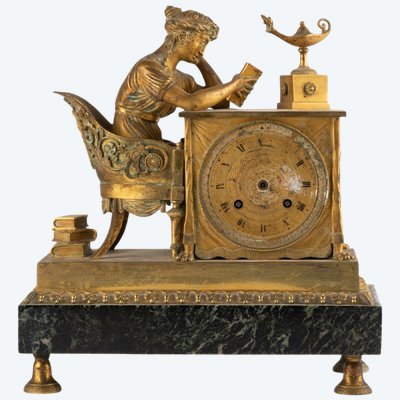
A rare and elegant Empire period clock in finely chased mercury-gilded bronze, depicting a young woman seated in front of her loom.
The subject, composition and quality of execution clearly place this clock among the models based on designs by Jean-André Reiche, famous for creating some of the finest allegorical Parisian clocks of the First Empire.
The subject is particularly rare on the market. Unlike the majority of Empire clocks, which generally feature a standing figure leaning against a classical clock post, this model adopts a much more sophisticated and refined design: here, the movement is directly integrated into the loom furniture, while the figure, depicted seated, plays a full part in the balance and architecture of the composition.
This construction gives the whole a particularly elegant silhouette and bears witness to genuine artistic research.
The feminine figure, treated with great delicacy, displays a very fine quality of chasing. The drapery, seat work, loom details and ornamental elements reveal a Parisian production of very high quality, in the spirit of the great models known as "à la Lecture", "à l'Astronomie" or "à l'Étude", particularly prized under the Empire.
The mercury gilding retains a beautiful presence and remarkable depth, and the whole is in a very good state of preservation, particularly appreciable for a work of this period. Only slight wear is visible on the smooth parts, perfectly consistent with the clock's age.
There is a small chip on the enamel dial (see photographs).
The movement works correctly.
Measuring 32 cm high by 28 cm wide, this clock has particularly harmonious proportions, ideal for a mantelpiece or bookcase.
A very fine Empire clock, rare in both subject and design, combining elegance, originality and quality of execution in the taste of the great Parisian productions of the early 19th century.
Ref: DR1I78QA2X

 English
 Français
 Italiano
 Deutsch
 Royal Banner
1.500 € EUR