This description has been translated and may not be completely accurate. Click here to see the original
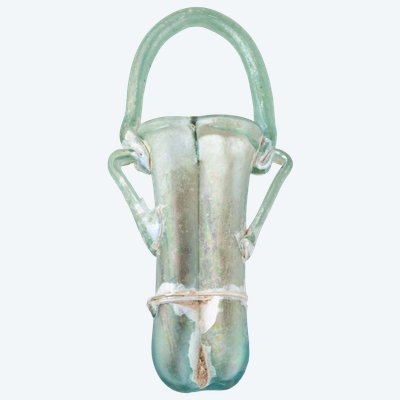
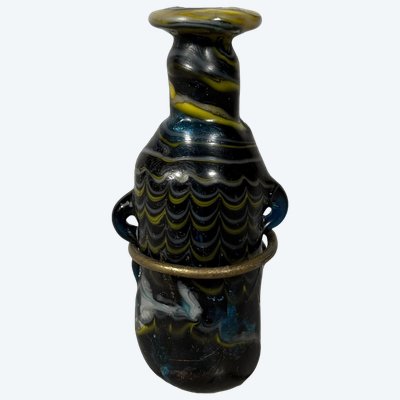
Votive ceramic flask from the Late Ptolemaic period (2nd–1st century BC), decorated in high relief with a baker’s oven on the body and inscribed “PANAT” above.
The object belongs to the tradition of small craft and ritual productions of Hellenistic Egypt, where the everyday and the sacred converge in miniatures of workshops, trades, and symbols of abundance.
The specimen displays a perfectly consistent ancient surface: matte patina, small age chips, and stabilized fissures. The harmonious wear, low-temperature firing, and homogeneous clay fabric correspond to genuinely ancient productions, excluding modern imitations or artificially aged copies.
Characteristics
-
Object: Votive flask with baker’s oven and “PANAT” inscription
-
Culture: Egyptian, Ptolemaic period
-
Date: 2nd–1st century BC
-
Material: Ceramic
-
Dimensions: 69 mm × 37 mm
-
Condition: Good — small ancient cracks on the reverse, slightly worn rim, highly attractive burial patina
-
Provenance: Former American gallery; old private American collection assembled before 2000
-
Certificate: Supplied with certificate of authenticity
Historical Context
In the Hellenistic period, Egypt experienced a unique cultural synthesis: Greek forms, Egyptian iconography, and artisanal innovation coexisted.
Miniature flasks—whether perfume containers, votive offerings, or depictions of workshops and trades—became highly symbolic objects.
The baker’s oven refers to the fundamental nourishment of the ancient world. Bread was both a daily sustenance and a sacred symbol of life and renewal.
Depositing a flask depicting an oven invoked subsistence, prosperity, domestic stability, or the success of a bakery workshop.
The inscription “PANAT” reinforces the concrete identity of the piece: possibly a workshop name, a personal mark, or a caption associated with the motif.
Pieces bearing inscriptions are rarer and more sought after, as they reveal individualized craftsmanship rather than anonymous production.
Formal and Material Analysis of the Specimen
-
Body: Pear-shaped, typical of late Egyptian votive ceramics
-
Handles: Two small vertical handles, well-formed, showing natural wear
-
Relief Decoration: Deeply modelled before firing, representing a rounded oven — bricks, opening, and base clearly defined
-
Inscription: “PANAT” in a rectangular cartouche, with a letterform consistent with local production
-
Surface: Beige-grey patina, slightly grainy texture, traces of ancient earthy deposits
-
Back: Old firing cracks characteristic of buried archaeological ceramics
-
Restoration: None observed — a major positive factor for collectors
This is one of those objects whose archaeological presence is immediately perceptible: the material, weight, texture, and wear speak unmistakably of antiquity.
A true collector’s piece.
Expert Report
This flask belongs to the most expressive class of votive miniatures from the Ptolemaic period.
The clearly legible relief of the oven, and above all the presence of an inscription, give this specimen a strong identity and a greater scholarly and artistic interest than anonymous pieces.
Objects connected to food trades, particularly baking, are highly appreciated by collectors, as they reveal the concrete daily life of the ancient world.
The decoration is not abstract—it tells a story of work, prayer, and prosperity: a genuine snapshot of life fixed in clay.
When compared with museum collections (Alexandria, Cairo, the British Museum, and major American institutions preserving artisan miniature flasks), the present example stands out for:
-
The clarity of its motif
-
The rare presence of an inscription
-
The authentic, homogeneous patina
-
The absence of restoration
-
Its early American provenance, ensuring excellent traceability
It is therefore a highly collectible object, ideal for a collection focused on Hellenistic Egypt, ancient trades, or votive miniatures.
Cultural Value
This flask encapsulates an entire vision of the ancient world: a craftsman, an oven, bread, and a silent prayer for sustenance.
It is a humble yet profoundly human object, bearing the imprints of history, economy, belief, and daily gesture.
Pieces bearing inscriptions are especially prized, as they belong not to mass production but to personalized artisanal creation.
Traceability & Guarantees
Old provenance, preserved for several decades in an American private collection.
Supplied with a certificate of authenticity.
Ref: UDXWX5EIVD

 English
 Français
 Italiano
 Deutsch
 Light stand, 17th century.
1.200 € EUR