This description has been translated and may not be completely accurate. Click here to see the original
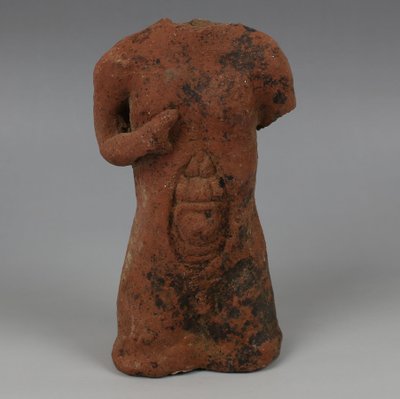
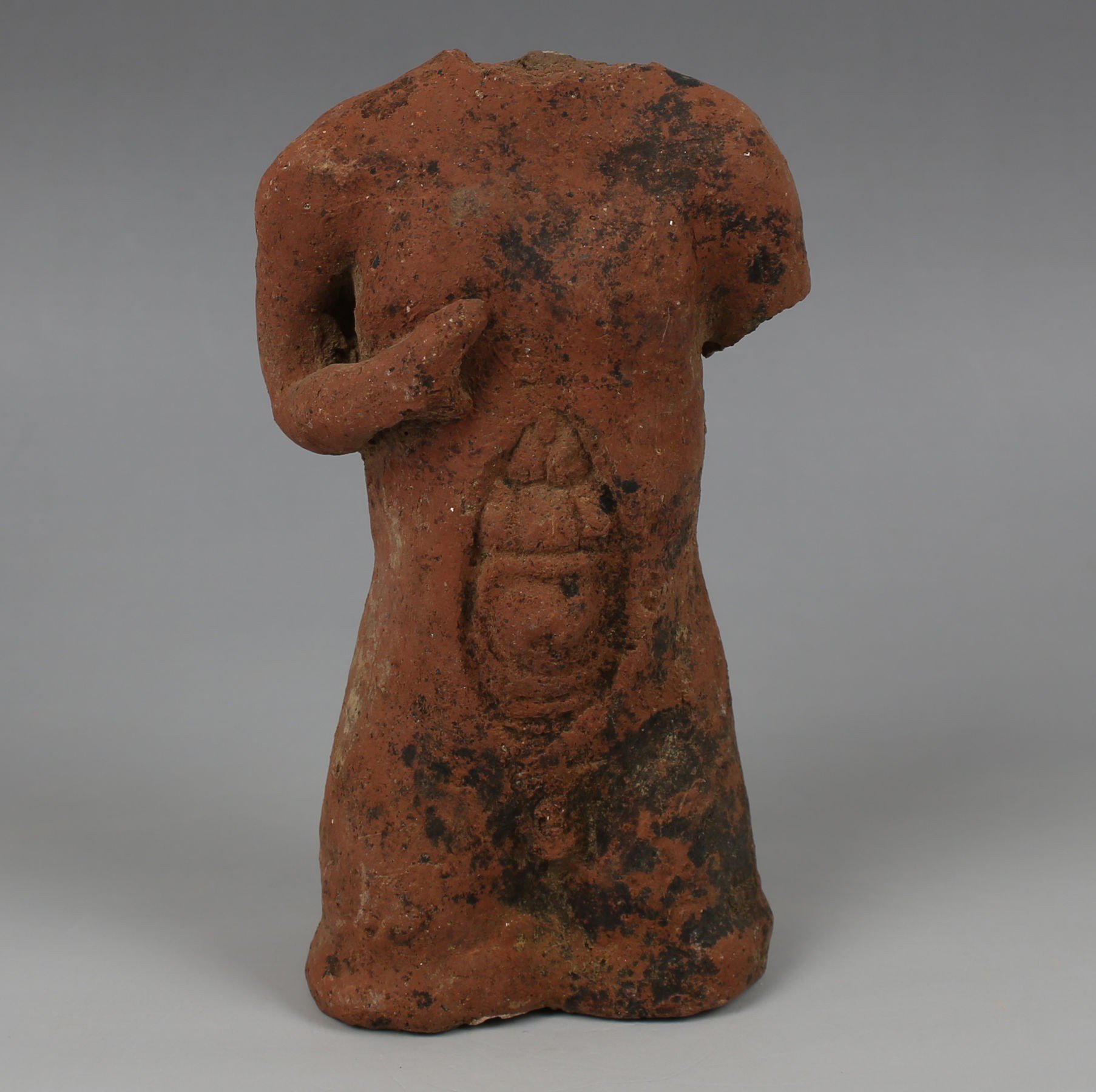
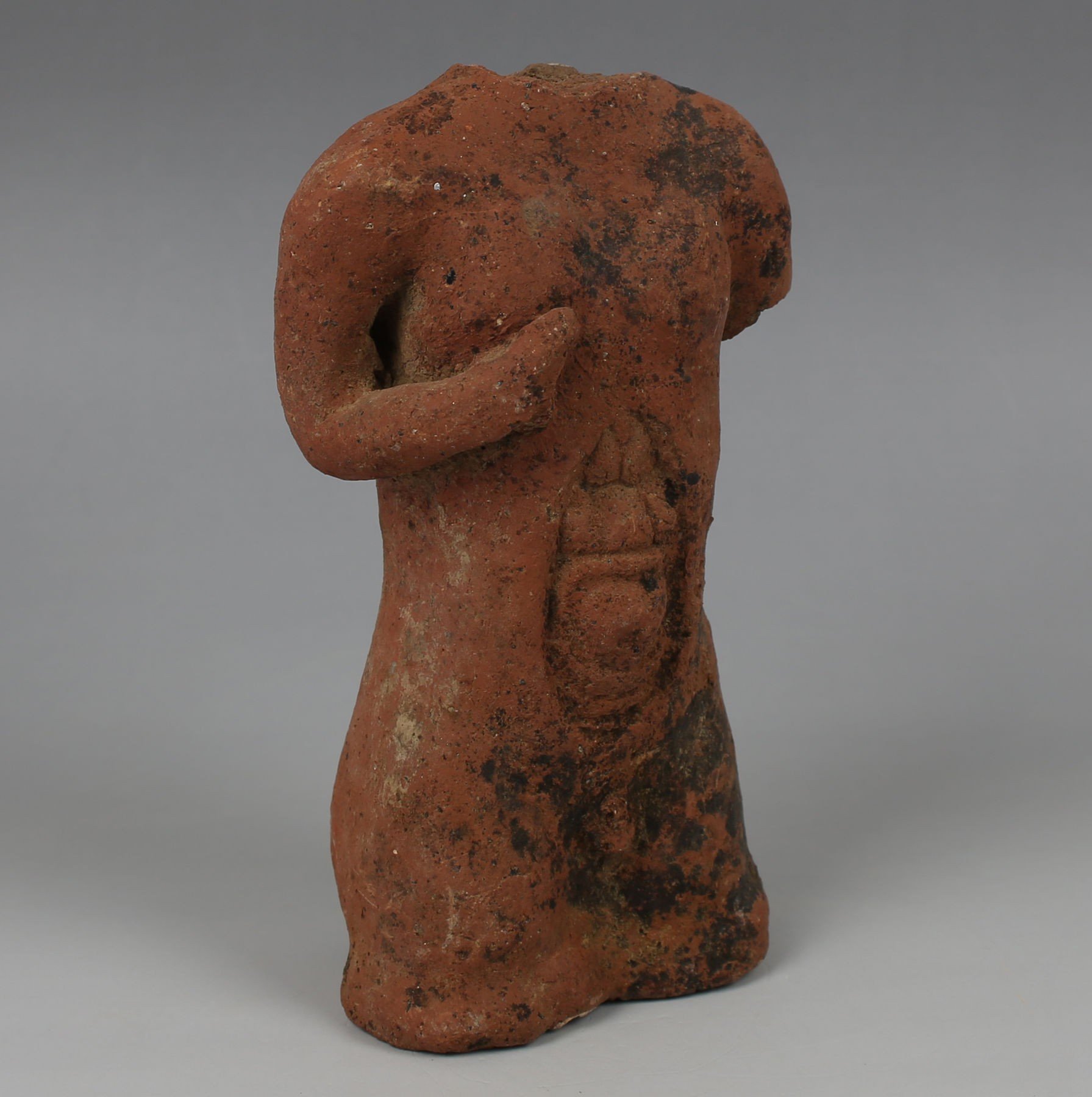
Votive fragment in reddish-orange terracotta, representing a stylised anatomical human torso, truncated at the shoulders and pelvis. The figure shows the right hand placed upon the chest, a gesture emblematic of the ex-voto, signifying self-offering.
On the abdomen, an oval raised relief can be distinguished — interpreted as a visceral or uterine representation, characteristic of Etruscan therapeutic votive offerings.
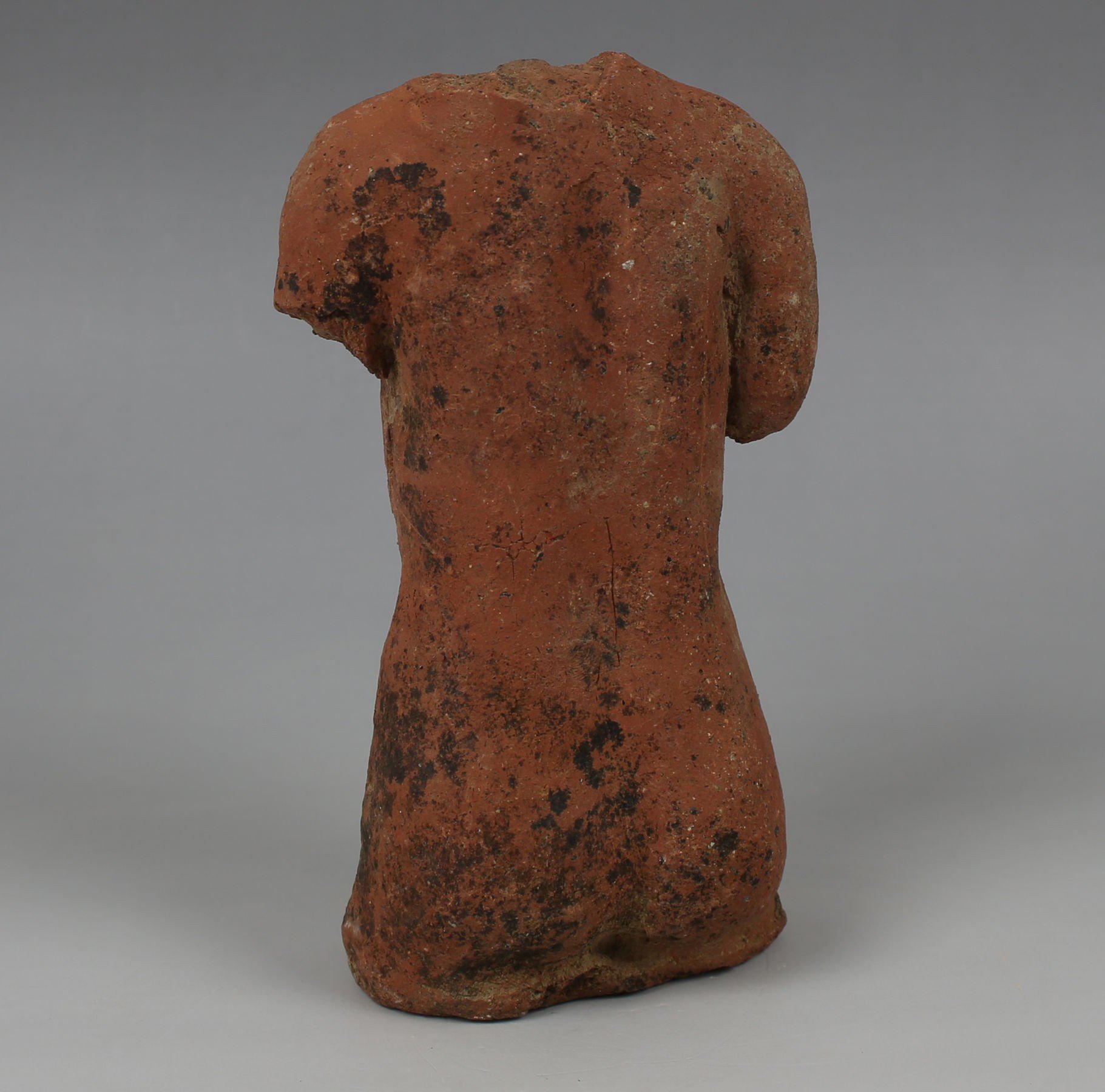
The surface is dry and matte, with irregular preservation, black oxidation zones from firing, and natural burial concretions.
No restoration; ancient fractures and abrasions with harmonious wear on the volumes, confirming absolute authenticity.
The dense clay patina, diffused manganese deposits, and visible mineral inclusions in the fabric attest to an ancient oxidising firing, typical of Central Italian workshops.
Characteristics
-
Culture / Period: Etruscan, 5th–4th century BC
-
Type: Anatomical votive model (human torso)
-
Material: Reddish-orange terracotta with fine mineral inclusions
-
Dimensions: 125 × 75 mm
-
Condition: Good; ancient fractures stabilised, consistent wear, original surface intact, no restoration
-
Provenance: Former private Belgian collection; Spanish antiquarian (2022); private collection, Brussels
-
Certificate: Certificate of authenticity issued
Historical Context
Etruscan anatomical ex-votos, which appeared as early as the 5th century BC, embody an archaic form of sacred medicine. Offered in sanctuaries such as Veii, Tarquinia, and Vulci, these models of limbs, organs, or torsos symbolised the part of the body to be healed.
Their schematic style is not simplification but symbolic codification: each sculpted element formed part of a ritual language of healing and gratitude.
This torso, with its arm position and abdominal depiction, bears witness to the corporeal liturgy of health intrinsic to Etruscan spirituality.
Formal and Material Analysis of the Specimen
The ferrous clay body exhibits a grainy texture with micaceous temper, fired in an oxidising atmosphere, showing blackened overfired zones and manganese spots indicative of prolonged burial.
The modelling is firm and geometric: high shoulders, short torso, right arm drawn inward, hand placed upon the chest, smooth back designed for flat deposition.
The oval protrusion at the lower thorax marks the anatomical zone concerned (probably visceral), functioning within a cultic context.
The absence of slip, adhesive, or modern additions confirms the archaeological integrity of the piece.
The surface exhibits a homogeneous patina, a naturally chalky aspect, and authentic ancient wear.
Alterations (abrasions, fissures, concretions) enhance rather than diminish its legibility, reinforcing its archaeological and didactic value.
Cultural Value
A museum-quality object, typical of archaic Tuscan votive deposits.
This torso embodies the tangible piety of the Etruscans, a people for whom the body was not symbol but medium of divine communication.
A rare didactic specimen, it encapsulates the religious anthropology of healing and testifies to the dialogue between medicine and cult in pre-Roman Italy.
Expert Report
Official type identification: Anatomical votive torso, terracotta, Central Italy (Etruria), 5th–4th century BC
Scientific and museum references:
-
Museo Nazionale Etrusco di Villa Giulia (Rome): Comparable anatomical ex-votos in red clay, 10–20 cm in size.
-
British Museum: Votive torso with organ relief, Central Italy, 5th century BC — same abdominal relief scheme and hand gesture.
-
Tarquinia Museum: Series of ex-votos with identical bust stylisation and uncoated surfaces.
Museum comparison analysis:
Direct formal analogies (organic oval, arm position, oxidised patina) confirm typological affiliation.
Indicative bibliography:
-
Comella, Il deposito votivo di Tarquinia (1981).
-
Phillips, Votive Offerings to Heal the Body in Etruria and Latium (2008).
-
Catalogues of Villa Giulia and Vulci — sections on ex-voto anatomici.
Expert conclusion: Authentic, coherent, and unrestored specimen, belonging to the Etruscan archaeological corpus; fabric, style, and wear fully consistent with museum examples.
Traceability & Guarantees
Provenance: clear and continuous — former private Belgian collection → Spanish antiquarian (2022) → private collection, Brussels.
The object is accompanied by its certificate of authenticity.
Shipping Time — Essential Information
A delay of 3 to 5 working days may apply before shipment, required for compiling the complete documentation file, verifying provenance and traceability, consolidating supporting documents, and scheduling insured and logistical procedures.
These operations, conducted according to current regulations governing the circulation of cultural property, condition the physical release of the piece. Shipment occurs after validation, with tracking and signature on delivery.
Legal Information
The General Terms and Conditions of Sale are available upon request or via the seller’s official channels.
Any order implies full acceptance of these terms.
Important — Regulatory Compliance
In accordance with European regulations on the export of cultural goods (Regulations (EC) No. 116/2009 and (EU) No. 2019/880), as well as the UNESCO Convention of 1970, no sales or shipments outside the European Union are conducted.
This measure, based on legal obligations of traceability and heritage protection, ensures the full compliance of our transactions.
Sales within the European Union remain fully active.
Ref: ETIKF977SZ

 English
 Français
  Italiano
  Deutsch
  Macassar Ebony 1930 Art Deco Coffee Table
2.050 € EUR
Macassar Ebony 1930 Art Deco Coffee Table
2.050 € EUR