This description has been translated and may not be completely accurate. Click here to see the original
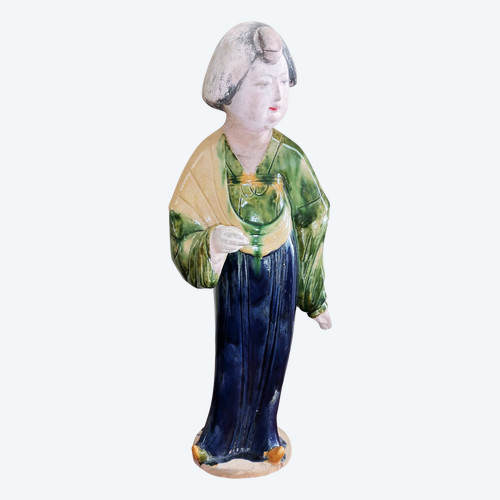
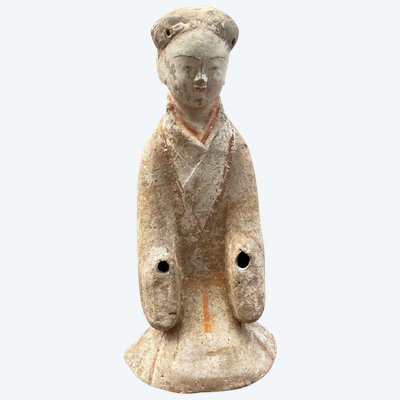
Upon careful examination, adopting a “magnified” approach and under raking light, this terracotta statuette of a Tang court lady presents itself as a very fine example of the famous funerary “Fat Ladies”: a full and compact silhouette, a hieratic yet animated bearing, a broad and serene face, dressed in a long robe with ample volumes. The object immediately stands out for the harmony of its proportions, the quality of the modeled volumes, and the softness of its expression, fully consistent with the finest types of the period.
A matte, homogeneous patina is observed, punctuated by warmer nuances in the recesses and slight abrasions on the edges (top of the hairstyle, tip of the nose, edges of the base), revealing a lighter terracotta beneath the surface layers. Traces of residual polychromy—slightly darker tonalities, remnants of ochre or reddish hues in the folds of the robe and around the face—remain lodged in the recesses, as is to be expected for a sculpture that spent a long time in a funerary context.
The restorations indicated by the seller appear visually discreet and localized: certain transitions that are slightly smoother or of barely different color on exposed areas (probably fragile extremities or small losses that were filled) suggest respectful interventions, without excessive re-modeling or invasive repainting. The ensemble retains its authenticity of reading, with a highly satisfactory balance between integrity, legibility, and the traces of time.
In this context—reinforced by a thermoluminescence (TL) test carried out by the QED laboratory, ref. QED2205/EC-0150, by the object’s old Spanish provenance, and by parallels in the collections of the National Palace Museum in Taipei—the statuette presents itself as an ancient, authentic example, of quality above the average of commonly encountered market pieces.
Characteristics
Object: Court lady statuette known as a “Fat Lady” (funerary mingqi)
Material: Terracotta (pottery)
Culture: Chinese
Period: Tang Dynasty, 618–907 AD
Dimensions: approx. 210 mm × 95 mm
State of preservation: Good overall condition; some restored areas, discreet repairs, surface generally stable with wear consistent with age
Provenance: Former Spanish private collection, assembled between 1980 and 2020
Accompanying documents:
– Certificate of authenticity
– QED Laboratory thermoluminescence test (ref. QED2205/EC-0150)
– Export license (for shipments outside the EU, where applicable)
Historical Context
Tang court lady statuettes belong to the vast repertoire of mingqi—substitute objects intended to accompany the deceased into the afterlife. Under the Tang dynasty, a period of exceptional prosperity, international openness, and artistic refinement, these figurines express the elite’s vision of elegance, rank, and comfort, both in life and in death.
The celebrated “Fat Ladies” aesthetic—full faces, deliberately rounded bodies, ample robes, and high hairstyles—breaks with the more slender ideals of other periods: roundness here becomes a sign of well-being, wealth, health, and charm. Tradition readily associates this fashion with the figure of Yang Guifei, the imperial consort whose “plump” beauty left a lasting impression on courtly imagination.
Placed in the tombs of dignitaries, these statuettes are far more than simple decorations: they embody the social universe of the deceased—musicians, dancers, servants, horsemen, court ladies—and ensure that, in the afterlife, existence continues surrounded by luxury, music, perfumes, and attendants. They also testify to the brilliant craftsmanship of Tang workshops, masters of expressive modeling, delicate polychromy, and, at times, sancai glazes.
Examples preserved in major museums—including those of the National Palace Museum in Taipei (object nos. 000550N000000000 and 000434N000000000, cited here for comparison)—demonstrate how central this iconographic type was in Tang funerary imagination. Our statuette fully belongs to this prestigious corpus.
Formal and Material Analysis of the Example
1. Silhouette and Posture
The figure is depicted standing, in a calm verticality, on a small rectangular base with gently softened corners. The body is drawn toward the central axis, with a stable center of gravity, reinforcing the impression of serene presence. The silhouette is deliberately compact and full:
– A relatively large head in proportion to the bust, recalling the Tang ideal of a round face.
– Soft, barely marked shoulders, absorbed into the volumes of the robe.
– A compact torso, without realistic anatomical emphasis, faithful to the “iconic” aesthetics of mingqi.
– A long robe descending to the feet, which are only faintly suggested at the base, creating the effect of a continuous, almost architectural volume.
The hands are brought toward the front of the body (or crossed against the bust, depending on the precise variant considered), in a contained, reserved gesture typical of court ladies: nothing theatrical, but an elegant restraint, perfectly suited to funerary function.
2. Head, Face, and Hairstyle
The face is one of the strongest points of the piece:
– Rounded face, full cheeks, soft chin: roundness dominates, without angular interruptions.
– Finely defined nose, slightly projecting but softened by wear; under raking light, small abrasions at the tip are visible, consistent with the natural fragility of the area.
– Almond-shaped eyes, low in relief, with eyelids incised or modeled in slight projection; a darker patina in the recesses subtly accentuates the gaze.
– Small mouth, lightly outlined, set low on the face, with corners softened by time.
The hairstyle, voluminous, is a defining element: a high, structured mass with rounded volumes, framing or surmounting the skull. Under oblique light, one perceives:
– Initially sharp modeling lines, now slightly softened by wear;
– A few micro-chips on the most projecting edges of the hairstyle, without compromising the reading of the profile;
– Remnants of darker tonality in certain recesses, suggesting an earlier pigment highlight on the hair.
3. Robe and Treatment of Drapery
The long enveloping robe is treated in large smooth planes, rhythmically structured by vertical and oblique folds:
– The folds are shallow but clearly defined—particularly visible when light comes from the side, with ridges appearing lighter and recesses remaining darker.
– Regular abrasion on the edges of the folds reveals lighter clay beneath, while some recesses retain warmer or slightly ochre hues, indicating former polychromy.
– The base of the robe, at ground level, shows a few small old chips and “polished” wear on the edges of the base, fully compatible with long burial and subsequent handling in collections.
4. Surface, Patina, and Restorations
The entire surface displays:
– A matte patina, slightly granular in places, with smoother zones on the most exposed reliefs;
– Very fine micro-shrinkage cracks in the superficial layer, visible under visual magnification, typical of ancient terracottas;
– Gradual, non-patchy discolorations, arguing for natural aging.
The declared restorations are consistent with what the eye perceives:
– Slightly more homogeneous color transitions on certain exposed zones (probable filling of small losses);
– Absence of thick overbuilds, glossy fillers, or repainting covering large areas;
– Overall reading of the piece remains fluid, indicating respectful interventions aimed at stabilization rather than concealment.
Cultural and Aesthetic Value
This statuette brings together several highly sought-after qualities:
Historical value: A direct testimony to the feminine ideal and courtly codes under the Tang dynasty, expressed through rounded silhouette, restrained posture, and high hairstyle.
Aesthetic value: Balance of volumes, softness of the face, calm verticality; even without vivid polychromy, the piece possesses a strong visual presence, very elegant in display.
Documentary value: As a mingqi, it informs us about the composition of Tang funerary processions and how the elite envisioned their continuation in the afterlife.
Collecting value: The combination of old provenance + QED TL test + explicitly referenced museum parallels places this piece in a category of immediate interest for collectors of Chinese art or Asian art cabinets.
Traceability & Guarantees
Provenance:
Former Spanish private collection, assembled between 1980 and 2020.
Documents provided:
– Certificate of authenticity
– QED Laboratory thermoluminescence test, ref. QED2205/EC-0150
– Export license for shipments outside the European Union (if required)
This combination—clearly dated old provenance, scientific TL testing, and museum references—offers a level of security and seriousness fully aligned with the expectations of discerning buyers on a platform such as Antikeo.
Expert Report
Authenticity:
Stylistic characteristics, patina, quality of modeling, nature of the terracotta, overall coherence with Tang types, combined with the presence of a QED thermoluminescence test, allow the statuette to be presented as authentic with a solid degree of confidence.
Dating:
Attributed to the Tang dynasty (618–907 AD), in agreement with the iconographic type, the Taipei museum parallels, and the accompanying scientific documentation.
State of preservation:
Good condition; some partial restorations of a consolidating and discreet nature, patinated and stable surface, wear consistent with age.
Interest:
A piece of high historical and decorative interest, highly representative of Tang “Fat Lady” iconography, with museum-level potential due to its institutional parallels and documented traceability.
Detailed Expert Report
Iconographic analysis immediately relates the example to Tang court lady statuettes preserved in major public collections, notably the National Palace Museum in Taipei (nos. 000550N000000000 and 000434N000000000 cited by the seller). One finds:
– The same tendency toward compact volumes,
– The same emphasis on facial roundness,
– The same stylized approach to drapery in large vertical planes,
– A high, structured hairstyle forming an integral part of the represented social status.
On the material level, the terracotta shows a fine to medium texture, without coarse inclusions, attesting to careful workshop production. Firing produced a homogeneous ceramic body, whose base color emerges in abraded zones, while the surface retains warmer nuances in recesses—likely traces of ancient polychromy. Erosion phenomena are logically positioned: exposed edges, top of the hairstyle, edges of the base.
The thermoluminescence test conducted by the QED laboratory (ref. QED2205/EC-0150), a specialized institution, adds a further scientific argument in favor of the object’s antiquity. Even without detailing the numerical data of the report here, the simple fact that TL testing is cited and included significantly strengthens the object’s credibility on the international market.
The ownership history—a Spanish private collection assembled between 1980 and 2020—provides the statuette with several decades of circulation, a valuable element in a context where traceability of archaeological artworks has become a major criterion.
Accepted Payment Methods
The following payment methods are accepted:
– Cheque: the shipment of the object will be carried out only after the cheque has been fully cleared.
– Bank transfer: our bank details will be provided once your choice of payment has been confirmed.
– Credit card: a secure payment link will be sent to you to complete the transaction safely.
Please send us a message indicating the chosen method of payment so that we may provide the necessary information and organize the next steps of the transaction.
Ref: VKXXMJ0FBL

 English
 Français
  Italiano
  Deutsch
  Powder or tobacco pear in Boxwood. XIXth Asia.
150 € EUR
Powder or tobacco pear in Boxwood. XIXth Asia.
150 € EUR