This description has been translated and may not be completely accurate. Click here to see the original
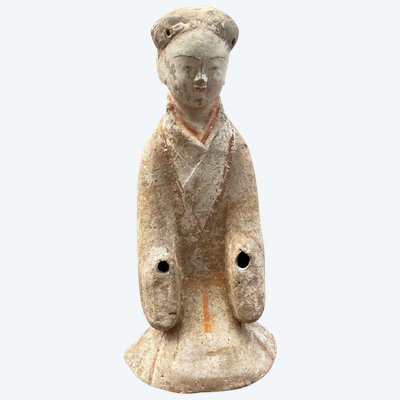
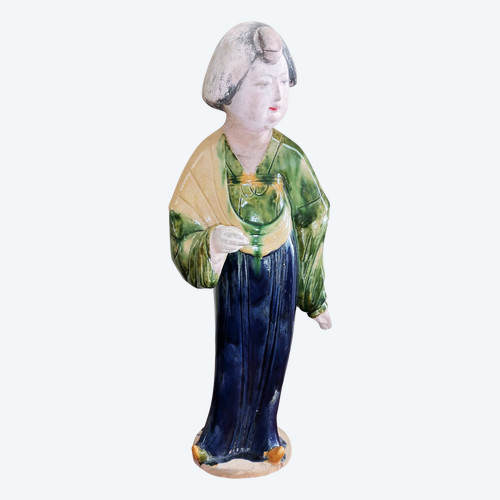
Elegant funerary figurine of a Tang dynasty court lady (仕女俑), modelled in grey-reddish earthenware, coated with a white slip and decorated with polychromy. Authentic pigment traces remain visible: pink on the cheeks and lips, black for the eyes, green residues on the sleeves, and a dark band marking the waist. The high coiffure with frontal volume, ending in a lateral scroll above the right side, is characteristic of the second half of the 8th century. The crossed hands, hidden beneath long, incised sleeves, reinforce the impression of courtly restraint. The surface displays a uniform burial patina, with oxidation abrasions and ancient micro-flakings enhancing its authenticity; no lead glaze is present, confirming paint on slip rather than sancai glazing.
The piece exhibits excellent structural stability with no modern restoration detected; the integrated low base, irregularly rectangular, is consistent with a funerary deposit. Authenticity verified by thermoluminescence analysis QED (ref. QED1211/FC-0204), confirming an ancient firing from the Tang period.
Characteristics
-
Culture / Period: China, Tang dynasty, 618–907 CE (stylistic language of the 8th century)
-
Material / Technique: modelled terracotta with white slip and polychromy (red/green/black), unglazed; incised folds; visible brushstrokes.
-
Dimensions: H. 303 mm × L. 110 mm × D. 83 mm.
-
Condition: good and coherent; regular archaeological wear, small losses of slip and pigment, light edge chipping at the base—sought-after marks of age.
-
Provenance: former private French collection (Toulouse), acquired in the 1980s.
-
Tests & Documentation: QED thermoluminescence report (ref. QED1211/FC-0204) included.
Historical Context
During the Tang dynasty, figurines of court ladies were part of the mingqi deposited in tombs to provide comfort and social rank to the deceased. The Tang aesthetic, influenced by the cosmopolitan culture of Chang’an, favoured full faces, high-waisted flowing robes, and elaborate coiffures.
The surviving polychromies, now softened by time, once animated these delicate presences and testify to the refinement of Tang funerary workshops.
Formal and Material Analysis of the Specimen
-
Morphology: standing lady with hands concealed within voluminous sleeves; long robe falling in softly incised pleats; waist marked by a dark pigment ring.
-
Head & Coiffure: full oval face, elongated black-lined eyes, rosy cheeks; high coiffure with a lateral scroll (volute)—an emblematic Tang motif.
-
Surface texture: ancient white slip with fine crackling and characteristic micro-lifting; green and red pigment traces well integrated into the patina.
-
Base & structure: one-piece rectangular base, irregular and authentic, with visible tooling marks, confirming an original, unaltered modelling.
-
Integrity: no apparent restoration; wear and pigment loss consistent with long burial in a dry environment—documentary qualities reinforcing authenticity.
Cultural Value
A museum-grade example of the Tang court lady typology, combining elegance, readable polychromy, prestigious coiffure, and documented provenance. The presence of a named TL test secures the authenticity of acquisition.
A reference piece for any collection devoted to Chinese historical art.
Expert Identification (Museum Nomenclature)
Painted pottery figure of a standing lady / 灰陶加彩仕女俑 — terracotta court lady with white slip and red/green/black pigments, hands concealed under sleeves, long robe, and elevated coiffure.
Scientific and Museum References
-
National Palace Museum, Taipei: two comparable figurines (贈瓷000434 and 贈瓷000550), described with grey paste, white slip, red/green/black pigments, concealed hands, and high coiffure — direct material and iconographic concordance.
-
Palace Museum, Beijing (故宫博物院): 陶仕女俑, H. 36.6 cm — nearly identical morphology (high-waisted robe, hands under sleeves, elevated coiffure).
-
Metropolitan Museum of Art, New York: several Standing/Court Lady, Tang, 7th–8th c. — international corpus confirming both date and typology.
Comparative Analysis
The voluted coiffure, marked waist, paint on slip, and reserved posture of this specimen align perfectly with the technical descriptions and photographic typologies published by these institutions. The residual polychromy (pink/green/black) and absence of glaze relate it particularly to NPM Taipei 000434.
Dating & Attribution
According to the stylistic and technical criteria of the aforementioned references, the specimen belongs to the 8th century (Tang dynasty).
Scientific verification: QED thermoluminescence test (ref. QED1211/FC-0204) confirming ancient firing, results consistent with attribution.
Indicative Bibliography
-
National Palace Museum, Taipei: Painted pottery figure of a standing lady / 灰陶加彩仕女俑.
-
Palace Museum, Beijing: 仕女俑 collection records.
-
The Metropolitan Museum of Art: Standing / Court Lady, Tang.
Provenance & Guarantees
-
Provenance: former private French collection (Toulouse), acquired in the 1980s.
-
Attached documents: QED thermoluminescence test (ref. QED1211/FC-0204).
-
Certificate of authenticity included.
Shipping Time — Essential Information
A delay of 3 to 5 working days may apply before shipment, required for compiling the full documentation, verifying provenance, consolidating supporting documents, and scheduling insured and logistical operations. Shipment takes place after all validations, with tracking and signature upon delivery.
Legal Information
The General Terms and Conditions of Sale are available upon request or via the seller’s official platforms. Any order implies full acceptance of these conditions.
Ref: AVOFKKHDBK

 English
 Français
  Italiano
  Deutsch
  Louis XVI secretary
5.800 € EUR
Louis XVI secretary
5.800 € EUR