This description has been translated and may not be completely accurate. Click here to see the original
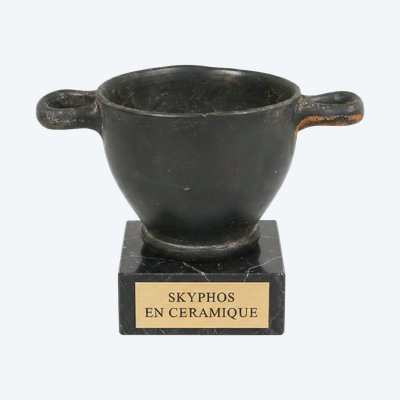
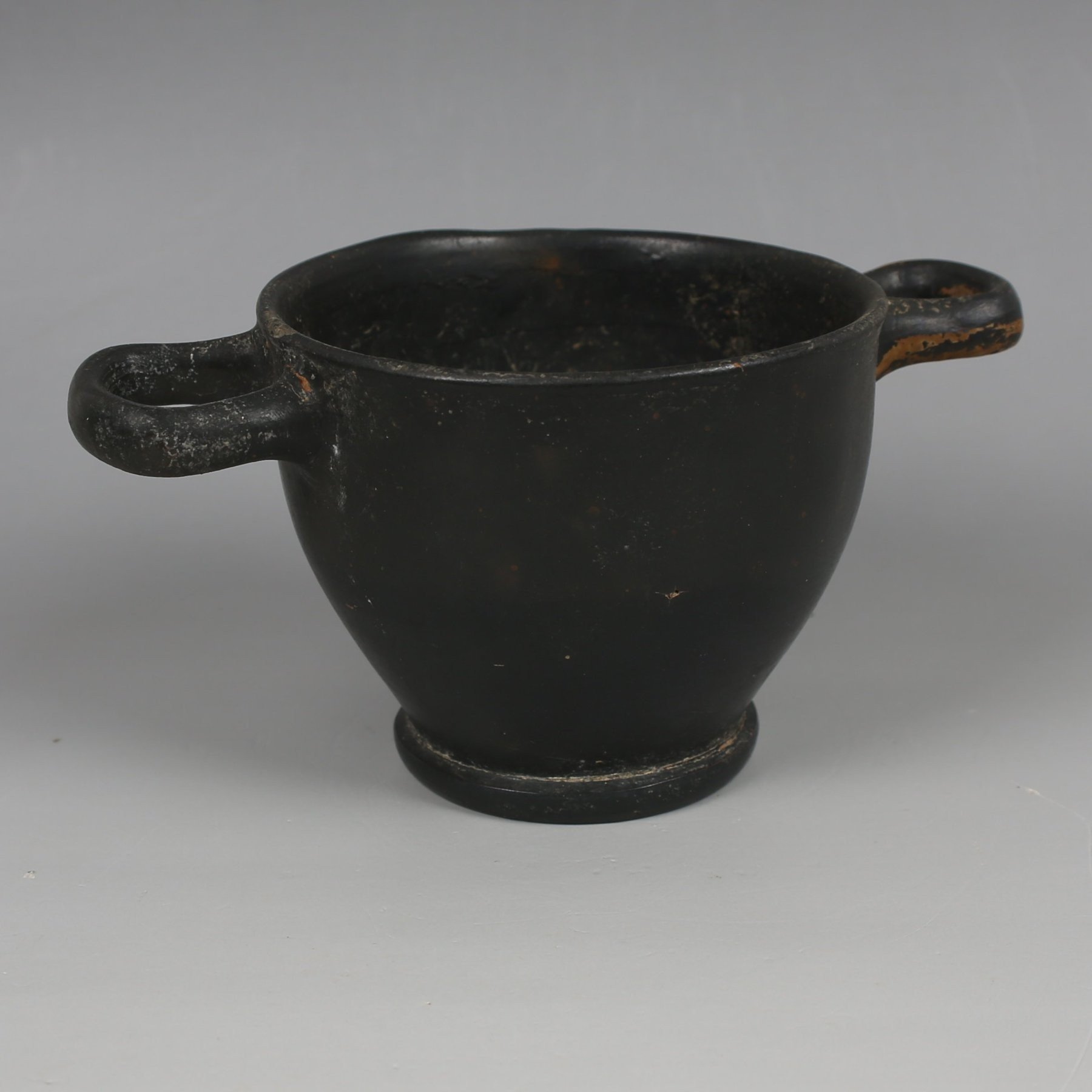
Originating from an old European private collection, with an explicitly established chain of provenance (formerly ALARA S.P.R.L., 1976; former F.K. collection, 1972–1976) and accompanied by a certificate of authenticity, this Greek skyphos of the 4th century BC presents itself—upon attentive examination of views from multiple angles—as a profoundly classical form through the balance of its proportions, the continuity of its body, and the stability of its ring foot.
The black glaze, more satin than mirror-like, is traversed by a patina of use whose rubbings, micro-chips, and occasional revelations of the clay body—particularly visible at the ends of the handles and along contact edges—constitute less “defects” than the noble marks of an ancient life that is coherent, legible, and typologically convincing.
Technical Characteristics
– Object: Skyphos
– Culture: Greek
– Period: 4th century BC
– Material: Pottery, black glaze with satin-black patina and reddish-brown clay showing through in places
– Dimensions: 70 × 140 mm
– Condition: Good condition; harmonious preservation with coherent usage wear, micro-chips, and contact abrasions
– Provenance: Former European private collection; formerly ALARA S.P.R.L (1976); former F.K. collection, 1972–1976
– Authenticity: Certificate provided
– Sale: Specialized European auction, under expert supervision
Historical Context
The skyphos belongs to those forms which, in the Greek world, accompanied social life with almost institutional obviousness, as it simultaneously met the requirements of handling, the depth necessary for wine mixed with water, and the civility of shared drinking during the symposium—where the object became the material accomplice of conversation and intellect.
In the 4th century BC, the taste for black glaze reflects an aesthetic of learned refinement, preferring to figurative narration the authority of a mastered surface, whose restrained sheen and clarity of profile alone suffice to produce formal dignity.
Formal and Material Analysis of the Example
– Volume and Profile: Deep bowl with broadly rounded body, narrowing regularly toward the base; the transition to the foot occurs without abrupt break, indicating attentive wheel work concerned with continuity of planes and overall balance.
– Lip and Opening: Slightly thickened and softened rim, visible from all views, showing fine wear along the upper edge, with small discreet micro-chips that, far from impairing legibility, emphasize the contact line and antiquity of use.
– Handles: Two robust horizontal handles set high on the shoulder; one shows, on its outer face toward the extremity, a more marked granular abrasion where the orange-brown clay appears in clear patches, while the other presents a more powdery patina with light deposits and diffuse abrasion—entirely compatible with repeated handling and points of impact.
– Surface and Glaze: Satin black glaze, homogeneous in coverage, animated by micro-scratches, small pits, and minor losses along edges; the distribution of these alterations follows a logic of contact (handles, foot perimeter, rim), reinforcing material coherence and avoiding the impression of an artificially “too new” surface.
– Interior: Inner bowl more matte, punctuated by traces of deposits and fine mineral dust, visible in close views, whose presence constitutes a frequent indication of long repose and of an object not visually “reconstructed.”
– Foot and Base: Stable ring foot, showing circular rubbing along the lower edge and continuous contact wear—particularly telling detail, as it records repeated interaction with supporting surfaces and thus the truth of ancient use.
– Typological Coherence: Proportions (70 × 140 mm), bowl depth, horizontal handles, and ring foot correspond to the canonical definition of the skyphos; the choice of black glaze without figural decoration fully accords with later Classical productions in which form, rather than image, becomes the principal argument.
– Traceability: The stated provenance, articulated together with a certificate of authenticity, provides a reassuring documentary framework, supporting continuity of collection and security of attribution.
Cultural Value
Through the masterful sobriety of its black glaze, the expressive solidity of its handles, and the quiet stability of its ring foot, this skyphos condenses an anthropology of the Greek gesture—drinking, conversing, instituting sociability—and makes of its very wear a form of eloquence.
The abrasions, exposed clay, and internal deposits are not degradations to excuse, but indices to be read, granting the object that superior quality sought by demanding connoisseurs: the intimate accord between typology, material, and time.
NB: The stands, frames, and presentation elements visible in the photographs are exclusively intended for display purposes and are not included in the sale.
Ref: T0KG185Q7G

 English
 Français
  Italiano
  Deutsch
  Napoleon marble inkwell, 19th century
450 € EUR
Napoleon marble inkwell, 19th century
450 € EUR