This description has been translated and may not be completely accurate. Click here to see the original
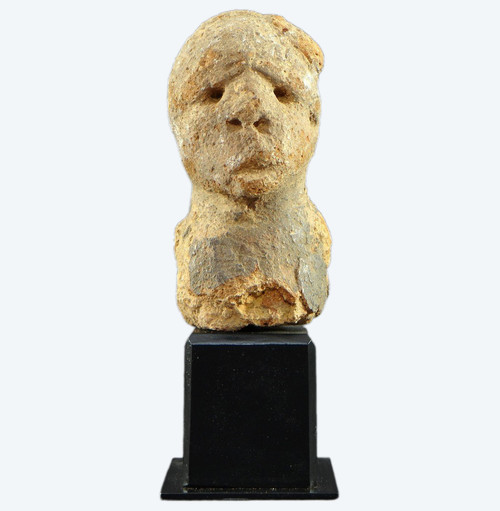
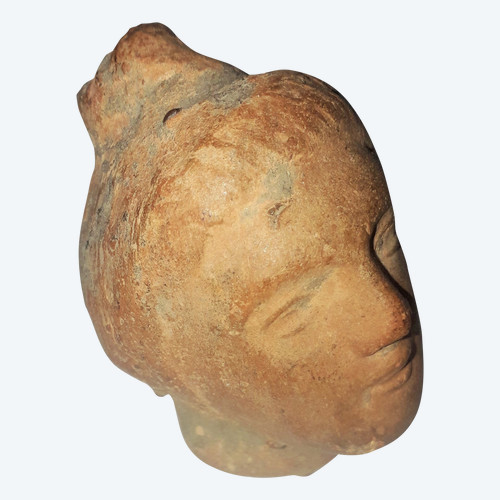
Female terracotta head from the Classical–Hellenistic Greek tradition, bearing a sober and assured presence. The modelling immediately establishes the oval of the face, the soft nasal line, the rounded cheeks, and a cap-like hairstyle where a discreet frontal band emerges. The honey-ochre patina, uniform over centuries, is enlivened by mineral veils and slight ferrous speckling: a continuous archaeological skin that enhances the volumes and seals its antiquity. The neck shows an ancient compositional break — an original and stabilized limit — conferring to the fragment an autonomous presentation much sought after by collectors.
Close examination confirms typological and workshop coherence: fine slightly sandy clay with rare micaceous inclusions, finishing smoothings still visible on the facial planes, and age-consistent softenings that enrich the plastic reading. The piece embodies an intense yet restrained effigy, consistent with Greek votive and funerary practice.
Technical Characteristics
– Object: votive/funerary female head, autonomous fragment
– Civilisation: Ancient Greece, Mycenaean and Hellenistic tradition
– Dating: 4th – 2nd century BC
– Material: fine terracotta, honey-ochre patina with mineral nuances
– Dimensions: 50 × 23 mm
– Condition: harmonious conservation; surface matured with time, ancient stabilized limits at the neck, clear volumetric reading
– Workshop technique: moulding with modelling rework and final smoothings
– Provenance: old English private collection (1980s–1990s)
– Authenticity: certificate provided by Galerie Antikarts
– Traceability: provenance documented in the official certificate, ensuring typological coherence and security of acquisition
– Sale: European specialized auction, under expert control
Historical Context
In Ancient Greece, terracotta figures were the discreet messengers of the sacred: they populated sanctuaries, homes, and tombs. Female heads, embodying harmony and piety, served as intercessors — both protective presences and signs of devotion. Classical and Hellenistic aesthetics favoured mastered stylisation: clear volumes, serene features, structured hair — a language that endured across centuries.
Formal and Material Analysis of the Piece
– Volumetry: regular oval, full cheeks, soft chin; continuous progression towards the nape.
– Hairstyle: cap-like arrangement with discrete frontal band, clearly legible frontally and in profile.
– Surface & patina: homogeneous ochre modulated by mineral veils; micro-concretions accentuating reliefs.
– Clay & firing: fine-grained body, well-fired, with stable chromatic range.
– Workshop gesture: smoothing striations and local modelling rework preserve the artisan’s hand.
– Ancient limits: original break at the neck, stable and clear — prized in collection and museum mounting.
Cultural Value
Through the clarity of its modelling, the nobility of its patina, and its typological precision, this female head epitomises Greek votive aesthetics: a protective presence, memory of artisan gesture, and symbolic strength. A secure addition to any classical archaeology collection, it offers a direct link to the religious and domestic imagination of the Greek world.
Secure Shipping
All our objects are carefully packaged in reinforced parcels, shipped via Colissimo or Chronopost with delivery against signature, and fully insured. Each shipment thus benefits from precise tracking, optimal protection, and maximum security — a guarantee of seriousness and trust from Antikarts to its clients.
NB: Stands, frames, and display elements visible in the photographs are exclusively intended for staging and are not included in the sale.
Ref: C39XEO0JQJ

 English
 Français
  Italiano
  Deutsch
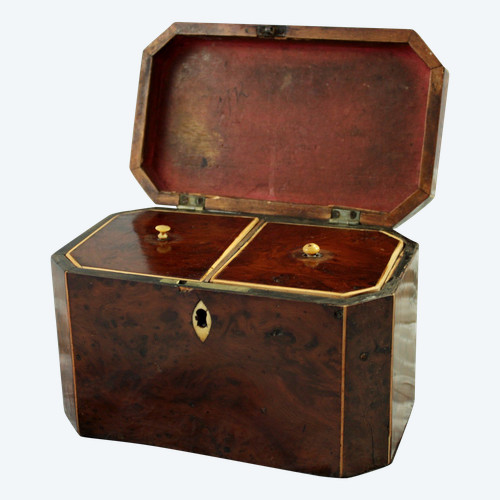
  19th century mahogany burr veneer box
160 € EUR
19th century mahogany burr veneer box
160 € EUR