












Would you like more images?


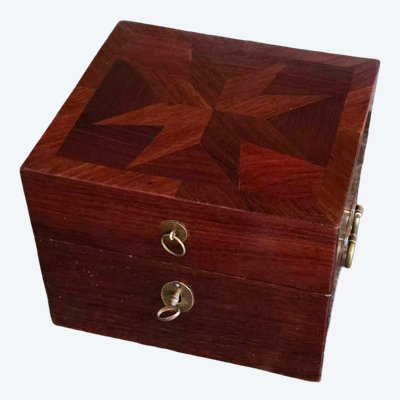
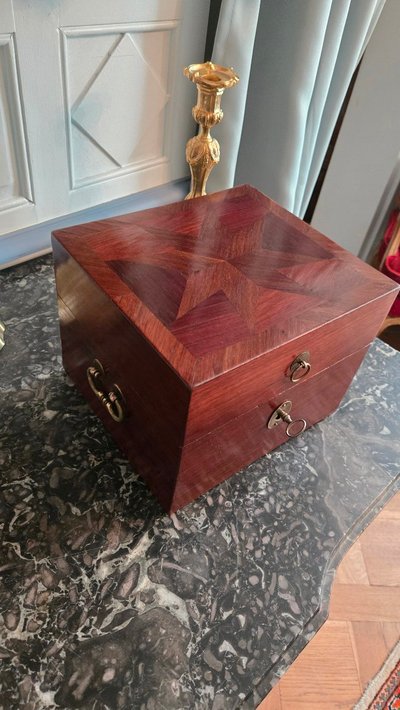
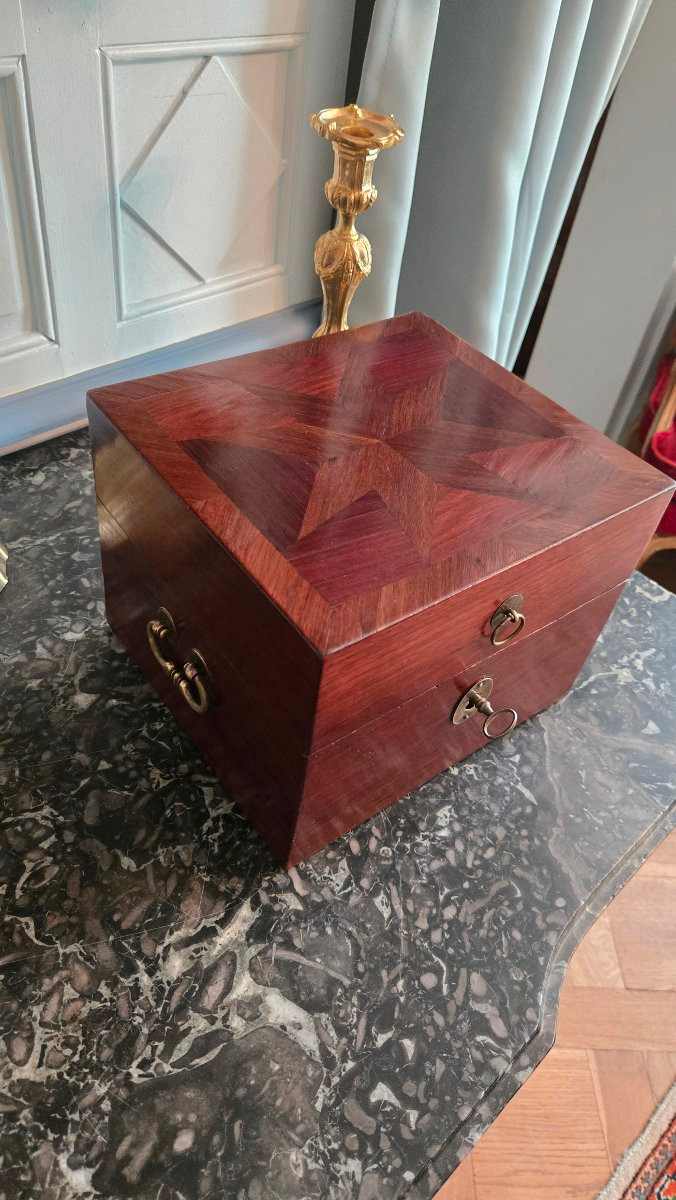
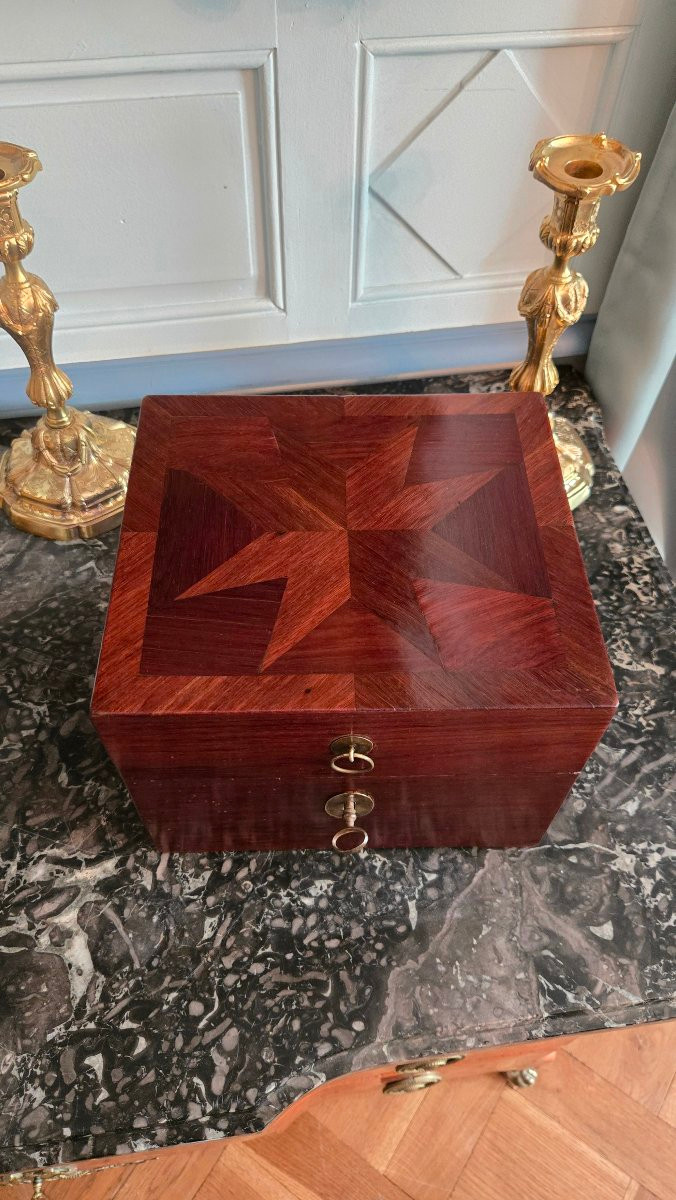
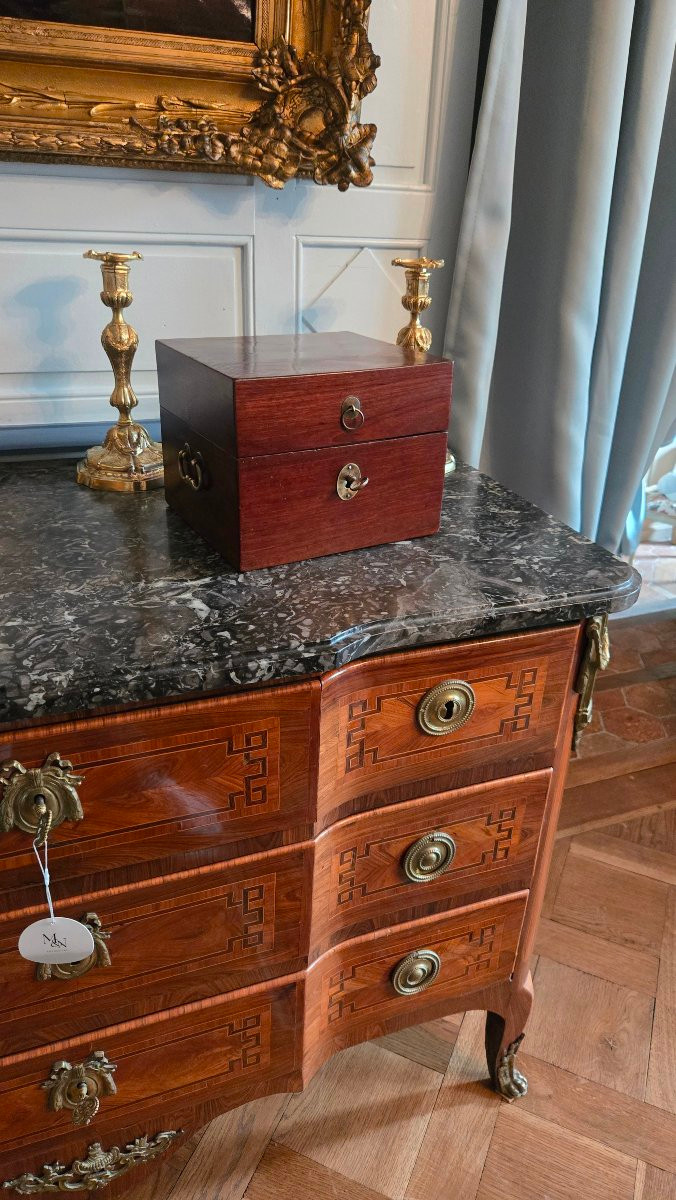
A nearly cubic box, built on an oak frame entirely veneered with amaranth, Parisian work from the Regency period, circa 1720-1730.
The box features a subtly applied amaranth veneer on its various sides, while the lid is decorated with a geometric frieze pattern arranged around an eight-pointed star.
This composition is crafted entirely from a single wood. The decoration is achieved by cutting and alternating the orientation of the amaranth leaves: the changes in the grain direction create variations in the wood's sheen and tones, allowing the star and the surrounding geometric compartments to emerge without the need for a second veneer.
The exclusive use of amaranth is one of the interesting features of this box. This exotic wood was particularly popular in Parisian cabinetmaking during the Regency and the early years of Louis XV's reign, especially for frieze decoration.
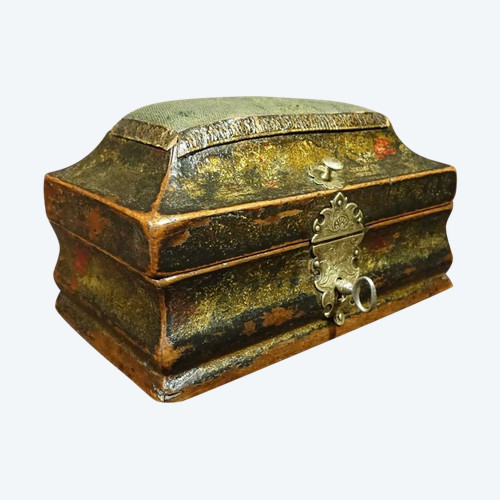
The two sides are fitted with movable brass carrying handles, attached to small rosettes. On the front, the lid has a small movable brass ring for lifting it. Beneath this ring is the brass keyhole.
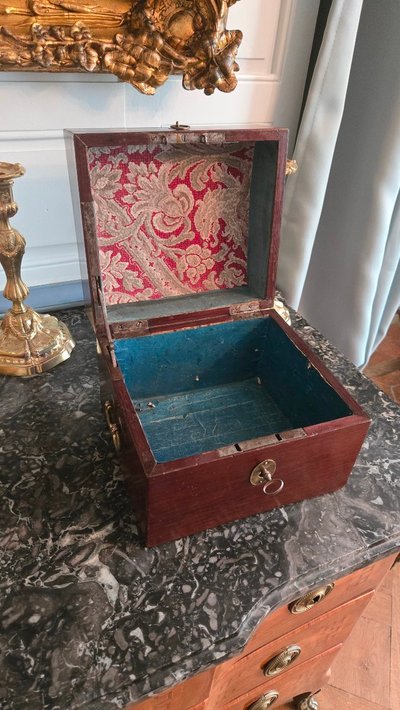
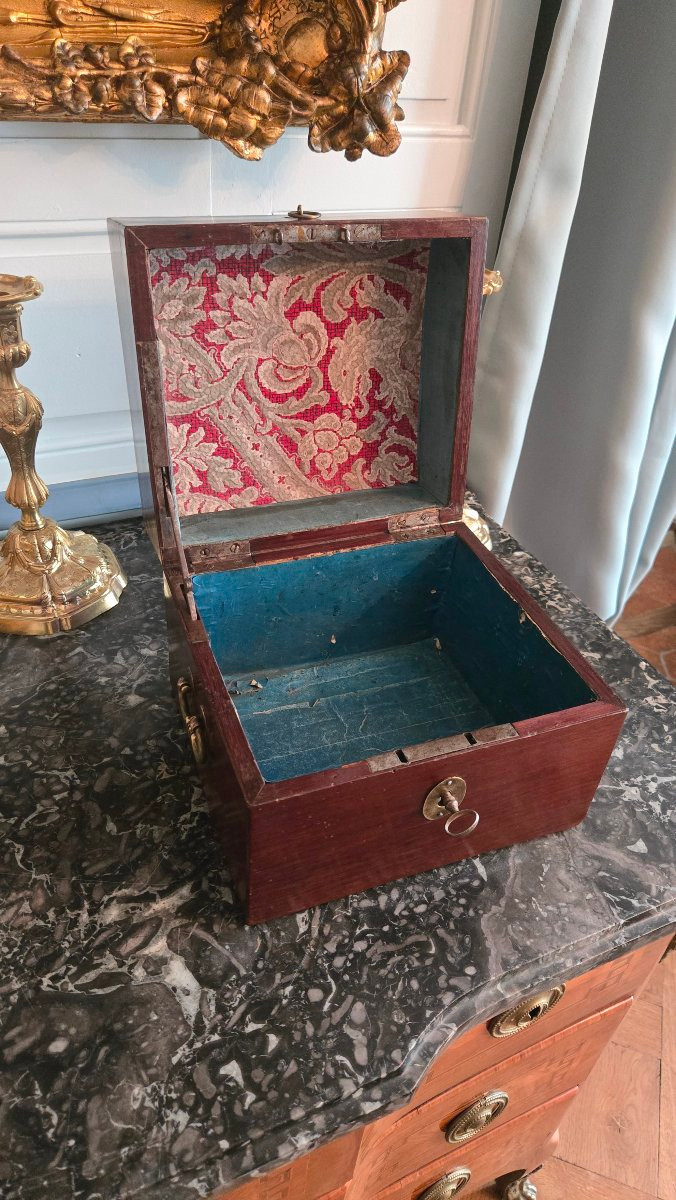
The box retains its original iron lock and key; the lock is in working order. The lid is hinged with its original hinges, which still have their original screws. Its original iron stay is also present and holds the lid open.
The interior now offers a large open space, lined with an old blue fabric. The underside of the lid also retains an old fabric lining decorated with foliate scrolls on a red background.
Given its proportions, depth, two side carrying handles, and lined interior, this box was likely intended to hold a dressing table set. Its original interior fittings, probably consisting of compartments or spaces adapted for different items, are no longer present. Without this arrangement, it is no longer possible to determine its precise purpose: toiletry kit, perfume case, beverage case, or other set of accessories.
The typology can be compared to the dressing cases made in Paris during the first decades of the 18th century. The Louvre Museum notably holds the dressing case of Queen Marie Leszczynska, dated around 1729-1730, comprising twenty-eight pieces intended for coffee, tea, and chocolate, and whose container is described as an oak case veneered with amaranth.
This similarity, through the combination of an oak frame and amaranth veneer from a similar period, constitutes an interesting point of technical and chronological comparison, without, however, allowing us to attribute the present case to a specific workshop.
The case shows some signs of use and very minor repairs to the veneer. It has been cleaned and polished in our workshop.
H. 19.5 × L. 25 × D. 22.5 cm
Ref: KOTQ4MOO76
| Condition | Very good |
| Style | Regency style (Boxes, Cases, Kits of Regency style Style) |
| Period | 18th century (Boxes, Cases, Kits 18th century) |
| Country of origin | France |
| Shipping Time | Ready to ship in 4-7 Business Days |
| Location | 89260, La chapelle sur oreuse, France |
4 commitments to buy with confidence

 English
 Français
  Italiano
  Deutsch