This description has been translated and may not be completely accurate. Click here to see the original
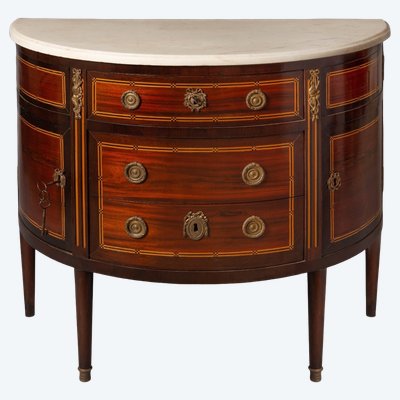
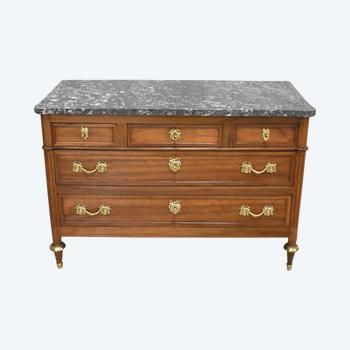
An elegant half-moon shaped commode, opening with three doors, the central door being wider than the two side doors. The front is punctuated by four slightly projecting uprights that harmoniously structure the piece and reinforce its architectural character.
The commode rests on four tapered legs ending in bronze sabots and is topped with an antique marble slab decorated with breccia, the shape and back edge of which suggest an 18th-century provenance. It is very likely that this antique marble was reused in the cabinet's construction, a practice frequently described by André Mailfert in his memoirs.
The front and sides are entirely covered with a remarkable black varnish inspired by Far Eastern lacquer. The panels are decorated with chinoiserie scenes executed in reddish-brown and golden tones. The main decoration depicts an interior rendered in perspective, with a checkerboard floor receding towards a central point—a composition reminiscent of certain perspective marquetry panels found on furniture from the late reign of Louis XV and the early reign of Louis XVI. This pursuit of depth and spatial illusion is one of the most appealing aspects of the piece.
The entire decoration displays a particularly convincing patina. The varnish has been applied to evoke an old lacquer that has survived the centuries, with its wear, repairs, transparencies, and successive alterations. This complex surface, rich in nuances and depth, creates the visual effect of a piece of furniture preserved for over two centuries. Here we find the aging and patination techniques described by André Mailfert in his book, *Au Pays des Antiquaires* (In the Land of Antique Dealers), where he explains the use of antique materials combined with extensive finishing work designed to recreate the appearance of time.
The bronze ornamentation is complete: drops decorated with foliate trophies, keyhole escutcheons, sabots, and a central corbel. The locks are functional and come with their keys.
The frame reveals a particularly interesting construction. It is made entirely of old wood, clearly from various repurposed materials. All the elements show traces of hand tools, with antique surfaces and natural patinas. The back panels, made of old walnut, appear to have come from dismantled furniture, probably components of 19th-century roll-top beds. Far from being artificially aged, this wood possesses a material authenticity that perfectly matches the methods used by Mailfert in his early years of production.
The piece bears a stamp "POPSEL," referring to Jean Popsel, an 18th-century Parisian cabinetmaker. This stamp should, of course, be considered apocryphal. Its use is in keeping with the tradition of pieces produced in the 18th-century style at the beginning of the 20th century, a practice whose mechanisms André Mailfert himself described at length in his memoirs.
The combination of observed characteristics—exclusive use of antique woods, reuse of elements from earlier furniture, repurposed antique marble, an apocryphal stamp, construction based on 18th-century principles, quality of execution, and particularly elaborate patina work—leads us to associate this commode with the early pieces produced in André Mailfert's workshops in the 1920s, before the period of more standardized manufacturing.
An old sales label from the office of Maître Pierre Cornette de Saint-Cyr, preserved on the back, further attests to its earlier appearance on the Parisian art market in the 1960s.
The piece comes from a private collection where it remained for several decades.
More than just a Louis XVI style copy, this commode stands today as a particularly interesting testament to the history of taste, the art market, and the manufacturing methods developed by one of the most singular figures in 20th-century French cabinetmaking.
Dimensions:
Height: 88 cm
Width: 98 cm
Depth: 44 cm
Ref: 6U97V5Q4LB

 English
 Français
  Italiano
  Deutsch
  Oak sideboard, 1950
1.100 € EUR
Oak sideboard, 1950
1.100 € EUR