This description has been translated and may not be completely accurate. Click here to see the original
JAPAN - Early Edo period (17th century)
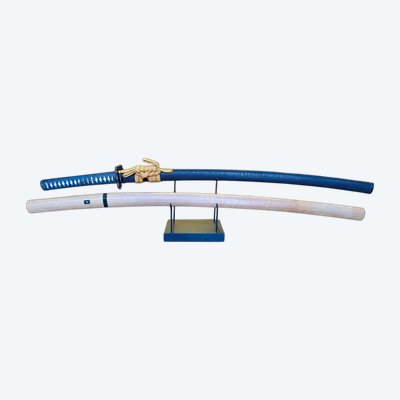
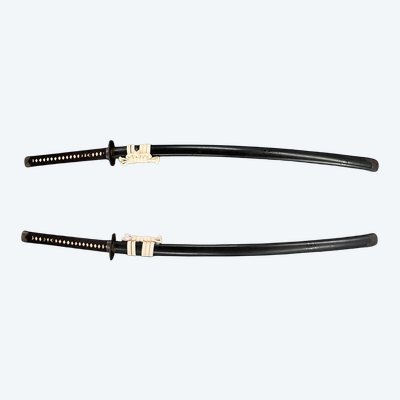
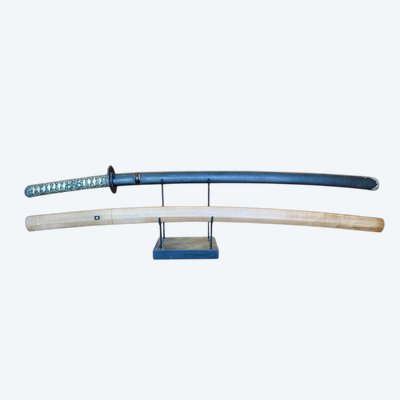
Samurai katana.
KASHIRA made of black-lacquered metal.
FUCHI made of engraved, patinated, and gilded copper, depicting a chilling on a nanako background.
Wooden TSUKA covered with stingray skin and braided with blue silk.
Chiseled copper MENUKI depicting a coiled dragon.
Forged iron TSUBA in the kaku-maru-gatta style with dragon decoration
SAYA made of wood covered with glossy black lacquer and decorated with a dragon motif
HABAKI made of copper covered with a silver leaf pattern of oblique striations.
Straight blade, regular, straight, and well-defined hamon; the tang has three perforations; signed KUNISHIGE (山城大掾源国重). He was the most prolific swordsmith at the beginning of the Edo period (mid-16th century). Yamashiro Daijyo is the honorary title bestowed upon this swordsmith in the second year of the Shoho era (1646). He was the younger brother of Otsuki Yogoro Kunishige (third-generation Kunishige), the most respected swordsmith of the Mizuta school, located in Bitchu Province (present-day Okayama Prefecture). Yamato Daijyo Kunishige’s real name was Ichizo. He also forged swords in the city of Edo alongside his son, the second-generation Yamashiro Daijyo Kunishige.
The Mizuta school was founded by the descendants of Ko Aoe Tametsugu at the end of the Muromachi period (1530–). Tametsugu was one of the most famous swordsmiths of the late Heian and early Kamakura periods (late 12th century and early 13th century). One of his works is now designated as a National Treasure of Japan. He was based in the city of Kurashiki, in Okayama Prefecture, as it is known today. The Aoe school flourished during the Kamakura-Nanbokucho era (late 12th century–late 14th century), but it nearly disappeared during the Muromachi period. Thanks to Tametsugu’s descendants, the Ko Aoe-style sword has regained popularity. They revitalized the school by changing its name to the Bitchu Koku Mizuta School.
The Bitchu Koku Mizuta school flourished from 1530 to 1700 (from the end of the Sengoku period to the middle of the Edo period) in what is now Okayama Prefecture. It lasted until the end of the Edo period. There were about 60 swordsmiths who belonged to the Mizuta school, and “Kunishige” was the most prestigious swordsmith name, which only select swordmakers were permitted to use within that school. During the Edo period, many Kunishige smiths settled in other regions of Japan.
There were two main groups of Kunishige smiths during the Edo period. One was the Oyogo Kunishige school (大与五国重派), led by Master Otsuki, and the other was the Kono school, led by Tameie. As he was the younger brother of Otsuki Yogoro Kunishige, this Kunishige belonged to the Oyogo Kunishige school. Yamato Daijyo Kunishige was a prestigious swordsmith. He used “Kunishige” as his maker’s name and was granted the honorary title “Yamato Daijyo.”
Okayama Prefecture is located near the Chugoku Mountains, where iron sand—one of the essential materials for making Japanese swords—was abundant. Furthermore, blacksmiths in Okayama Prefecture had easy access to the Yoshi River for pure water and high-quality charcoal, both of which are essential for crafting large swords. These geographical conditions enabled the blacksmiths to forge refined, high-quality blades. We believe that Bichu has been a major center for sword forging since ancient times.
Sold with its stand and silk carrying case.
Dimensions: 101 x 7 x 7 cm.
Blade length: 68.3 cm.
Curvature: 1.82 cm.
Ref: E7DVXGTCTA

 English
 Français
  Italiano
  Deutsch
  Large Italian abbey table in walnut
7.500 € EUR
Large Italian abbey table in walnut
7.500 € EUR