This description has been translated and may not be completely accurate. Click here to see the original
JAPAN - Early to mid-Edo period (1615-1741).
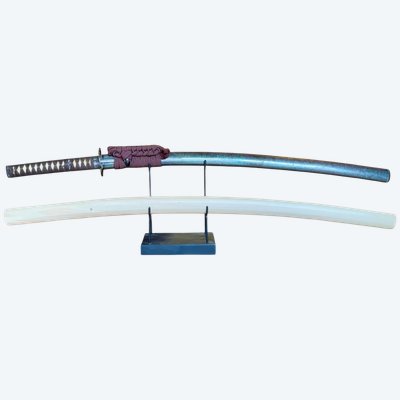
Samurai katana in shirasaya style.
FUSHI - KASHIRA set in chased and patinated metal decorated with a butterfly (symbol of rebirth) with outstretched wings inlaid with copper and silver threads.
TSUKA in wood covered with stingray skin and brown silk braid.
MENUKI in chased and patinated copper depicting full-length figures in profile.
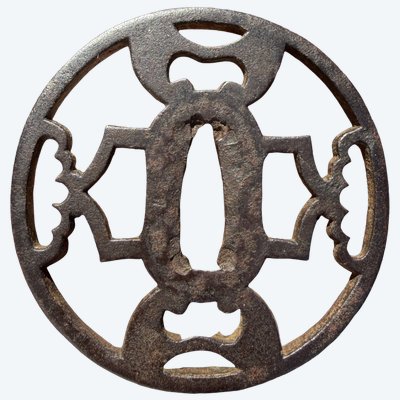
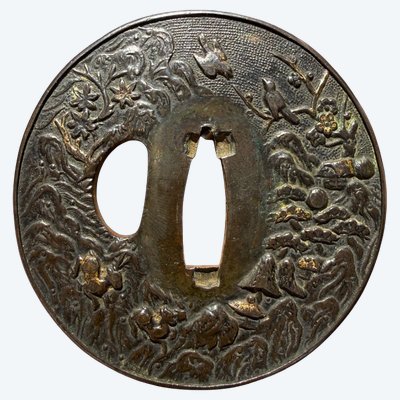
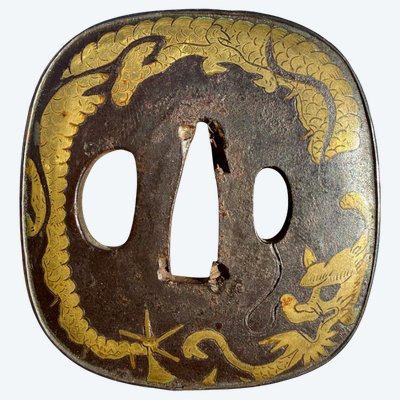
TSUBA moko-gata in openwork and silvered metal, the mimi edge hemmed, signed.
SAYA in wood covered with lacquer infused with mother-of-pearl powder, adorned with a finely chased silver kojiri in a pattern of foaming waves.
Double HABAKI in smooth copper decorated with parallel vertical striations.
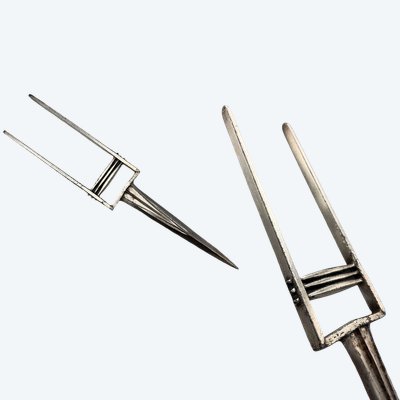
A simple kogai in patinated copper, the ringed handle topped with opposing interlacing (wear).
Straight blade, regular, straight, and well-defined hamon, the tang pierced twice, signed by Kanekage.
Sold with stand, silk carrying case, and NBTHK Hozon certificate.
NBTHK, also known as Nihon Bijutsu Touken Hozon Kyokai (the Society for the Preservation of Japanese Art Swords), is one of the oldest Japanese sword evaluation organizations in modern Japan.
Dimensions: 97 x 8 x 7.5 cm.
Edge length: 65.7 cm.
Curve (sori): 1.8 cm.
Notes: This blade was signed by Mimasaka Koku Jyu Kanekage, a swordsmith active from the early Muromachi period to the Edo period. According to the NBTHK, this sword was forged during the Shinto era (early to mid-Edo period). The name of the maker, Mimasaka Jyu Kanekage, persisted for four generations during the Genna-Genbun era (1615–1741: early to mid-Edo period).
This lineage originally worked in Seki, Mino Province (present-day Gifu Prefecture), which was one of the most flourishing centers of sword forging at the time. However, some later generations of Kanekage relocated to Mimasaka during the Edo period.
The first-generation Kanekage in Mino Province was the son of Naoe Kaneyuki, who, through Kaneuji, was related to the lineage of the Masamune Jittetsu ("Ten Great Disciples of Masamune"). Consequently, the first Kanekage belonged to the Naoe Shizu school, one of the renowned sword-fighting traditions in Mino Province.
The Kanekage name was passed down through generations. While many swordsmiths in Seki changed their names upon entering the Shinto period (the era of the new sword), Kanekage retained both his lineage and name, as well as his distinctive style, characterized by bold and powerful features.
Ref: 709Y6WIKSD

 English
 Français
 Italiano
 Deutsch
 Louis XVI secretary
5.800 € EUR