This description has been translated and may not be completely accurate. Click here to see the original
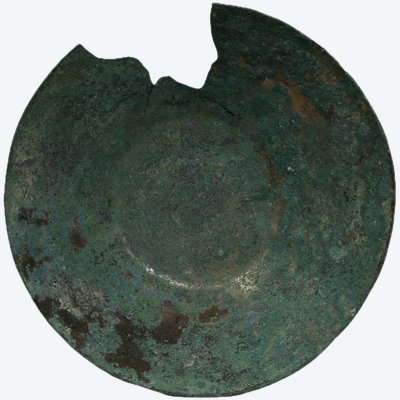
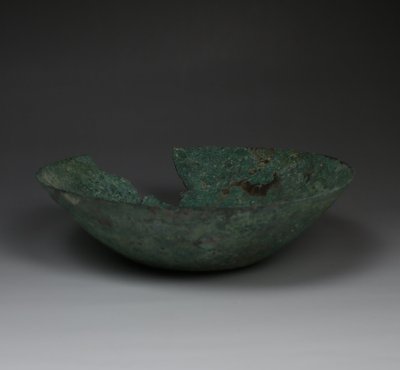
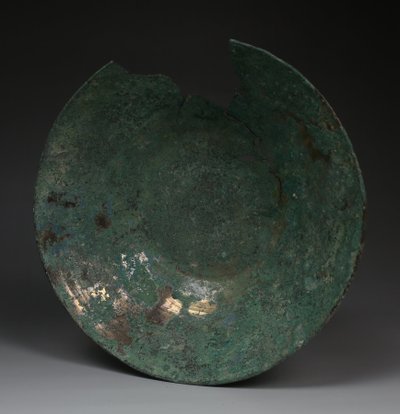
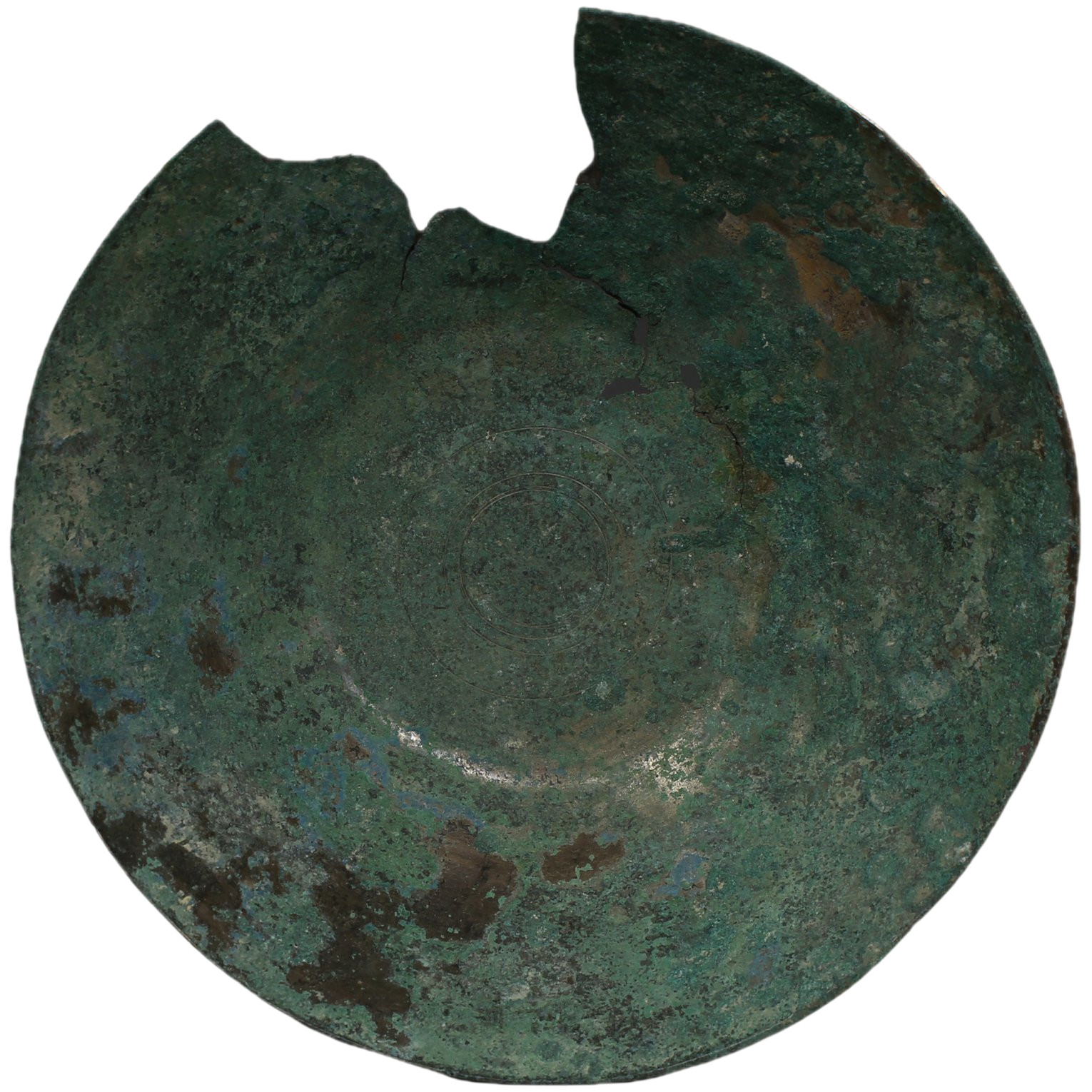
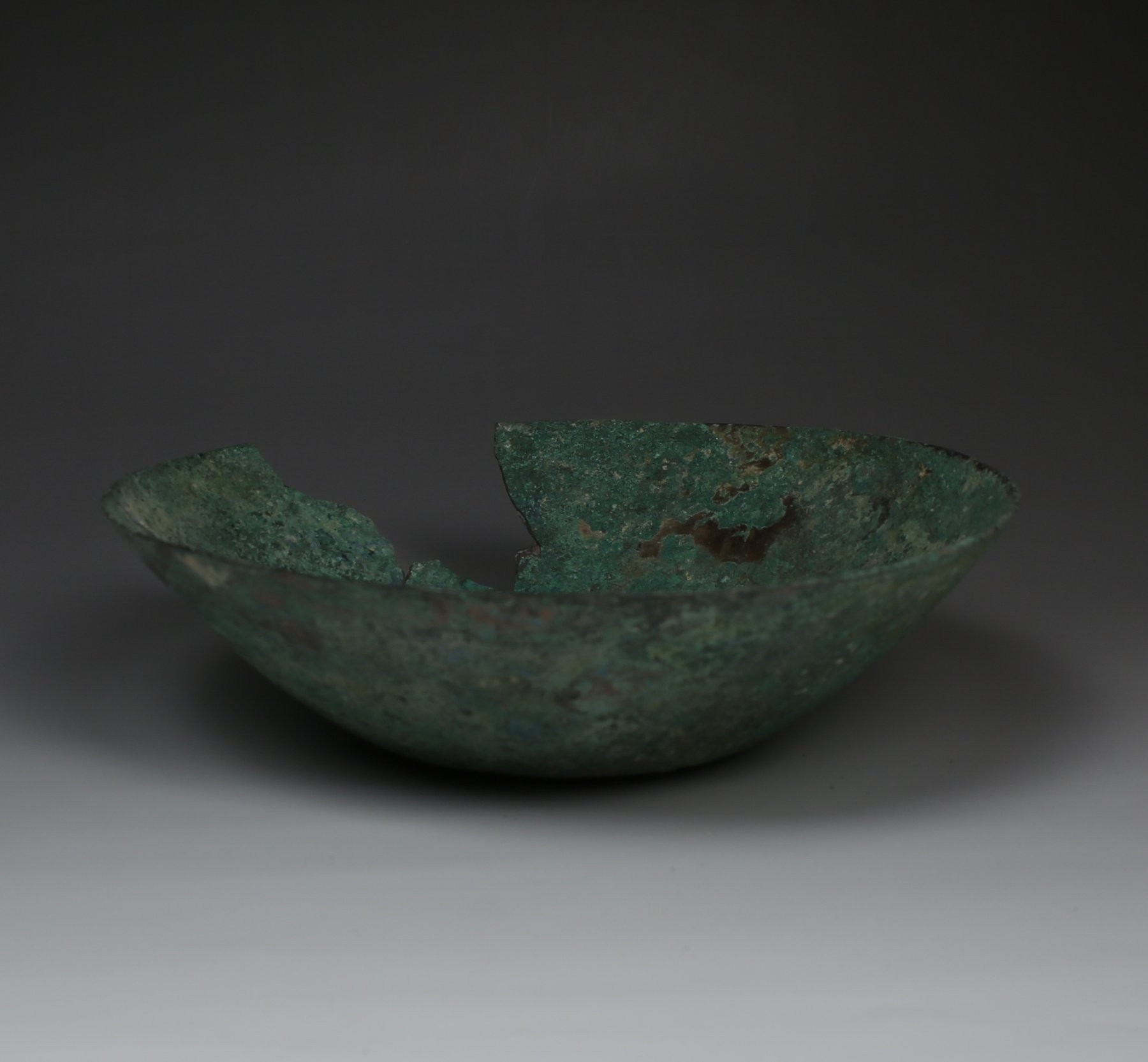
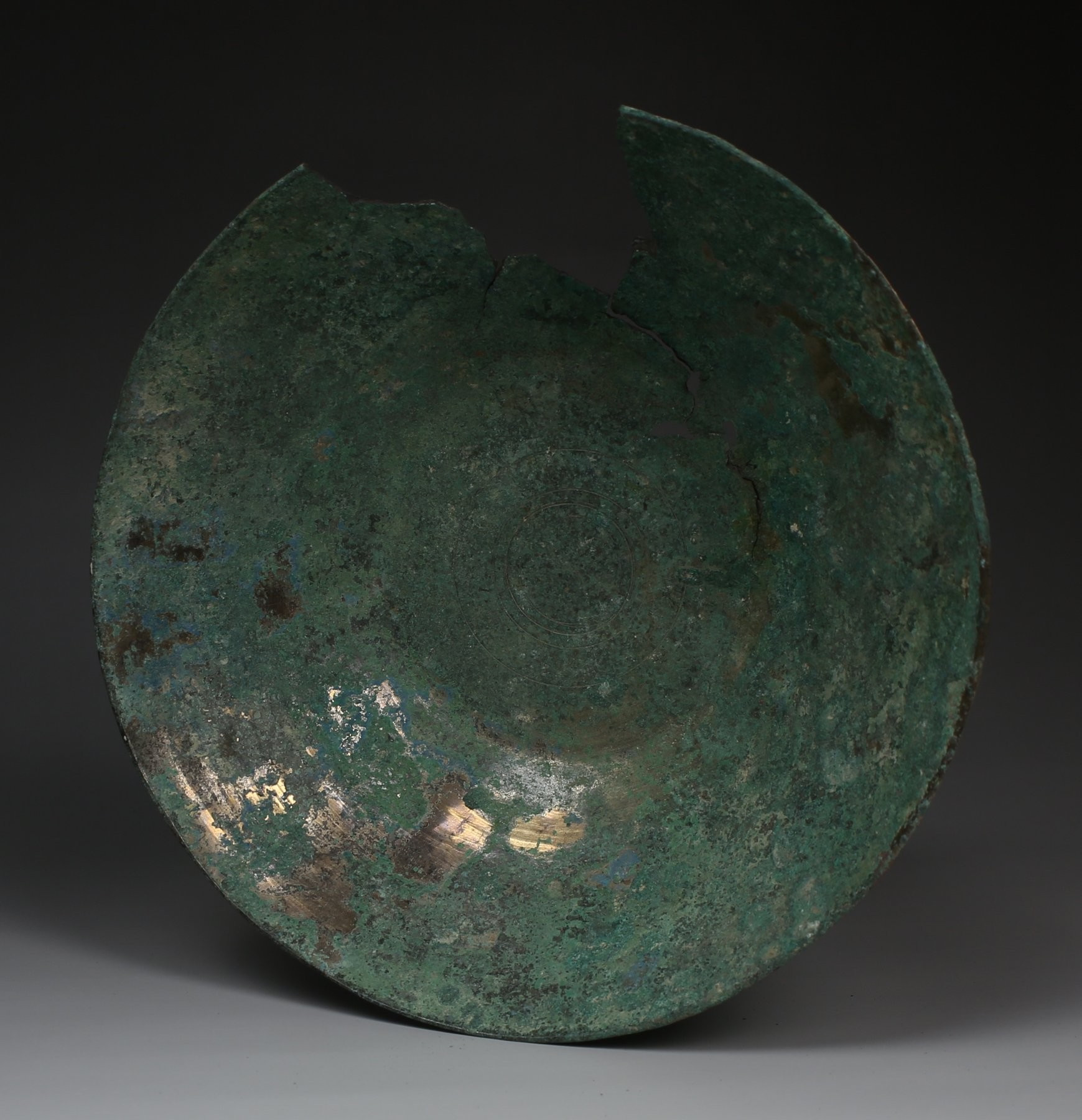
Originating from a former English private collection in London, with a documented acquisition dating to the 1990s, and accompanied by a certificate of authenticity, this remarkable Ancient Near Eastern bronze bowl, attributed to the Iron Age, between the 9th and 7th centuries BC, belongs to the prestigious tradition of Oriental metal vessels that experienced particularly significant development during the Neo-Assyrian period, when the workshops of Mesopotamia, Syria and neighbouring regions brought the art of bronze working to a remarkable degree of technical mastery and formal elegance; with a generous diameter of 20 centimetres, this example is distinguished by the breadth of its hemispherical basin, the continuity of its curves and the delicacy of its central decoration consisting of finely incised concentric circles, while its deep green, turquoise and blue-green archaeological patina, enlivened by brownish areas and mineral speckling, envelops the surface in a particularly expressive richness of colour, whose variations, traces of oxidation and ancient alterations to the material bear witness to the long history of this bronze, preserved in its archaeological character with a substantial portion of its original silhouette, despite a peripheral loss accompanied by fissures, the whole offering the collector an object of singular historical presence, in which the sobriety of form meets the evocative power of the great civilizations of the ancient Near East.
Technical Characteristics
– Object: hemispherical bronze bowl decorated with incised concentric circles
– Culture: Ancient Near East, Iron Age; Neo-Assyrian and Syro-Oriental cultural horizon
– Period: 9th–7th centuries BC
– Material: bronze, copper alloy with green, blue-green and turquoise archaeological patina, brownish nuances and oxidation deposits
– Dimensions: 55 × 200 mm (height × diameter)
– Condition: good archaeological state of preservation; substantial portion of the basin preserved, with ancient patina, peripheral loss, fissures and surface alterations; two additional fragments accompany the object and are not shown in the photographs
– Provenance: former English private collection, London; acquired in the 1990s
– Authenticity: certificate of authenticity provided
– Sale: acquired from a private collection; example offered by ANTIKARTS
Historical Context
During the 9th–7th centuries BC, the Near East experienced a period of intense political, economic and artistic transformation, dominated by the expansion of the Neo-Assyrian Empire, whose rulers, from the great capitals of Kalhu — present-day Nimrud —, Dur-Sharrukin and Nineveh, organized an immense territory traversed by trade routes, diplomatic exchanges and the circulation of precious materials, while metalworking workshops developed a remarkably diverse production, ranging from everyday objects to ceremonial vessels, weapons, ornaments and sumptuous pieces intended for royal courts; within this particularly refined material culture, bronze bowls occupied an important place, since their manufacture required mastery of a metal that was both resistant and malleable, which craftsmen knew how to work through hammering, shaping and chasing in order to produce vessels with relatively thin walls, balanced profiles and surfaces sometimes enriched with geometric or figurative motifs. Archaeological discoveries made in Assyrian palaces, particularly at Nimrud, have revealed the importance of these metal vessels, some examples of which bear rosettes, animal friezes or skilfully arranged concentric compositions, while others favour, like the present bowl, a more restrained aesthetic, in which the regularity of the curve and the discreet presence of a central decoration are sufficient to demonstrate the skill of the bronze worker. This tradition, however, extended beyond the borders of Assyria alone: the productions of the Levant, Syria, Phoenicia and Iran maintained close stylistic and technical relationships, contributing to the dissemination of related forms as far as Cyprus, the Aegean world and certain regions of the western Mediterranean. These vessels could serve domestic purposes, the serving of beverages and prestigious social practices, while some were also employed in ritual contexts or deposited in burials, revealing the value ancient societies attached to metal tableware and its ability to endure across generations. Representations of Assyrian royal banquets, particularly those associated with the reign of Ashurbanipal in the 7th century BC, testify to the cultural importance of these vessels, which formed part of a genuine civilization of banqueting, gift-giving and the representation of power, in which the possession and use of a bronze object could express both the refinement of social customs and the prestige of its owner.
Formal and Material Analysis of the Example
– Volume and profile: open bowl of hemispherical form, presenting a wide circular opening of 200 mm and a height of 55 mm, whose relatively shallow basin develops a continuous curvature from the bottom to the rim, without any pronounced angular interruption, creating a broad, sober and particularly balanced silhouette; this design favours the purity of the line and the regularity of the surface, two essential qualities of Oriental metal vessels of the Iron Age.
– Bronze working and manufacturing technique: metal body with relatively thin walls, whose regular curvature and gradual transition between the bottom and the sides correspond to the traditions of manufacture through the shaping of a hammered bronze sheet, a technique widely attested in the workshops of the ancient Near East; the continuity of the basin and the absence of visible assembly give the whole a structural coherence characteristic of metal vessels fashioned from a single piece.
– Central decoration of concentric circles: the interior bottom preserves a particularly interesting arrangement of fine circular incisions surrounding a central medallion, whose parallel lines, now partially softened by the patina, form a geometric composition of great sobriety; this motif, obtained through precise work on the metal surface, belongs to the decorative vocabulary of Near Eastern bronzes of the Iron Age, a period during which craftsmen frequently used concentric rings to emphasize the centre of bowls and visually organize the interior space of vessels.
– Organization of the interior bottom: slightly recessed central region, in which the incised circles occupy a clearly defined position, while the surrounding surface rises progressively towards the walls, producing a gentle transition between the medallion and the basin; this arrangement gives the decoration a particularly subtle aesthetic function, since the circular lines naturally draw the eye towards the centre without interrupting the continuity of the form.
– Lip and rim: thin edge following the general curvature of the vessel, whose peripheral line retains a substantial portion of its original extent; a relatively significant loss nevertheless interrupts the rim in one area, with irregular breaks and several fissure lines extending towards the central section, material characteristics that make the conservation history of this archaeological piece legible and allow direct appreciation of the thinness of its metal wall.
– Interior patina: remarkable surface dominated by deep green, verdigris and turquoise, traversed by blue-green nuances, dark speckling and more concentrated brownish areas, whose irregular distribution produces a particularly expressive richness of colour; certain areas display a matte, mineral appearance, while others retain small, brighter glimpses of metal, creating a subtle contrast between the bronze material and the layers of alteration covering it.
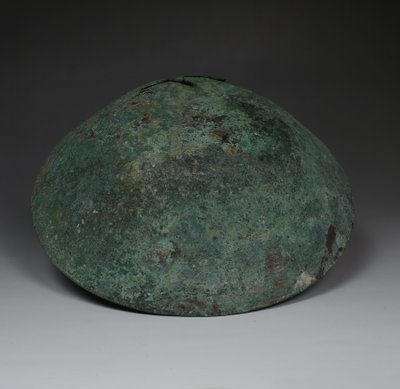
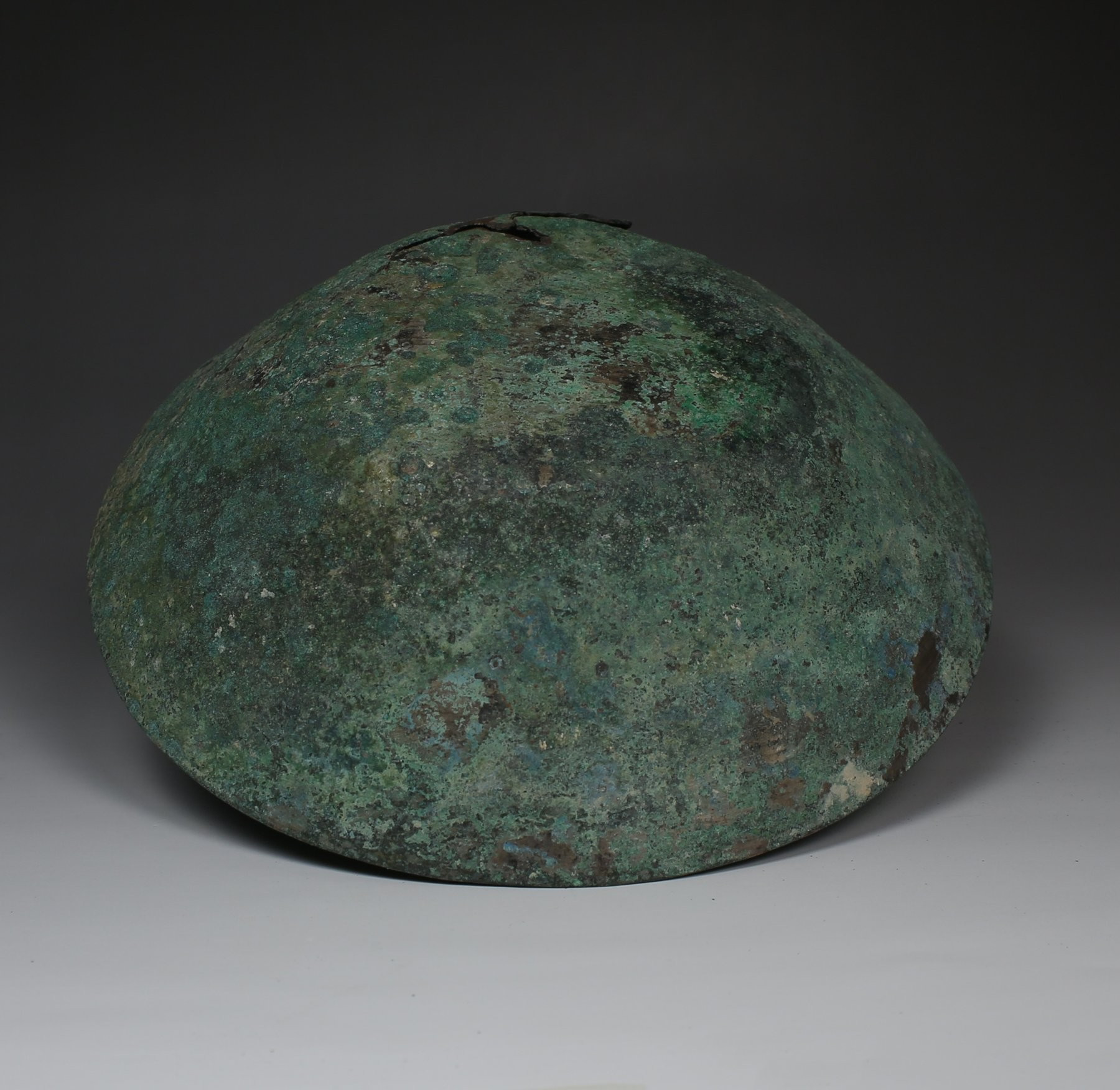
– Exterior patina: convex outer face entirely enlivened by a green patina displaying numerous chromatic variations, combining olive green, dark green, blue-green and earthy brown tones; areas of oxidation, small concretions and changes in texture are distributed across the entire surface, whose curvature remains perfectly legible, offering a particularly evocative presentation of archaeological bronzes preserved with their ancient material character.
– Texture and surface alterations: surface displaying diffuse mineral granulation, small irregularities, traces of corrosion and several areas where the patina layers reveal differences in relief, while the brownish areas contrast with the more abundant green deposits; this diversity of textures gives the example remarkable visual depth and makes it possible to distinguish the various manifestations of copper alteration within the alloy.
– Preservation and fragments: basin retaining most of its form and circular extent, despite an ancient opening in the rim and several fissures affecting the continuity of the wall; the example is accompanied by two additional fragments not represented in the photographs, elements forming part of its material assemblage, while the preservation of the central bottom and its fine incisions allows the principal morphological and decorative characteristics of the vessel to remain exceptionally clear.
– Aesthetic balance: the appeal of this bowl lies in the harmony between the simplicity of its silhouette, the breadth of its diameter and the delicacy of its geometric decoration, whose discretion contrasts with the powerful chromatic effects of the patina; this opposition between a rigorously controlled form and a surface profoundly transformed by time gives the object a particularly interesting sculptural presence, characteristic of the great archaeological bronzes of the Near East.
– Typological consistency: the proportions (55 × 200 mm), hemispherical profile, absence of handles, relative thinness of the wall and decoration of concentric circles present significant correspondences with the metalworking traditions of the Iron Age Near East, particularly Neo-Assyrian and Syro-Levantine productions of the 9th–7th centuries BC; comparisons may be drawn with bronze bowls preserved in the collections of the Metropolitan Museum of Art and the Los Angeles County Museum of Art, as well as with several examples published in specialized catalogues of Assyrian bronzes, where the combination of an open basin and central circular decoration constitutes a recurring characteristic of this family of objects.
– Traceability: the stated origin in a former London private collection, with an acquisition dating back to the 1990s, provides this example with an identified framework of modern provenance, while the accompanying certificate of authenticity constitutes an additional documentary element intended to support its attribution and collection history.
Cultural Value
Through the majestic breadth of its basin, the delicacy of its concentric circles and the almost pictorial depth of its green and turquoise patina, this Near Eastern bronze bowl embodies one of the most fascinating expressions of Iron Age craftsmanship, when mastery of metal enabled Oriental civilizations to transform a demanding material into objects of remarkable elegance, capable of accompanying both the ordinary gestures of existence and manifestations of prestige, hospitality and ceremonial traditions; beyond its original function, it brings us closer to a world in which the workshops of bronze craftsmen fully participated in the cultural greatness of cities and empires, where forms circulated between Mesopotamia, Syria, the Levant and Mediterranean regions, and where the beauty of an object could arise solely from the sought-after perfection of a curve or a few geometric lines carefully traced into the metal. The preservation of its central medallion, the still perfectly perceptible breadth of its profile and the extraordinary variety of its mineral tones now give this example a particularly expressive archaeological personality, while its ancient alterations, far from erasing its identity, make tangible the depth of time separating it from its first users. Originating from a former English private collection and accompanied by a certificate of authenticity, it thus represents an evocative material testimony to the great metalworking traditions of the ancient Near East, offering the collector the opportunity to acquire a piece in which the history of techniques, the aesthetics of bronze and the memory of the civilizations that shaped the first millennium before our era come together.
NB: The stands, frames and display elements visible in the photographs are intended exclusively for presentation purposes and are not included in the sale.
Ref: MWZM7E3YKR

 English
 Français
 Italiano
 Deutsch
 Jean PIAUBERT
12.700 € EUR