This description has been translated and may not be completely accurate. Click here to see the original
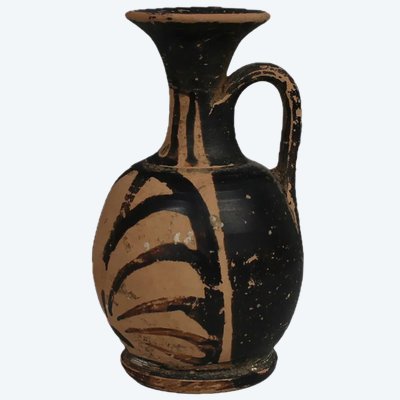
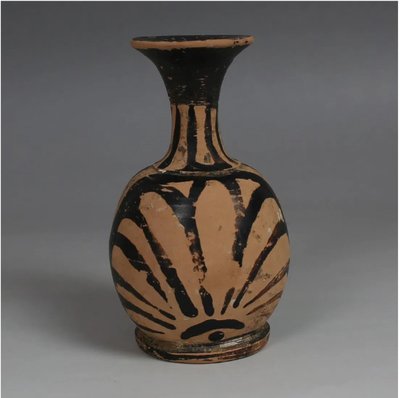
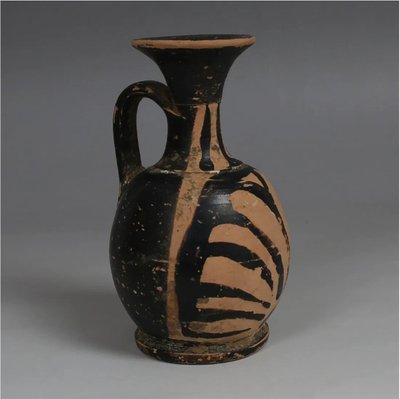
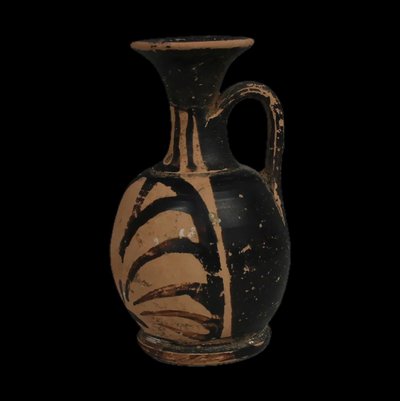
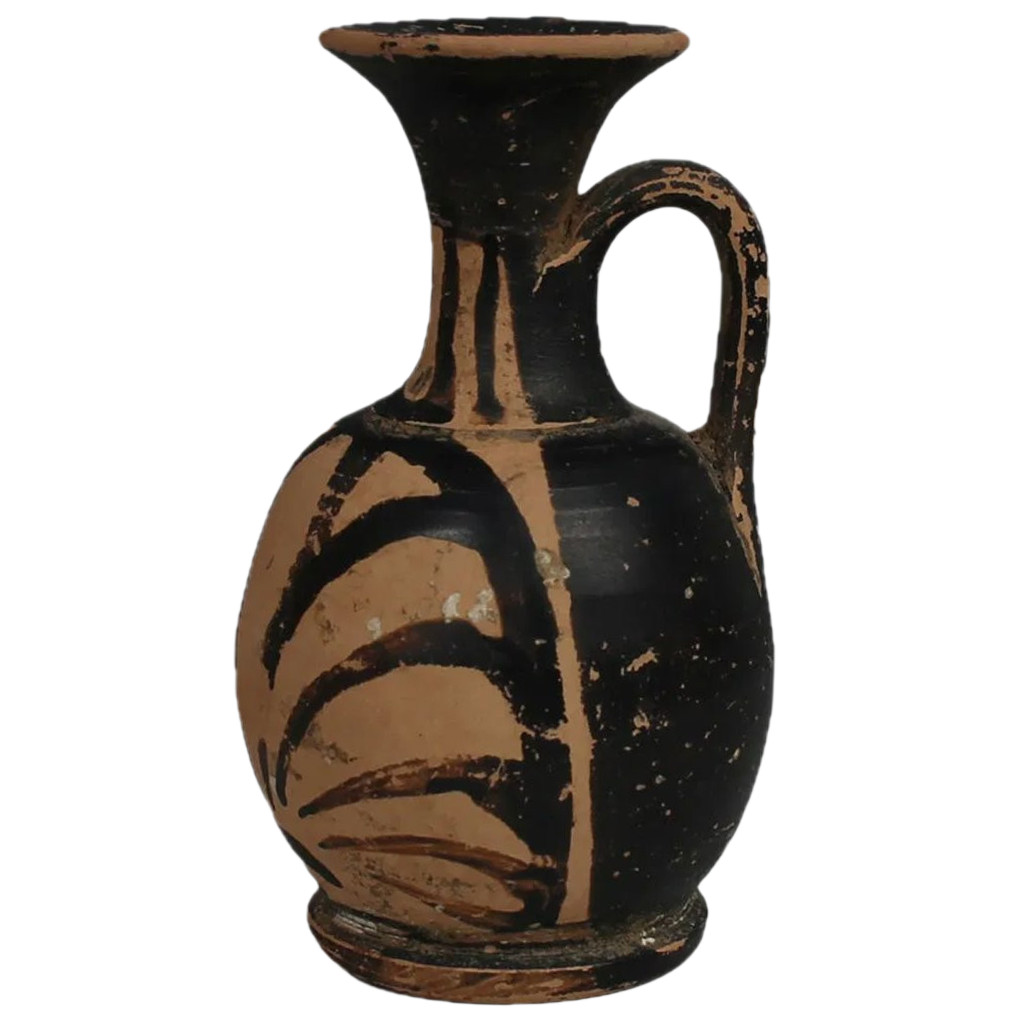
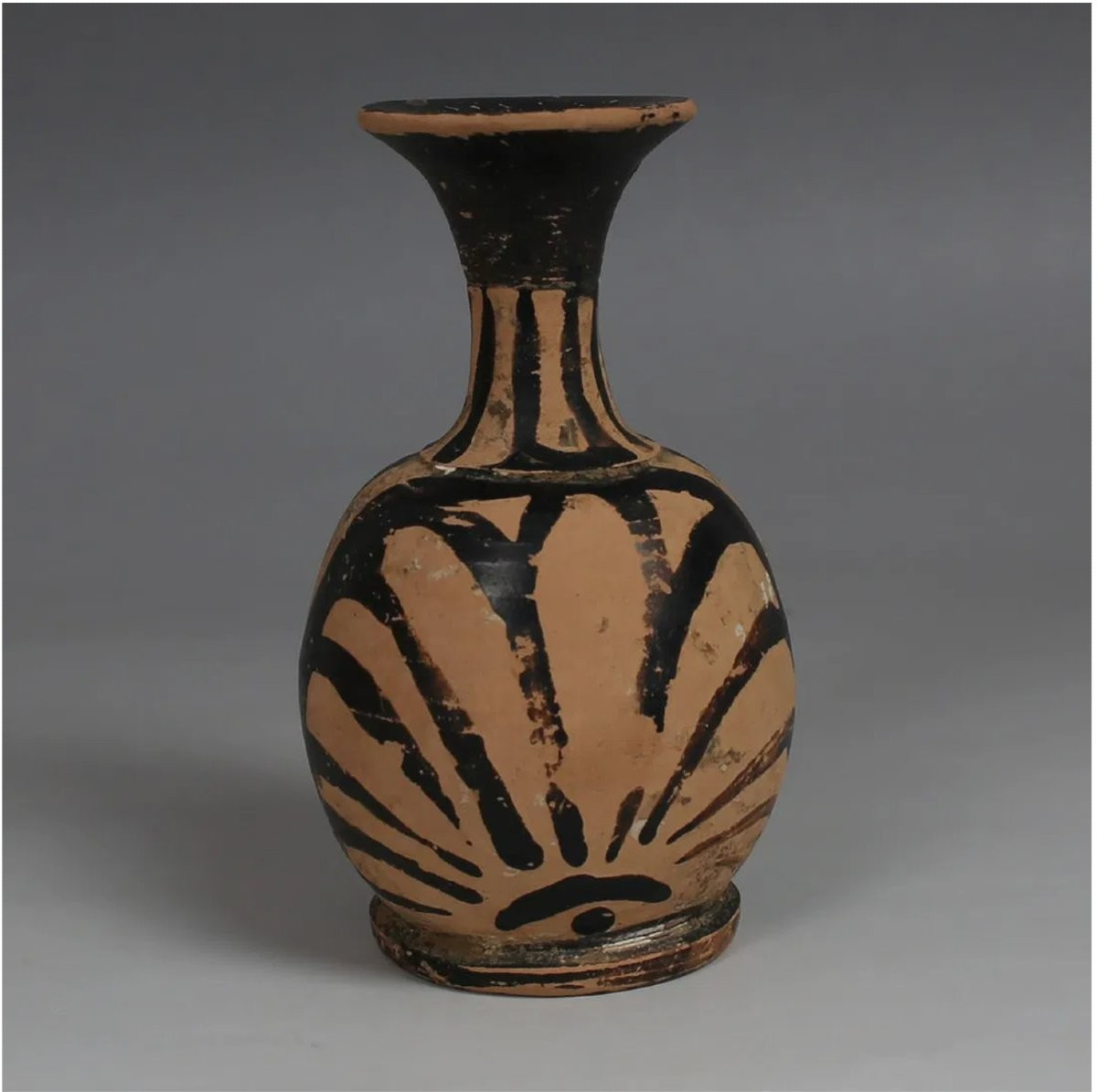
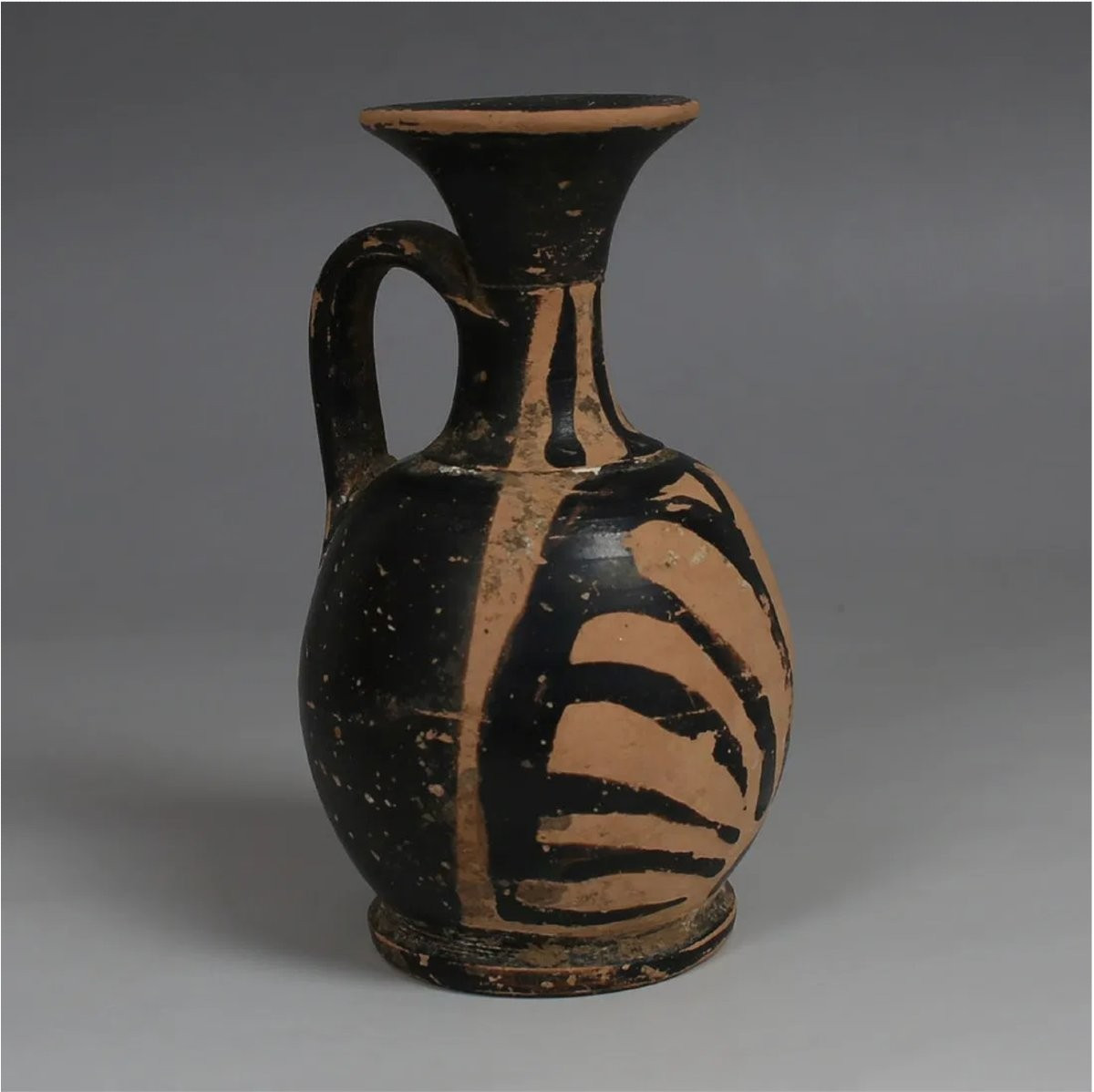
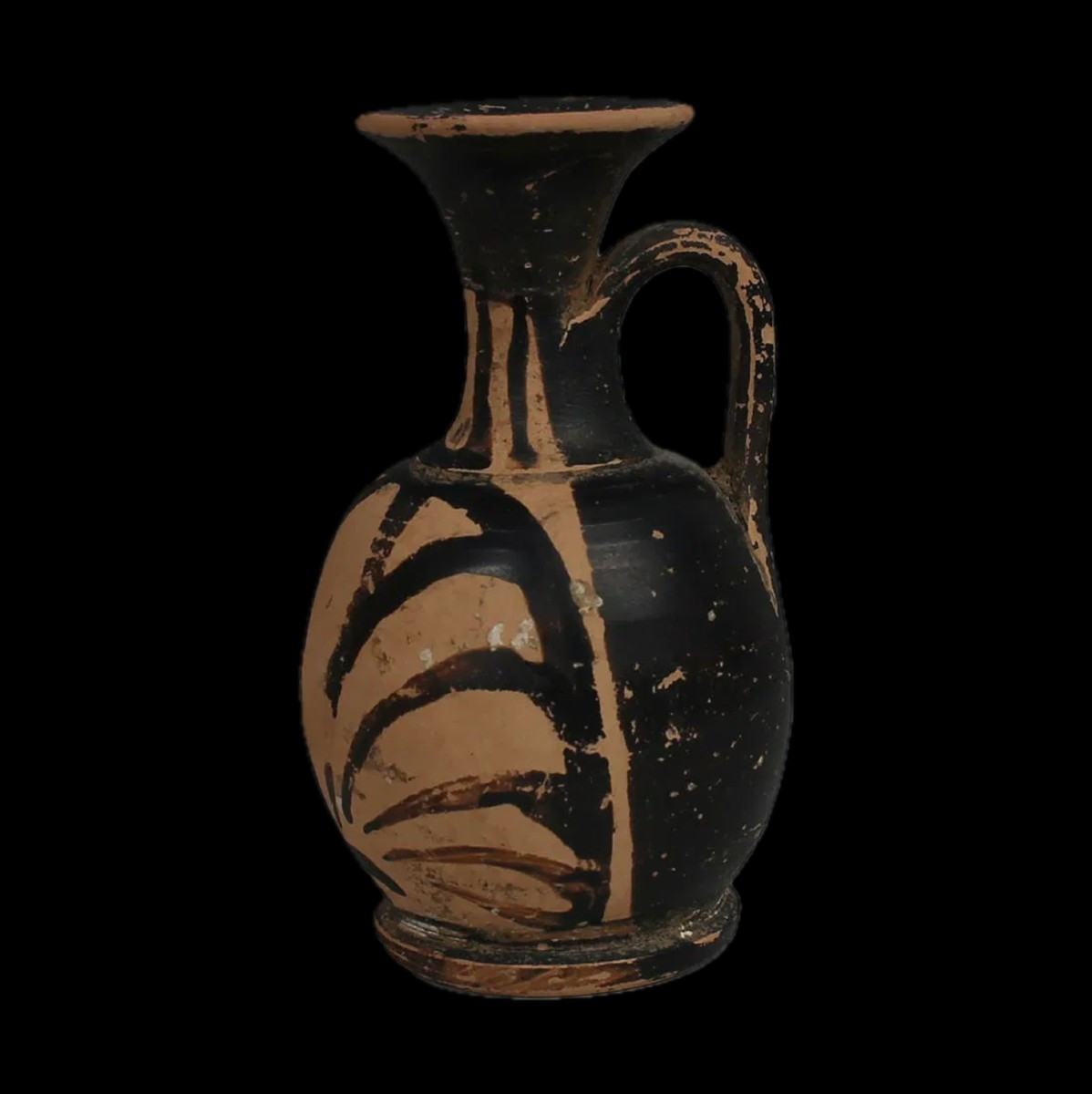
Originating from a former German private collection, assembled in the early 2000s, with a provenance history mentioning an earlier acquisition at a European auction specializing in antiquities, and accompanied by a certificate of authenticity, this charming Greek squat lekythos dating from the 4th century BC constitutes a particularly appealing testimony to the ceramic art of Classical Greece, bringing together, within an intimate format measuring only 9 centimetres in height, elegance of proportions, mastery of ornamental composition and that remarkable ability of Greek craftsmen to transform a vessel intended for scented oils into a genuine miniature work of art; its generously rounded body, slender neck terminating in a widely flared mouth, harmoniously shaped vertical handle and carefully defined ring foot compose a silhouette of great refinement, while the decoration of large radiating palmettes, unfolding in bold black motifs against the orange-beige background of the terracotta, lends the whole a particularly expressive vegetal movement, animated by the contrasts between the light surfaces and the deep black glaze, now softened by an ancient patina whose rubbing marks, small exposures of the clay body and delicate surface irregularities contribute to the archaeological character of this example, preserved in a complete and balanced form, with decoration that remains perfectly intelligible, characteristic of productions from the late Classical period.
Technical Characteristics
– Object: Greek squat lekythos decorated with radiating palmettes
– Culture: Greek, Classical-period ceramic tradition
– Period: 4th century BC
– Material: fine orange-beige terracotta, decoration painted in black glaze, with ancient patina and occasional exposures of the natural colour of the clay
– Dimensions: 90 × 53 mm (height × maximum diameter)
– Condition: good overall condition; complete example with a well-preserved silhouette, displaying ancient wear to the glaze, discreet abrasions, small chips around the lip and foot, together with some deposits and superficial alterations
– Provenance: former German private collection, early 2000s; earlier provenance stated as a European online antiquities auction
– Authenticity: certificate of authenticity provided
– Sale: formerly acquired on the European antiquities market; offered by ANTIKARTS
Historical Context
The lekythos, or lêkythos in Ancient Greek, belongs to one of the most characteristic categories of Greek pottery, because it accompanied practices deeply rooted in Hellenic civilization: preserving precious oils, perfuming the body, performing personal grooming rituals and, in certain circumstances, honouring the deceased through libations or offerings, while its distinctive morphology, combining a body intended to contain the liquid with a relatively narrow neck allowing its flow to be controlled, reveals that functional intelligence which Greek potters knew how to unite with an aesthetic pursuit of remarkable subtlety. During the 5th and 4th centuries BC, the squat form, characterized by its globular body, small ring foot and single handle, became widely distributed, particularly in Attic workshops and throughout the Mediterranean regions where Greek productions circulated, while decorative tastes evolved towards sometimes simpler compositions, favouring the expressive power of a vegetal motif, the depth of black glaze and the natural beauty of terracotta. Among these ornaments, the palmette occupies an essential place: inheriting an ancient decorative vocabulary enriched through contact with Eastern artistic traditions, it became a motif of extraordinary fertility in Greek art, appearing not only on painted vases but also in architecture, sculpture and the decorative arts, where its stylized, fan-shaped leaves introduce an ordered movement evoking vegetal growth without necessarily seeking the faithful representation of any particular plant. On small lekythoi of the late Classical period, these palmettes were frequently arranged across the body in radiating compositions or framed by glazed surfaces, their apparent simplicity concealing a genuine understanding of the relationships between filled and empty spaces, between the curvature of the vessel and the progression of the brush. These vessels participated in everyday life as well as in the funerary sphere, since scented oils could accompany personal care, social interactions and certain religious practices, while lekythoi deposited in graves expressed the enduring bond between the living and the dead, making these modest objects a particularly sensitive expression of Greek intimacy and its relationship with beauty, the body and memory.
Formal and Material Analysis of the Example
– Volume and profile: small vessel with a generously developed globular body, whose maximum diameter of 53 mm fits harmoniously within a total height of 90 mm, presenting a gently rounded shoulder, a progressive narrowing towards the neck and a lower transition to a clearly defined ring foot; this succession of volumes, perfectly representative of the squat lekythos family, establishes a particularly successful balance between the fullness of the body and the verticality of the upper section.
– Neck and mouth: relatively slender neck, slightly constricted in its middle section before widening considerably towards a small trumpet-shaped mouth, whose gently rounded horizontal lip retains pleasing overall regularity; the rim displays discreet wear and small exposures of the orange-coloured clay body, while the contrast between the black glaze of the flared section and the warm tone of the upper edge elegantly emphasizes the delicacy of the profile.
– Vertical handle: single handle, firmly attached between the upper shoulder and the neck area, describing a broad and regular arc whose generous opening visually balances the silhouette of the vessel; its surface retains areas of black glaze combined with lighter abrasions, particularly noticeable along the outer curvature and contact areas, while its junctions with the neck and shoulder remain clearly visible, revealing the coherence of its shaping.
– Main palmette decoration: the body displays a particularly expressive vegetal composition consisting of large stylized leaves arranged in a fan, whose elongated forms, alternately broad and tapering, extend from the lower section towards the shoulder; the interplay between the black motifs and the reserved spaces revealing the orange-beige colour of the terracotta produces a remarkable radiating effect, in which the lines appear to follow naturally the curvature of the vessel, giving the decoration an immediately recognizable graphic strength.
– Ornamental composition: the palmettes are distinguished by deliberately broad execution, favouring the vigour of the brushwork and the contrast between areas of colour rather than a multiplication of secondary details; some leaves widen near the shoulder before tapering towards their base, while others extend the movement through narrower and slightly curved lines, creating a succession of visual rhythms that animate the entire body and give this small vessel a particularly assertive decorative presence.
– Decoration of the neck and shoulder: the lower section of the neck displays several vertical black bands, distributed against the light background of the ceramic and extending towards the beginning of the shoulder, where they meet the glazed surfaces of the body; this arrangement establishes an aesthetic continuity between the vegetal decoration of the body and the verticality of the neck, while the upper section, extensively covered with black glaze, introduces a sober transition towards the flared mouth.
– Surface and glaze: black glaze with deep nuances, sometimes satin-like and sometimes slightly mattified by surface wear, retaining extensive coverage on the lateral sections of the body, the handle and the mouth; small abrasions, light-coloured speckling and localized losses reveal the natural colour of the clay body, particularly on raised areas and handling points, while certain portions of the decoration display a slight softening of their outlines, lending the whole a visually harmonious patina.
– Clay body and material: fine terracotta ranging from beige to pale orange, whose reserved surfaces provide a particularly warm contrast with the black glaze; the material displays small chromatic variations, discreet mineral speckling and a few traces of deposits, characteristics that enliven the unglazed areas and preserve the legibility of the ceramic texture without altering the clarity of the principal decorative motifs.
– Foot and base: low ring foot, clearly separated from the body by a slight narrowing, displaying a succession of circular lines and dark bands that emphasize the lower termination of the vessel; the surface of the foot shows rubbing marks and small chips revealing the orange-brown clay body, while its diameter and arrangement provide the example with a balanced resting base, in accordance with the functional design of small Greek oil vessels.
– Overall preservation: example retaining the apparent entirety of its silhouette, from the mouth to the foot, with its handle present and vegetal decoration largely preserved; alterations are essentially concentrated on the glaze and contact edges, in the form of small chips, abrasions and surface speckling, without compromising the harmony of the proportions or the understanding of the decorative composition, the whole offering a particularly satisfactory presentation for a ceramic vessel attributed to the Classical period.
– Typological consistency: the proportions (90 × 53 mm), globular body, narrow neck with flared mouth, single vertical handle, ring foot and palmette decoration belong to the well-documented repertoire of Greek squat lekythoi of the late 5th and 4th centuries BC, comparable examples of which are preserved in several international archaeological collections, particularly at the Acropolis Museum in Athens, which possesses an Attic palmette lekythos dated to 400–375 BC; the morphological and ornamental comparison confirms the relevance of the stylistic attribution of this example to the Greek ceramic tradition of the 4th century BC.
– Traceability: the stated provenance, linking this piece to a former German private collection from the early 2000s, with an earlier history mentioning the European antiquities market, constitutes an interesting documentary element in the modern history of the object; the certificate of authenticity provided accompanies this attribution and contributes to the presentation of the example within a specialized collection.
Cultural Value
Through the grace of its proportions, the elegance of its flared mouth and the almost calligraphic beauty of its radiating palmettes, this Greek lekythos of the 4th century BC brings together, within an object measuring only a few centimetres, several of the most characteristic qualities of Classical aesthetics: the pursuit of balance, the expressive simplicity of decoration, the perfect adaptation of form to function and that remarkable ability to confer an enduring artistic presence upon the most familiar objects of everyday existence. It thus evokes a civilization in which oil, perfumes and bodily care occupied an important place, where grooming practices formed part of a genuine culture of beauty and where the same vessels could also acquire a commemorative dimension when associated with funerary practices, connecting everyday life with the beliefs and traditions of the city. The palmette, whose leaves unfold across the body with particularly appealing graphic vigour, recalls the extraordinary dissemination of vegetal motifs in Greek art, from potters' workshops to the architectural ornaments of sanctuaries, bearing witness to an artistic sensibility in which nature, stylized and ordered, becomes a universal decorative language. Retaining its complete silhouette, the legibility of its decoration and a beautiful contrast between the deep black of the glaze and the warm tones of the clay, this example possesses that particularly sought-after quality of small Classical Greek vessels: the ability to be simultaneously a witness to ancient practices, a finely crafted work of art and a collector's object whose very presence is sufficient to evoke an entire vanished world. Originating from a former German private collection and accompanied by a certificate of authenticity, it therefore constitutes a particularly appealing piece, capable of finding a natural place within a collection of ancient ceramics, while also attracting, through the elegance of its lines and decoration alone, the attention of an enthusiast sensitive to the timeless beauty of Greek art.
NB: The stands, frames and display elements visible in the photographs are intended exclusively for presentation purposes and are not included in the sale.
Ref: XAC2WRVJI8

 English
 Français
 Italiano
 Deutsch
 Napoleon marble inkwell, 19th century
450 € EUR