This description has been translated and may not be completely accurate. Click here to see the original
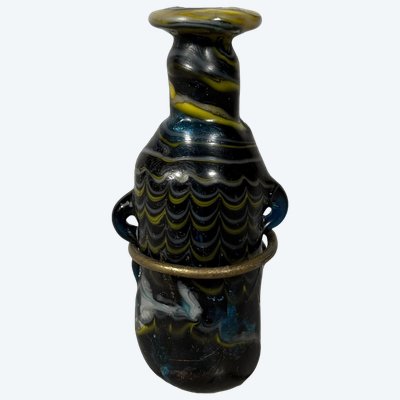
Small moulded Greek glass amphoriskos, of the classical type, featuring a well-tensioned piriform body, a cylindrical neck with flaring lip, and two thick vertical handles connecting the shoulder to the upper neck. The piece is distinguished by a very fine decoration of intertwined yellow-ochre and white trails arranged in wavy registers over a dark blue background, today partially veiled by a sandy beige patina. The object appears homogeneous, without visible joins, with overall wear perfectly consistent with a long burial period: surface pitting, partial loss of original gloss, mineral crusts and slight localized iridescence. No element suggests modern work; on the contrary, everything supports its identification as a Greek core-formed amphoriskos from the end of the Classical period / early Hellenistic period (5th–4th century BC).
Characteristics
Object: Moulded glass amphoriskos decorated with polychrome trails
Material: Core-formed glass with applied marbled yellow and white trails on dark blue ground
Culture: Greek, Eastern Mediterranean
Period: 5th–4th century BC
Dimensions: approx. 77 mm high × 52 mm maximum diameter
Condition: Good overall condition; stable ancient surface; pronounced burial patina
Provenance: Former Dutch private collection, acquired from Helios Gallery (United Kingdom), before 2000
Authenticity: Delivered with certificate of authenticity issued by a specialist in Classical Antiquities
Historical Context
Glass amphoriskoi decorated with wavy trails belong to the most refined category of pre-Roman Greek glassware. Produced using the core-forming technique in workshops of the Eastern Mediterranean (Rhodes, Cyprus, Syro-Palestinian coast), they circulated widely across the Greek world during the 5th–4th centuries BC. Their contents—perfumed oils, balms, ointments—linked them to the intimate sphere of the body, care, and ritual: daily grooming, gymnasium, sacred perfumes, funerary deposits.
Often placed in tombs, these small vessels held both social and symbolic functions: marking status, signalling a refined lifestyle, taking into the afterlife a reserve of precious oil. The deep opaque blue glass, enriched with yellow and white trails, consciously imitated the preciousness of semi-precious stones (lapis lazuli, banded agates), making these flasks true jewels of the dressing table.
Formal and Material Analysis of the Specimen
Shape and proportions
The amphoriskos displays a regular piriform profile: broad, well-rounded shoulder, full belly tapering into a small, slightly flattened button base ensuring satisfying stability despite the fine point of contact. The neck, slightly flaring, ends in a thickened horizontal lip, flattened and turned outward, typical of Classical forms. The two handles, symmetrical, are pulled in thick ribbons, rising from the shoulder and attached to the upper neck; their curve is harmonious, with slight central flattening and attachment compression perfectly consistent with ancient manufacture.
Marbled trail decoration
The decoration is organised into several registers:
– at the shoulder, a wide yellow-ochre band encircles the vase, slightly irregular, testifying to the glassmaker’s hand;
– at the centre of the body, the most striking zone features a frieze of marbled white and yellow trails stretched into continuous zigzags, like a garland of feathers or waves, on a dark background; the trails were first applied in spiral form and then combed while hot, creating this highly prized “chevron” motif;
– a second, more discreet yellow band accompanies the transition between the decorated zone and the lower point of the amphoriskos.
Beneath the patina, deep blue can still be seen in the interstices of the decoration, the classic colour of these productions. The contrast between warm yellow, opaque white and the darkened blue remains very readable under raking light, giving the vase a subtle yet elegant chromatic vibration.
Surface, patina and burial traces
The surface is covered with a sandy beige patina mixed with fine calcareous concretions, especially in the recesses of the decoration and near the lower point. Observed features include:
– regular micro-pitting of the glass, typical of ancient corrosion, with minute superficial losses that mattify the original gloss;
– some zones of preserved, very smooth vitrified shine, notably on the ridges of the yellow trails, evidence of the initial lustre;
– discreet blue-violet iridescence beneath the patina in certain areas, further indication of slow, natural glass ageing in a humid environment;
– darker incrustations linked to burial sediments, especially visible near the base and behind the handles.
The lip shows very small ancient chips, rounded by wear, without affecting the reading of the shape or the solidity of the piece. The handles are complete, with no visible restoration, a major advantage for an object of such fragility. The button base shows slight circular wear consistent with ancient contact. No join, no modern fill is perceptible: the piece presents a “stabilised archaeological” state perfectly suitable for collection.
Cultural and Aesthetic Value
This amphoriskos concentrates, on a small scale, all the technical and aesthetic refinement of pre-Roman Greek glass: mastery of form, virtuosity of marbled trail decoration, harmony of colours, balance of proportions.
For a collector, it combines several sought-after qualities:
– Canonical typology of core-formed glass amphoriskoi;
– Chevron marbled decoration still clearly readable, in an elegant blue / yellow / white palette;
– Complete state with intact handles, increasingly rare on the market;
– Expressive ancient patina telling the long burial history of the object and giving it strong archaeological presence.
It is both a highly decorative display piece—thanks to its chromatic contrasts—and a key technical witness to the art of glass before the invention of glassblowing.
Provenance & Guarantees
Solid provenance: former Dutch private collection, acquired through Helios Gallery (United Kingdom), a specialised dealer in Classical antiquities.
The object will be delivered with a certificate of authenticity describing the piece, its dating, culture, provenance and technique, intended to accompany the amphoriskos permanently within any collection or future resale.
The transmitted information is recorded in a documentary file (photographs, description, comparative references) kept by the seller.
Expert Report
This marbled glass amphoriskos belongs to the highly sought-after family of Greek core-formed perfume flasks produced in Eastern Mediterranean workshops in the 5th–4th centuries BC. Its elegant silhouette, complete handles, well-preserved chevron decoration and nuanced archaeological patina make it an ideal display piece, both decorative and fully representative of a glassmaking technique now extinct.
For a private collection or connoisseur’s cabinet, it plays the role of a key object: compact enough to be displayed in a domestic showcase, yet possessing a historical pedigree and manufacturing quality comparable to examples preserved in the British Museum, the Louvre or the Metropolitan Museum. It is an object that immediately “tells a story”: perfume, luxury, the refined intimacy of the Classical Greek world.
Detailed Expert Report
Identification of the official type
Greek core-formed glass amphoriskos with marbled trail decoration, belonging to the Classical group of miniature toilet vessels.
Typology close to core-formed glass amphoriskoi, Group II, according to the traditional classification (Harden / Grose), with piriform body, two handles, button base and wavy chevron decoration.
Scientific and museum references
Comparable pieces are preserved in major public collections:
– British Museum, London: several glass amphoriskoi with yellow and white trails on blue ground (notably the Cesnola Collection).
– Musée du Louvre, Paris: Department of Greek, Etruscan and Roman Antiquities, series of core-formed glass vessels (“Greek and Eastern Glass” displays).
– Metropolitan Museum of Art, New York: gallery of pre-Roman glass, amphoriskoi with wavy chevron trails dated to the 5th–4th century BC.
Museum comparisons
The present example belongs to the same typological family as these museum pieces: identical format, comparable decoration, same colour range. Its stronger archaeological patina gives it a very authentic presence appealing to collectors who appreciate objects preserved in a minimally restored state. The still-clear chevron decoration makes it a piece worthy of a museum-level glass assemblage within a private collection.
Indicative bibliography
For classification and study of this type of object, see:
– D. B. Harden, Glass of the Caesars, 1987.
– D. F. Grose, The Toledo Museum of Art – Early Ancient Glass, 1989.
– M. Stern, Ancient Glass at the Israel Museum, 1995.
– S. Whitehouse, various articles on pre-Roman Mediterranean glass in museum catalogues.
Ref: 191X9UA28B

 English
 Français
 Italiano
 Deutsch
 Macassar Ebony 1930 Art Deco Coffee Table
2.050 € EUR