This description has been translated and may not be completely accurate. Click here to see the original
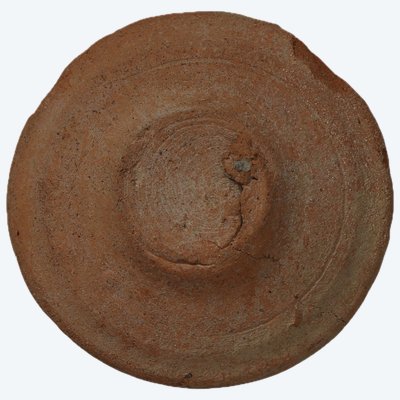
A rare and demonstrative specimen, a Byzantine commercial weight cast in copper alloy, of polyhedral geometry with multiple faces (a type attested in scientific corpora), each adorned with a concentric circular medallion — a true ocellus of reading — which structures the planes and signals the metrological vocation of the object. The surface displays an archaeological patina in brown and dark green tones, edged with mineral highlights (verdigris shades, micro–earthy deposits), serving as a seal of antiquity and stability. The softened edges from use, the homogeneous metal, and the volumetric cohesion confirm a precise calibration instrument intended for the reliability of exchanges on test benches or market scales.
Technical Characteristics
— Civilization: Byzantine Empire (trade weight)
— Dating: Late Antiquity / Early Byzantine period, published attestations 5th–7th centuries; more broadly 6th–11th centuries according to the corpora (see Dating Note below)
— Material: Cast bronze, homogeneous and stable ancient patina
— Dimensions: 10 × 12 mm (compact proportions, secure handhold)
— Condition: Sound surface, regular period wear unifying the reliefs and facilitating face reading
— Typology: Polyhedral weight with “ring-and-dot” (bird’s-eye) decoration struck or stamped on each face
— Provenance: Old English private collection (formed in the 1980s)
— Authenticity: Certificate issued by Galerie Antikarts (photographic and descriptive dossier)
— Sale: European specialized auction, under expert supervision and in accordance with art-market standards
Historical Context
In the Byzantine Empire, bronze weights guaranteed the fairness of measures in markets, within mint workshops, and for imperial administration. The strict geometry (standardized polyhedra) coupled form, mass, and ponderal value, ensuring the continuity of standards inherited from Late Antiquity. Discreet yet decisive, these artefacts materialized the will of the State: to stabilize the economy, secure public trust, and discipline exchange.
Formal and Material Analysis of the Specimen
— Geometry: Polyhedron with regular faces (published parallels: cuboctahedral forms — 6 square and 8 triangular faces), compact proportions allowing immediate reading on a flat surface or in hand.
— Decoration: Concentric medallions (ring + central core) on each face, a clear mark functioning as workshop signature and aiding weight identification.
— Patina and Deposits: Subtle mixture of verdigris and browns, fine mineral concretions; uniform maturation — a convergent indicator of antiquity.
— Metallurgy: Solid cast bronze, dense material; age-softened edges and corners — positive markers of prolonged, controlled use.
— Function: Measuring and control instrument; repetition of the motif per face accelerates reading, reduces error, and secures transaction reliability.
— Traceability: Certified by Antikarts: secure custody chain and acquisition record.
Comprehensive Expertise and References (Official Typology and Comparanda)
Recognized Type: Byzantine polyhedral weight in copper alloy, “ring-and-dot” (bird’s-eye) decoration stamped on the faces.
— Pondera Online (UCLouvain), academic reference database:
• ID 11386: “Polyhedron; on large square facets, five bird’s eyes; on narrow triangle facets, four bird’s eyes.” — paradigmatic description of the ring-and-dot motif per face.
• ID 11431: “Shape: Polyhedron” — another attestation of polyhedral form.
— Published parallel (Christie’s): “Byzantine Bronze Polyhedral Weight,” 5th–7th centuries; cuboctahedral geometry (6 squares + 8 triangles), circular punches with central dot on each face.
— CPAI (Corpus Ponderum Antiquorum et Islamicorum, Part 2: Late Roman and Byzantine Weights, ed. O. Tekin, Pera Museum): reference catalogue (742 pieces), typological and metrological framework.
— Vikan, G. & Nesbitt, J. (1980), Security in Byzantium: Locking, Sealing and Weighing (Dumbarton Oaks): synthesis of Byzantine weighing systems.
— Bendall, S. (1996), Byzantine Weights: An Introduction: foundational manual cited by the British Museum.
— Entwistle, C., A Catalogue of the Late Roman and Byzantine Weights and Weighing Equipment in the British Museum: museum corpus and standardized typology (BM entries).
Dating Note (Scientific Rigor)
Although some late-market notices occasionally propose a 10th–13th century range, specialized corpora (CPAI, Pondera) and published comparanda (Christie’s) more securely anchor ring-and-dot polyhedra in Late Antiquity / Early Byzantine contexts, with occurrences from the 5th–7th centuries, extending in certain subtypes and workshops to the 6th–11th centuries.
Accordingly, a dating of 5th–7th centuries (or cautiously 6th–11th) is preferable to any uniformly later attribution.
Cultural Value
Beyond its ponderal function, this weight embodies the Byzantine ethic of the just measure: a technical, economic, and political object at once. Its authentic patina, metrical geometry, and normative decoration make it a secure archaeological document — sought after by collectors and museographically relevant to any section devoted to medieval Mediterranean commerce.
Bibliography / Cited Corpora
— Pondera Online (UCLouvain): ID 11386, ID 11431 (polyhedral weights; bird’s-eye decoration).
— CPAI, Part 2: Late Roman and Byzantine Weights (ed. O. Tekin, Pera Museum).
— Christie’s, A Byzantine Bronze Polyhedral Weight, 5th–7th centuries (cuboctahedron, ring-and-dot).
— Vikan, G. & Nesbitt, J. (1980), Security in Byzantium: Locking, Sealing and Weighing (Dumbarton Oaks).
— Bendall, S. (1996), Byzantine Weights: An Introduction.
— Entwistle, C., Late Roman and Byzantine Weights… (British Museum Catalogue).
Secure Shipping
All our items are carefully packed in reinforced parcels, shipped via Colissimo or Chronopost with delivery signature, and fully insured. Each shipment benefits from precise tracking, optimal protection, and maximum security — hallmarks of the reliability and trust that Antikarts guarantees to its clients.
Note: Stands, frames, or presentation elements visible in photographs are intended solely for staging and are not included in the sale.
Legal Information:
The applicable Terms and Conditions of Sale are available upon request or on the Seller’s official channels.
Any order constitutes full acceptance of these conditions.
Ref: XSQLAAEXE4

 English
 Français
 Italiano
 Deutsch
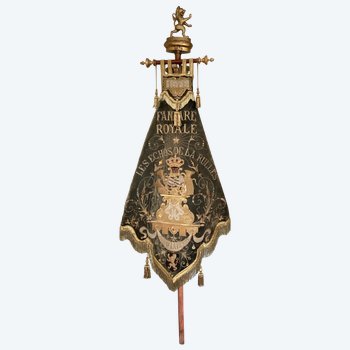
 Royal Banner
1.500 € EUR