This description has been translated and may not be completely accurate. Click here to see the original
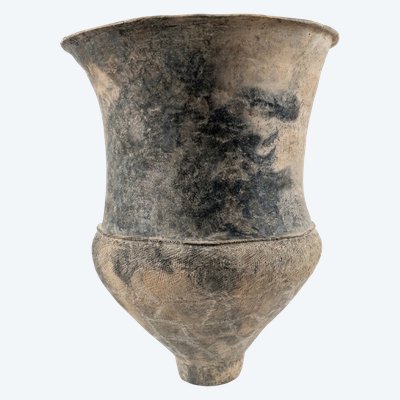
We are dealing here with an imposing Chinese funerary jar in cocoon shape, made of cold-painted terracotta, attributable to the Han dynasty and secured by a QED thermoluminescence test. A meticulous examination of the photographs, as if under magnification and raking light, reveals an object entirely consistent with this attribution: form, proportions, nature of the fabric, pictorial technique, decorative scheme of cloud-like volutes and vertical bands, surface alterations and encrustations all correspond to a piece from an ancient funerary context, not reassembled from fragments but preserved as a homogeneous whole.
The jar displays the typical appearance of the Han “cocoon vessel”: a very swollen, horizontally oriented body, a short neck and a low annular foot, the whole forming a heavy, compact volume that seems to “weigh” upon its narrow foot. The polychromy, although faded, still allows a complex decoration to be read: wide rectilinear bands alternating with spiral volutes painted in chalky white and pink, standing out against a grey-brown ground. At the centre, a vertical panel with a geometric motif (cross-hatching and parallel lines) structures the decorative space.
The wear is clear, deep, and irregularly distributed, with stronger abrasions on the protruding areas of the body and neck; the pigments appear as matte films, at places powdery, sometimes dissolved into greyish halos, sometimes preserved as very sharp edging. Earthen encrustations, particularly at the lower body and around the foot, penetrate the micro-cracks of the pictorial layer; they are not superficial dirt, but the result of a long burial period. No visual evidence suggests extensive modern reconstruction: the few lighter areas seem due more to filled and stabilised chips than to fanciful additions.
In sum, this is an ancient, authentic example, aesthetically strong and scientifically documented, belonging to the now canonical corpus of Han cocoon jars.
Characteristics
Object: Cocoon-shaped funerary jar with thermoluminescence (TL) test
Material: Ceramic (terracotta with cold-applied slip painting)
Culture: Chinese
Period: Han dynasty, 206 BC – AD 220
Dimensions: approx. 296 mm (height) × 330 mm (maximum length) × 203 mm (approximate depth)
Condition: Good overall condition; complete structure, intact body, preserved neck and foot; marked wear of the polychromy, abrasions, encrustations and some small losses consistent with age
Provenance: Former French private collection, Toulouse region, assembled in the 1980s
Museum equivalents:
– Metropolitan Museum of Art, New York, no. 1994.605.31
– Maxwell Museum of Anthropology, MMA 2012.91.60
– Montreal Museum of Fine Arts, inv. 2014.177
Scientific analysis: Thermoluminescence test by QED Laboratory, Marseille, ref. QED1703/FC-0907, concluding ancient firing compatible with the Han period
Documentation: Certificate of authenticity and TL report provided
Historical Context
The so-called “cocoon-shaped jars” are among the most emblematic markers of Western Han funerary ceramics. Their oblong, horizontally swollen silhouette is generally interpreted as a stylisation of the silkworm cocoon, a direct reference to the silk industry—an economic pillar of imperial China—as well as a symbol of transformation, gestation and rebirth.
These containers originally served as liquid vessels—wines, millet beers or other beverages—used in drinking services and rituals. Very early on, they entered the funerary sphere as mingqi, “substitute objects” destined to accompany the deceased and provide him, in the afterlife, with the material means for a continued existence.
Most cocoon jars surviving today are made of grey or red, low-fired terracotta, then painted after firing with mineral pigments applied cold: a more economical technique than lacquer or bronze but visually intended to rival them. The decoration typically features cloud volutes (yunqi) and vertical bands, interpreted as allusions to the belts of the sky, the ascending flows of the soul, or the straps of nomadic leather containers. The Han, nourished by Taoist cosmology, conceived the tomb as a dwelling oriented toward the ascension of the spirit; these motifs of clouds and vertical movement symbolically configure that trajectory.
The present example fits entirely within this tradition: through its form, decoration and method of manufacture, it belongs to this corpus of cosmological funerary ceramics that express, in clay, the Han conception of survival and the journey toward immortality.
Formal and Material Analysis of the Specimen
1. Morphology
Under raking light, the double construction line is clearly perceptible:
– a low annular foot with slightly flaring profile, whose rim is softened by wear; fine circular striations reveal wheel-turning;
– a very developed, horizontally ovoid body, almost symmetrical, with maximum diameter low on the vessel; the curve is regular, without break, indicating excellent mastery of volume.
The neck rises in a slightly truncated cylinder, with a slight thickening at the junction with the body; the rim is discoidal, almost horizontal, forming a broad “plate” crowning the vase. Small rounded chips around the rim and slight irregularity of the disk confirm handcraft shaping, not standardised manufacture.
In overall views with the reference coin, the height/length ratio precisely conveys the “cocoon” effect: the vessel appears longer than tall, with a low centre of gravity resting on a foot that seems almost undersized—an effect typical of Han forms.
2. Fabric and surface
Where the slip is missing, the clay fabric appears reddish-brown, tending toward beige in some areas, quite compact, with small mineral inclusions forming dark speckling. The break (visible on a few small chips) shows a dense structure, with no apparent bubbles, consistent with moderate firing.
The surface is covered with a greyish preparatory layer, probably a slip or fine wash, on which the pigments were applied. Under oblique light, this slip shows a micro-crackled texture, powdery in places, with slightly satin areas where the brush smoothed the surface more.
Numerous areas of earthen encrustation are visible:
– at the lower body, an irregular band of beige-brown deposits fills small depressions;
– on certain decorative bands, earth has mingled with pigment, producing a “blurred” effect that does not result from recent intervention but from prolonged exposure in a humid burial environment.
These encrustations are neither superficial nor uniform, which strongly supports natural ageing.
3. Painted decoration
The decoration, though heavily worn, remains readable when one follows the bands under raking light:
On the main face, a central vertical panel stands out, forming a sort of red-ochre “pilaster” on which a very faded geometric motif—cross-hatching, small triangles, parallel segments—is still discernible. This organisation appears in several Han cocoon jars, where a central column serves as an axis of symmetry for the volutes.
On either side of this panel, cloud volutes develop: a thick, chalky white line, slightly raised, runs in an upward trajectory, then curls into spirals; a second, pinkish line doubles it at a few millimetres, creating a ribbon-like effect. Abrasion has sometimes erased the colour but left the raised brush trace, visible only under oblique light.
Between these volutes and the central panel, one can detect vertical bands of varying width, sometimes filled with attenuated red, sometimes almost erased and reduced to a textural difference.
On the lateral areas (oblique photos), certain motifs seem to reprise the same vocabulary in variant form: tighter volutes, small “ladders” of parallel lines, narrow vertical strokes.
The palette consists mainly of white, pink, red-ochre and grey; the grey background of the body results partly from the original slip and partly from alteration and pigment migration in the surface layer. No areas of garish colour or abnormally sharp contours suggest modern repainting; the only sharper contrasts are localised and consistent with zones that were somewhat better protected.
4. Condition and possible interventions
Structural integrity: no visible through-cracks, no obvious joins. The silhouette remains homogeneous.
Losses and chips: some small losses on the body and foot; the edges of these losses are rounded and patinated.
Local infill: on one area of the body near a vertical band, there is what may be a slight restoration fill: slightly lighter tone, smoother surface, but neutrally covered, with no attempt to repaint the motif.
Natural alterations: pitting, small erosion holes, areas of slip delamination, discreet streaking—all within the normal vocabulary of excavated Han funerary ceramics.
The overall appearance indicates respectful cleaning, without harsh stripping, leaving in place most original encrustations and patinas.
Cultural and Aesthetic Value
This cocoon jar carries several layers of significance:
Typological value: its form is perfectly representative of Han production, documenting funerary practices and sericultural symbolism.
Iconographic value: cloud and cosmic-band motifs provide concrete testimony to the visual translation of Taoist beliefs in the 2nd–1st centuries BC.
Aesthetic value: despite the wear, the combination of the large oblong volume, vertical bands and volutes creates a very contemporary, almost abstract effect that makes archaic and modern sensibilities converse. The wide grey-blue areas, punctuated with pink and white traces, give the piece a pictorial presence almost like a mural.
Collecting value: comparison with examples from the Met, the Maxwell Museum and the Montreal Museum of Fine Arts places this object at a museum-level standard within its typology.
It is therefore both a documentary and contemplative work, capable of entering into demanding dialogue with collections of archaic ceramics, funerary art or abstract art.
Provenance & Guarantees
French private provenance, originating from Toulouse, acquired in the 1980s, which situates its entry into the collection before recent heritage protection regulations.
Independent scientific analysis carried out by QED Laboratory (Marseille), specialising in thermoluminescence of terracotta artworks; report reference QED1703/FC-0907.
Certificate of authenticity issued based on this analysis and comparison with museum corpora.
The combination of old provenance, TL test and typological analogies with major institutions constitutes a coherent set of guarantees for a piece of this type.
Expert Report
This Han-dynasty cocoon-shaped funerary jar presents itself as an authentic, complete and characteristic example, with cloud volutes and vertical bands still readable. Though affected by polychromy wear and natural encrustations, its state of preservation remains very satisfactory and faithful to its funerary history.
The QED thermoluminescence test confirms ancient firing compatible with Han dating; no formal, material or stylistic anomaly contradicted this conclusion during visual analysis. The jar fully fits within the typology of cocoon vessels preserved in major public collections and can be considered a reference piece in a demanding private collection.
Detailed Expert Report (Interpretative Summary of the TL Test)
The document provided by QED Laboratory (dated 30/01/2017) states:
Study reference: QED1703/FC-0907
Presumed provenance and culture: China, Han dynasty
Description: “Cocoon-type vessel, polychrome terracotta”
Samples:
A: inside the neck
B: lower body
The thermoluminescence curves (NatA/ArtA, NatB/ArtB, etc.) show a progressive rise in TL intensity from around 200–260 °C, with a characteristic peak at higher temperatures, consistent with ancient firings and not with recent manufacture. The laboratory concludes that results for both samples are homogeneous and compatible with the presumed period and culture.
In terms of expertise, this means:
– the ceramic fabric underwent ancient firing, not artificially reheated in recent decades;
– the two sampling points, distant from each other (neck and lower body), belong to the same firing, excluding the hypothesis of a composite vessel made from fragments of different periods;
– the TL signature, together with stylistic analysis, validates attribution to the Han dynasty within the usual precision of this method.
Thus, the TL test is not merely a formality: it materially corroborates stylistic and typological observations, making this cocoon jar an object whose authenticity rests on an archaeological, stylistic and physico-chemical basis.
Ref: QI72NP53C9

 English
 Français
 Italiano
 Deutsch
 Crow pouch
800 € EUR