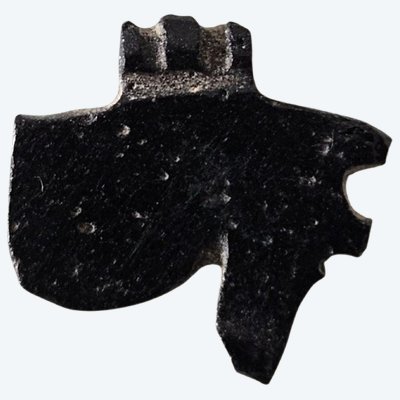
Authentic bronze arrowhead originating from the Ancient Near East, dated to the early 1st millennium BCE (approximately 10th–8th century BCE). This specimen, with its slender profile, preserves a green archaeological patina with brown and ochre reflections, attesting to its long maturation in ancient soil. The prominent central rib, the triangular leaf-shaped blade, and the square tang make it a type perfectly identified within international museum typology, attested in the collections of the Metropolitan Museum of Art and the Harvard Art Museums.
Its functional and balanced form, combined with the nobility of patinated bronze, illustrates the technical and symbolic mastery of Ancient Near Eastern metallurgists, notably those of Luristan and the Caucaso-Iranian regions.
— Civilization: Ancient Near East (Caucaso-Iranian-Southern area)
— Period: Early 1st millennium BCE (circa 10th–8th c. BCE)
— Material: Bronze with homogeneous green archaeological patina
— Dimensions: 12.5 × 1.8 cm (consistent with museum specimens)
— Condition: Excellent structural state; wear consistent with age and burial context; stable ancient patina
— Typology: Tanged arrowhead with triangular leaf-shaped blade and pronounced central rib
— Provenance: Old English private collection (London), formed in the 1980s
— Authenticity: Certificate of authenticity provided by Galerie Antikarts
— Sale: Specialized European auction conducted under expert supervision according to art-market standards
Official Typology
Classified as “Bronze arrowhead with tang, leaf-shaped blade and raised midrib.”
This typological scheme is universally recognized in museum documentation for Transcaucasian and Iranian weapons of the early 1st millennium BCE.
The quadrangular tang and raised axial rib ensured both the weapon’s structural solidity and its aerodynamic efficiency.
— Metropolitan Museum of Art (New York): “Cast bronze arrowhead with triangular head, raised midrib, and tang (square in section),” provenance Transcaucasia / Northwest Iran, dated to the early 1st millennium BCE — identical in type to the present specimen.
— Harvard Art Museums (Cambridge): Bronze arrowhead from Luristan, 10th–8th c. BCE, ribbed blade and quadrangular tang, dimensions 12 × 2 cm.
— Bristol Museums / Europeana: “Bronze tanged arrowhead with raised mid-rib, leaf-shaped blade and tang of square section” (Iranian region).
The dimensions of the specimen (12.5 × 1.8 cm) correspond exactly to those published by the Metropolitan Museum of Art (≈ 11.8 × 2.1 cm) and the Harvard Art Museums (≈ 12 × 2 cm), thus confirming its typological authenticity.
— Form and Structure: Leaf-shaped, symmetrical blade with a raised median ridge extending into a quadrangular tang. This morphology, typical of the Ancient Near East, provided secure shaft insertion and effective penetration upon impact.
— Metallurgy: Homogeneous copper-tin alloy, cast in a bivalve mould; the surface exhibits fine polishing striations and differential oxidation traces typical of funerary contexts or low-aeration soil deposits.
— Patina: Deep green tone mixed with brown nuances, with micro-calcareous deposits and stable oxidation traces; authentic aging of ancient bronzes.
— Condition: No deformation; tip remains sharp; patina unrestored; tang completely intact.
Bronze arrowheads from Luristan, Iranian, and Transcaucasian regions of the early 1st millennium BCE occupy a central place in the material culture of the Ancient Near East.
They testify to a high degree of metallurgical specialization and to a symbolic imagination in which the weapon became a sign of power, honor, and divine protection.
These objects circulated along the caravan routes linking Mesopotamia, the Levant, and Central Asia, serving as weapons, votive offerings, and funerary deposits alike.
Their typology is remarkably consistent: a balanced leaf-shaped body, a dorsal rib to reinforce penetration, and a square tang for hafting into wood or bone.
— O. W. Muscarella, Bronze and Iron: Ancient Near Eastern Artifacts in The Metropolitan Museum of Art, New York, 1988 — the standard catalogue for Ancient Near Eastern bronze weapons (section “Arrowheads”).
— The Metropolitan Museum of Art, online database: “Cast bronze arrowhead with triangular head, raised midrib, and tang” (Transcaucasia / NW Iran).
— Harvard Art Museums, catalogue entry “Arrowhead, Bronze, Luristan,” 10th–8th c. BCE.
— Europeana / Bristol Museums, “Bronze tanged arrowhead with raised midrib.”
— Google Books, partial view of Muscarella (1988).
This object embodies both the military prowess and the artisanal sophistication of Ancient Near Eastern civilizations.
Its authentic patina, formal balance, and conformity with museum corpora make it a primary material witness to the history of technology and warfare in ancient societies.
It appeals equally to the discerning collector and to the historian of material culture, constituting a secure archaeological document fit for inclusion in a private or public reference collection.
All our items are carefully packed in reinforced parcels, shipped via Colissimo or Chronopost with delivery signature, and fully insured.
Each shipment benefits from precise tracking, optimal protection, and maximum security, in accordance with professional standards of the archaeological art market.
NB: Stands, frames, and display elements visible in the photographs are intended solely for presentation and are not included in the sale.
The arrowhead is not merely a relic of war: it is the emblem of a civilization that united the rigor of metal with the beauty of form.
In its patina, bronze writes the story of the hand that forged it.
Each rib, each tang, each deposit is an archive of the ancient human gesture.
Ref: UFCQZ5Z1EF
| Style | Other style (Archeology of Other style Style) |
| Period | 16th century and older (Archeology 16th century and older) |
| Country of origin | France |
| Internal reference | ANT-0004 |
| Shipping Time | Ready to ship in 4-7 Business Days |
| Location | 75008, Paris, France |
4 commitments to buy with confidence

 English
 Français
 Italiano
 Deutsch