This description has been translated and may not be completely accurate. Click here to see the original
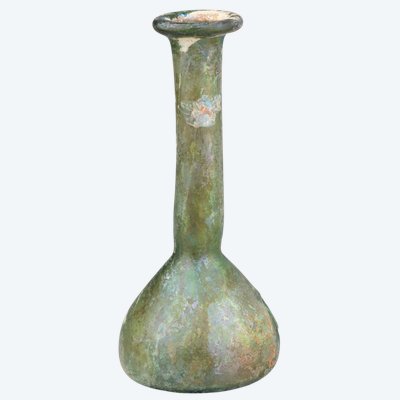
This perfume bottle, or unguentarium, constitutes a moving testament to private life and rituals of care under the Roman Empire. The object presents itself in a refined utilitarian form, designed for the conservation of precious oils and ointments. Its surface offers a fascinating geological reading: the original reddish terracotta is partially veiled by significant white and grayish calcareous concretions. These deposits, far from altering the object, constitute its archaeological "skin." They attest to a long period of burial and a slow chemical interaction with the soil, guaranteeing that the piece has undergone no aggressive modern cleaning. The natural erosion of the epidermis confers upon this modest artifact an aura of tangible authenticity and a texture rich in history.
Characteristics
-
Object: Unguentarium (balsamarium/oil flask).
-
Culture: Roman.
-
Period: 1st – 3rd century A.D. (High Empire).
-
Material: Terracotta, calcareous excavation patina.
-
Dimensions: Height 82 mm × Width 40 mm.
-
Condition: Good state of conservation; structural integrity preserved; surface presenting erosion and concretions characteristic of antiquity.
-
Provenance: Former private American collection, formed between 1970 and 2000.
-
Authenticity: Certificate provided.
Historical Context In the Roman world, the unguentarium was an indispensable accessory for the toilette and funerary rites. It contained perfumed oils, medicinal balms, or ointments used at the thermal baths or during the preparation of bodies. Its form is not accidental: the swollen body allows for holding the substance, while the narrow neck limits the evaporation of costly perfumes and allows for drop-by-drop pouring. Often deposited in tombs as offerings, these objects served as a viaticum for the deceased, ensuring the persistence of bodily care in the afterlife. They are markers of a civilization that accorded capital importance to hygiene and aesthetics.
Formal and Material Analysis of the Specimen
-
Typology and Form: The piece adopts a fusiform profile with a globular tendency. The body, low and rounded, ensures stability and capacity, tapering progressively toward a slender tubular neck. The edge of the lip, slightly flared and irregular, bears witness to rapid wheel-throwing, typical of mass productions intended for daily use.
-
Material and Surface: The major interest of this specimen lies in its materiality. The ceramic paste, of a warm ochre-red hue, is visible intermittently beneath a dense layer of sediments. The "crusty" and matte aspect of the white deposits indicates a natural mineral crystallization. One observes in places a network of crazing and superficial wear which are not defects, but the stigmas of time that validate the age of the object.
-
Technique: The slight asymmetries in the silhouette and the turning striae perceptible beneath the patina reveal the hand of the potter artisan, conferring a unique identity upon this standardized object.
Cultural Value This unguentarium transcends its function as a simple container to become an object of memory. It embodies the intimacy of the Roman citizen. Its value lies less in decorative sophistication than in its raw authenticity: it is in its "state of discovery." For the collector, it offers the tactile experience of Antiquity, without artifice, with a patina that alone recounts the centuries spent underground. It is an atmospheric artifact, evoking the palaestrae and necropolises of the Empire.
Traceability & Guarantees
-
History: The piece comes from an old private American collection established over three decades (1970-2000), ensuring a stable and documented provenance.
-
Expertise: The object is delivered with a certificate of authenticity guaranteeing its cultural and chronological classification.
Ref: 367WXGXQXD

 English
 Français
 Italiano
 Deutsch
 Light stand, 17th century.
1.200 € EUR