This description has been translated and may not be completely accurate. Click here to see the original
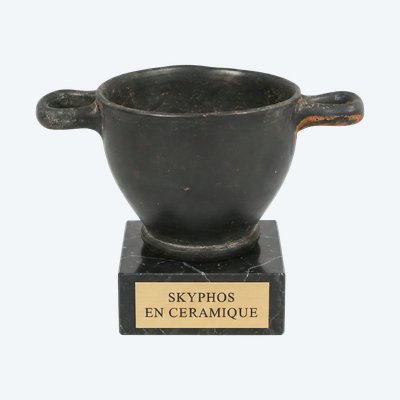
This pyxis is an archaeological artifact from the Late Bronze Age, a witness to the material culture of Canaan in the Levant. The object is distinguished by its formal simplicity and its telluric authenticity, characteristics of utilitarian productions from this early period. The ceramic, of a coarse nature and an ochre-grayish hue, presents an irregular and granular surface. Far from being imperfections, these qualities are direct indicators of the primitive manufacturing technique and the kilns with heterogeneous firing used between 1400 and 1200 B.C. The two rudimentary lug-handles and the globular body are markers of a functional artisan tradition, conferring remarkable historical integrity and a raw presence upon the piece.
Characteristics
-
Object: Pyxis (storage container, lid missing).
-
Culture: Canaanite, Levant.
-
Period: 1400 – 1200 B.C. (Late Bronze Age).
-
Material: Coarse ware ceramic, ochre-grayish paste.
-
Dimensions: Height 79 mm × Diameter 92 mm.
-
Condition: Good structural condition; raw and rough surface, consistent with the technique and sedimentation of the Bronze Age.
-
Provenance: Former private collection from Jerusalem, acquired between 1975 and 1990.
-
Authenticity: Certificate provided.
Historical Context The Late Bronze Age was a period of intense commercial activity and cultural exchange in the Levant, then under Egyptian influence. The pyxis, designating a small closed container, played an essential role in domestic and ritual life, serving to hold cosmetics, pigments, jewelry, or precious seals. Frequently found in funerary contexts, these objects underline the importance of personal possessions in the rites of passage of this civilization. This production testifies to a ceramic tradition focused on function and robustness, prefiguring subsequent artistic developments.
Formal and Material Analysis of the Specimen
-
Manufacturing and Texture: The pyxis presents a squat globular body and a short, wide neck. The surface is particularly revealing: its granularity, mineral inclusions, and the irregularity of its contours demonstrate slow wheel-throwing or even hand-modeling, a technique characteristic of utilitarian ceramics of this era.
-
Firing and Patina: The weakly purified clay was subjected to firing whose heterogeneity is evident in the areas of blackening and grayness (dark patches) that contrast with the basic ochre tone. These chromatic variations are the signature of a firing process using open kilns of the Bronze Age. The epidermis also exhibits surface wear and light flaking, signs of its telluric interaction over more than three millennia.
-
Lug-Handles: The two lateral protuberances, vertically pierced, are rudimentary lug-handles. They served to secure the lid (now missing) with a tie or to suspend the vessel. Their simple form, obtained by a simple pinching of the paste, underscores the economy of means and the effectiveness of the design.
Cultural and Decorative Value This pyxis is an archaeological artifact of great sincerity. Its value lies in its chronological rarity and its quality as a direct testament to the techniques of the 2nd millennium B.C. It represents the Canaanite tradition at a key moment in its history, just before the upheavals of the end of the Bronze Age. The object speaks through its raw texture and its archaic form, conferring a depth and authenticity not possessed by the smoother ceramics of later periods.
Traceability & Guarantees
-
History: The piece benefits from documented traceability assured by its belonging to a private collection established in Jerusalem between 1975 and 1990, consistent with the practices of collecting ancient objects.
-
Expertise: The object is delivered with a certificate of authenticity, confirming its classification and dating.
Ref: OE850GQ6X7

 English
 Français
 Italiano
 Deutsch
 Center table in walnut, Regency period
780 € EUR