This description has been translated and may not be completely accurate. Click here to see the original
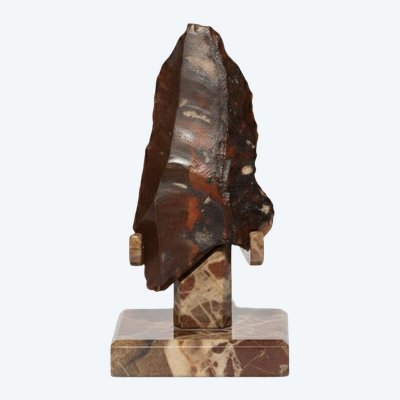
Laminar knife carefully shaped from high-quality Eocene flint, displaying a warm geological palette — deep chocolate brown enlivened with reddish and orange hues. Elegantly proportioned (approx. 6.5 cm), the piece exhibits the sought-after lanceolate profile: a clear dorsal ridge resulting from a controlled laminar knapping, a continuous active cutting edge, and a back shaped by abrupt retouches for secure handling or hafting. The surface reveals desert varnish in patches and micro-concretions of calcareous-siliceous origin, offering both aesthetic refinement and instructive evidence of its long history in an arid context.
Closer examination highlights a ventral face smoothed by knapping gestures, a series of parallel negatives along the back, and a functional edge with fine micro-denticulation, signature of a ready-to-use tool. The biconvex thinning and the shortened distal end bear witness to the rigorous material economy characteristic of Predynastic Nile workshops.
Technical Features
– Culture: Ancient Egypt, Badarian – Naqada I–II horizons
– Period: Late Neolithic / Predynastic, c. 4500–3500 BC
– Material: Eocene nodular flint (likely from Middle/Upper Egypt deposits)
– Dimensions: approx. 6.5 cm (length)
– Morphology: lanceolate form, central dorsal ridge, active edge opposite a retouched back
– Surface aspect: chocolate brown with red-ochre nuances, desert varnish patches, fine calcareous concretions
– Provenance: former Parisian collection (1960–1970), transmitted via Barcelona gallery
– Authenticity: certificate provided
– Sale: European adjudication under expert supervision
Historical Context
This type of laminar knife illustrates the technical maturity of Predynastic lithic workshops: core preparation, standardized knapping, functional retouching. In a time of increasing aridity, Nile Valley communities perfected planned operational sequences serving agricultural, craft, and ritual purposes. Flint, endowed with sacred connotations in the Egyptian imagination, also accompanied funerary deposits as emblematic tools.
Formal and Material Analysis
– Knapping: straight dorsal ridge and parallel negatives of systematic laminar removal.
– Back: abrupt, regular retouches for hand grip and hafting compatibility.
– Edge: continuous cutting line with ancient micro-sinuosities consistent with active use.
– Section: biconvex thinning ensuring efficiency and lightness.
– Desert varnish: satin-like surface film, clear sign of prolonged arid exposure.
– Mineralogical palette: deep brown animated by red tones and whitish calcareous inclusions — a combination prized by collectors for its aesthetic and documentary value.
– Workshop gesture: preserved knapping ridges revealing the precision and rationality of the artisan’s gesture.
Cultural Value
As a normative and elegant tool, this knife embodies the transition from opportunistic economies to standardized production in Badarian–Naqada cultures. Through its patina reading, desert varnish, and clear technical architecture (back, edge, ridge), it constitutes a remarkable pedagogical and collectible piece, situating human craftsmanship at the very origins of the technical and symbolic foundations preceding the Pharaonic civilization.
NB: Stands, frames, and display elements visible in the photographs are exclusively for staging purposes and are not included in the sale.
Ref: US5HTGMOAH

 English
 Français
  Italiano
  Deutsch
  Crow pouch
800 € EUR
Crow pouch
800 € EUR