This description has been translated and may not be completely accurate. Click here to see the original
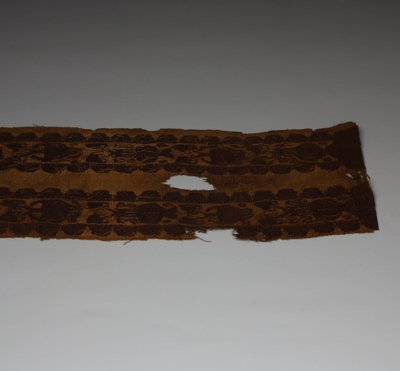
Superb Coptic textile fragment in woven linen, dated between the 4th and 9th centuries AD, accompanied by its certificate of authenticity.
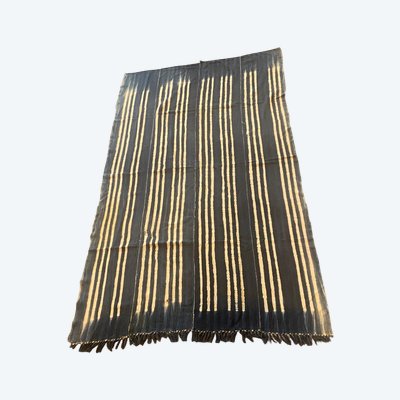
The piece displays two parallel dark brown bands adorned with stylized geometric and floral motifs, on a honey-colored linen ground. The plain weave, perfectly legible, reveals the technical rigor of Coptic weaving workshops. The frayed edges, ancient central fenestration, and homogeneous fibrous patina attest to a complete textile life, endowing the ensemble with authentic archaeological nobility.
Technical Characteristics
— Culture: Coptic Egypt
— Period: 4th–9th century AD
— Material: woven linen (plain weave) with dark brown dyed decoration
— Dimensions: 290 × 80 mm
— Condition: excellent stability; frayed edges and ancient lacuna enhancing authenticity; design legible
— Provenance: former English private collection, ex-American collection (1970–1996)
— Authenticity: certificate provided
— Sale: European adjudication conducted under expert supervision
Full Expertise — Museum Identification and Scholarly Assessment
Typology and Official Designation
The object belongs to the recognized type of Coptic clavus (longitudinal decorative band from a tunic), an official terminology used in Louvre collections.
Such clavi, often made of colored wool tapestry woven into a linen ground, are the most emblematic decorative features of Coptic garments.
→ Ref.: Louvre, Coptic Textiles, Fragments of Clavi — official designation.
Textile Technique and Structure
The canonical structure is that of a weft-faced tapestry weave in colored wool on a plain-woven linen base.
This configuration is documented in the collections of the British Museum, Cleveland Museum of Art, and Brooklyn Museum, each describing tapestry clavi preserving brownish-purple or violet designs on undyed linen grounds.
→ Ref.: British Museum, Textile fragment with wool tapestry on linen ground; Cleveland Museum, Clavi (Decorative Band).
Formal Organization and Ornamentation
The bipartite ornamental scheme—two parallel bands framing a central field—is typical of Coptic tunics from the 4th to the 7th centuries.
Comparable examples in the Brooklyn Museum (Two clavi connected by a longitudinal band) and Dumbarton Oaks (Clavi with vine and palmette motifs) exhibit identical structures with vegetal and geometric designs.
→ Ref.: Dumbarton Oaks, BZ.1953.2.6 / .2.12 / .2.7 / .2.15.
Historical Context and Function
The clavi derive directly from Roman dress traditions.
As stated in the Metropolitan Museum of Art and in Textiles of Late Antiquity (1995), these bands, often of the latus clavus type (broad stripe), signified social rank and dignity.
Thus, the continuity of Roman symbols of authority within Coptic art lends these fragments a high cultural significance.
→ Ref.: Metropolitan Museum, Tunic with clavi and roundels; Oxford Classical Dictionary, entry Clavus.
Material and Stylistic Convergence
This specimen aligns fully with established museum standards:
— Technique: colored wool tapestry on natural linen
— Decoration: parallel brown geometric and floral bands on honey background
— Morphology: tunic fragment (complete or partial clavus)
— Scale: dimensions consistent with preserved museum clavi (approx. 20–35 cm)
These convergences confirm the typological authenticity and heritage value of the object.
Historical Context
Coptic textiles mark the transition between Pharaonic heritage, Hellenistic influence, and early Christian symbolism.
Their motifs—palmettes, crosses, vine scrolls, and garlands—illustrate the fusion of visual traditions in Late Antique Egypt.
The workshops of Panopolis, Akhmim, and Antinoë were renowned for their mixed linen/wool weaving and vegetal pigment dyes.
Preserved by Egypt’s arid climate, these fragments constitute essential documentation on textile arts, religious iconography, and early Christian society.
Cultural and Museum Value
This Coptic clavus fragment, modest in size yet rich in meaning, represents a secure archaeological document, typologically complete and museum-worthy.
It illustrates:
— the technical continuity of ancient weaving,
— the endurance of Roman social symbols,
— and the spiritual dimension of Coptic textile art.
Bibliography and Comparative References
— Marie-Hélène Rutschowscaya, Tissus coptes, Paris, Adam Biro, 1990.
— Annemarie Stauffer (ed.), Textiles of Late Antiquity, New York, The Metropolitan Museum of Art, 1995.
— A. F. Kendrick, Catalogue of Textiles from Burying-Grounds in Egypt, London, H.M.S.O., 1920–1922.
— Louvre Collections, Coptic clavus in linen and wool.
— British Museum, EA 21794.
— Brooklyn Museum, inv. 121841 & 118284.
— Cleveland Museum of Art, inv. 1982.107.a.
— Dumbarton Oaks, BZ.1953.2.6 / .2.7 / .2.12 / .2.15.
— The Metropolitan Museum of Art, Tunic with clavi and roundels.
Secure Shipping
Each object is carefully packed in reinforced packaging, shipped via Colissimo or Chronopost, with signature upon delivery and full insurance.
Tracking, protection, and traceability ensure a safe and transparent acquisition.
NB: Stands and frames visible in photographs are not included in the sale.
The weave is memory: each thread binds a century.
The pattern is not mere ornament, but a liturgy of color.
Thus, this fragment becomes a textile gospel of Late Antique Egypt.
Ref: 4UHER38GOR

 English
 Français
  Italiano
  Deutsch
  Black metal magazine rack, France 1950s
120 € EUR
Black metal magazine rack, France 1950s
120 € EUR