This description has been translated and may not be completely accurate. Click here to see the original
Examination under ×10 magnification and raking light of a squat Greek lekythos with black glaze, remarkable for its balanced form and homogeneous firing. Globular body, short conical neck with slightly inturned lip, and a ribbon-shaped handle neatly joined from shoulder to rim. The surface retains its original satin black glaze, showing minor ancient wear (micro-chipping, light glaze abrasions, tiny firing pits) — clear indicators of authentic archaeological aging.
The body is entirely decorated with stamped palmettes arranged in regular horizontal registers, preserving crisp relief and symmetry — proof of skilled ancient craftsmanship. No repaint, no filling, no retouching: complete museal integrity.
Technical characteristics
Object: Squat lekythos with palmettes
Material: Fine terracotta with black glaze
Culture: Greek
Period: 5th–4th century B.C.
Dimensions: 105 × 60 mm
Technique: wheel-thrown; fired in reduction; decoration stamped before firing
Decoration: stylized palmettes in superposed registers, impressed into the fresh clay
Condition: good overall condition; consistent wear to rim and base; stable patina; no visible restoration
Provenance: Ex Galerie George Krimitsos, Paris (1971–1973) → Ex Nina Borowski – Archéologie (1974) → Former European private collection
Authenticity: certificate of authenticity enclosed; microscopic and raking-light inspection confirming coherence of glaze, deposits, and patina
Historical context
The squat lekythos belongs to the class of small Greek oil vessels used in both daily life and ritual practice. Its compact body, short neck, and narrow mouth made it ideal for containing perfumed oils and unguents, whether for personal care or as offerings to household deities.
The palmette motif—a central emblem of Greek ceramic art—symbolizes vitality, regeneration, and the ordered beauty of nature. In southern workshops, especially in Apulia, it replaced narrative scenes to favor a decorative language based on rhythm, symmetry, and restraint, aligned with the classical ideal of balance.
Formal and material analysis of the specimen
Morphology: well-rounded body, flaring conical neck with neat lip, proportionate ring base; vertical ribbon handle firmly attached to rim and shoulder.
Decoration: palmettes impressed before firing, arranged in successive registers; crisp stamping, steady artisan hand.
Surface: black glaze with metallic sheen, stable and gently lustrous; minor edge chipping and abrasion consistent with age.
Fabrication: expertly wheel-thrown, circular striations visible beneath the glaze; even reduction firing.
Aging: stable patina, absence of modern restoration; tiny mineral accretions confirming long burial.
Cultural value
This miniature vase embodies the essence of classical Greek ceramic art—clarity of form, disciplined ornament, and perfect technique. Its stamped palmette frieze, intact surface, and documented provenance make it a museum-quality collector’s piece, both aesthetic and educational. It illustrates the technical mastery and symbolic vocabulary of 4th-century B.C. production and stands as an authentic witness to Hellenic material culture.
Provenance & guarantees
Provenance: private collection, attested by certificate of authenticity.
Authenticity: certificate provided + expertise document.
Sale: specialized numismatic and archaeological transaction conducted within a recognized professional network and validated by reference experts, in accordance with the highest standards of the art market.
Secure shipping
All our items are carefully packed in reinforced parcels, shipped via Colissimo or Chronopost with signature upon delivery, and covered by full insurance. Each shipment benefits from precise tracking, optimal protection, and maximum security.
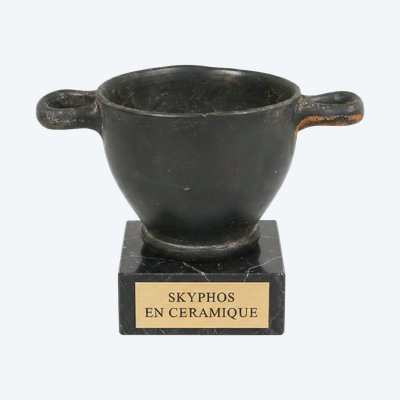
NB: The stands, frames, and display elements visible in the photographs are intended solely for presentation and are not included in the sale.
Shipping time — essential information
A period of 5 to 20 business days may apply before shipment. This time is required to complete the documentation file, verify traceability, consolidate supporting documents, and schedule insurance and logistics operations. These procedures, carried out in accordance with the regulations governing the circulation of cultural property, condition the physical release of the item. Shipment takes place once all required validations have been obtained, with tracking and delivery upon signature.
Ref: KM9BTAEF7I

 English
 Français
  Italiano
  Deutsch
  Jean PIAUBERT
12.700 € EUR
Jean PIAUBERT
12.700 € EUR