

Would you like more images?


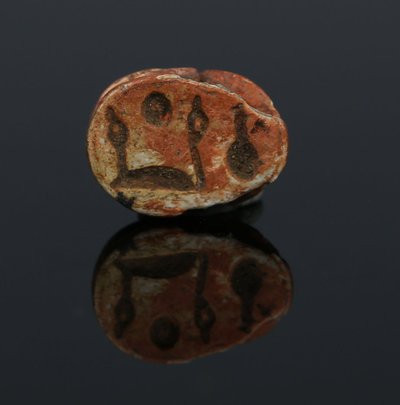
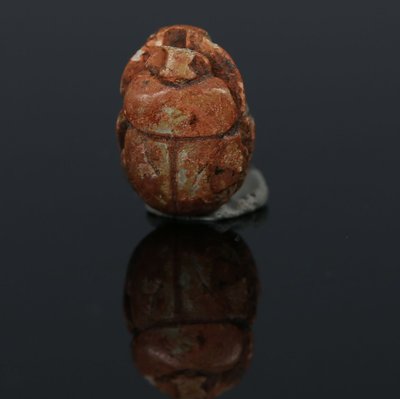
Upon close examination, under raking light and with changes of viewing angle, this tiny scarab measuring 7 × 11 mm displays all the expected markers of a royal amulet in glazed steatite from the Late Period, reattributed to the prenomen (throne name) Neferkare of Pharaoh Shabaka (25th Dynasty).
The following observations can be made:
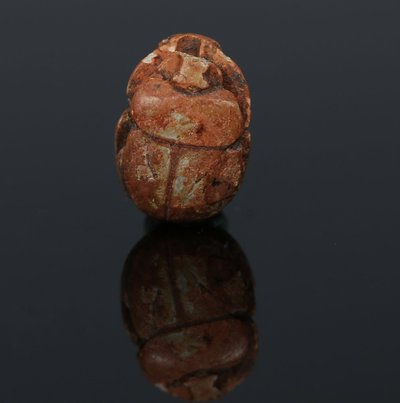
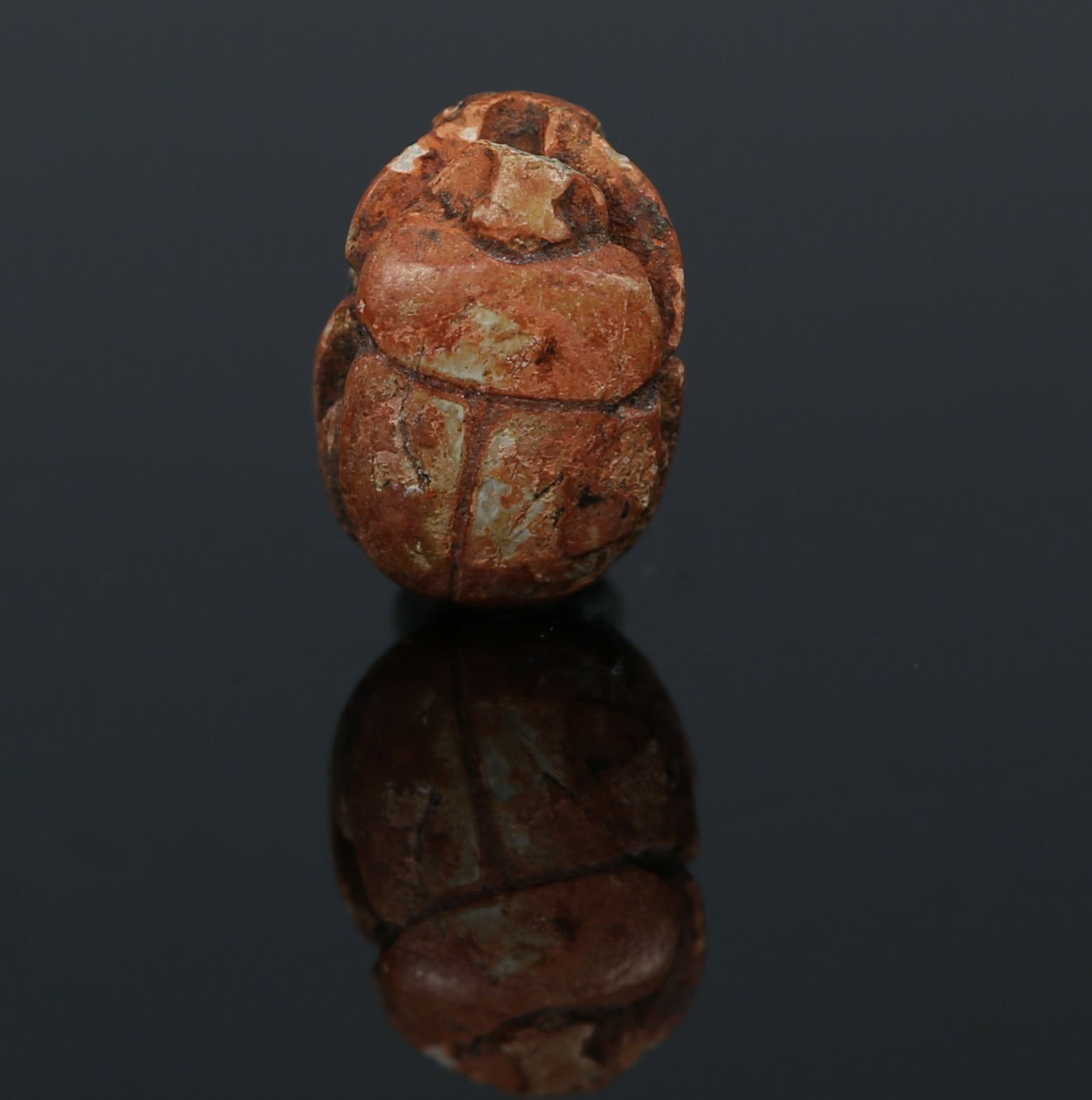
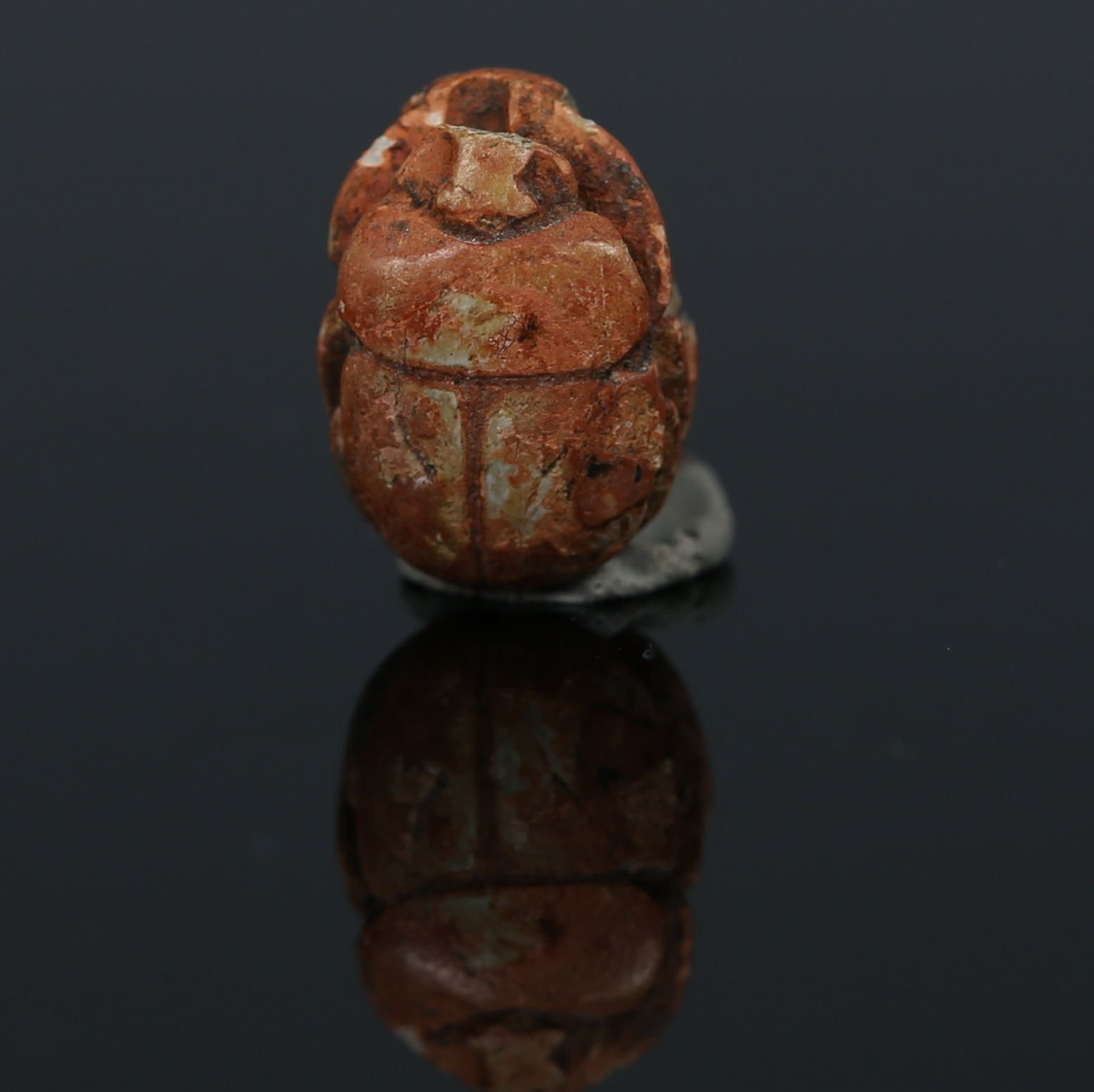
– Coherent wear of edges and reliefs, particularly on the back of the scarab and along its sides, with ancient rounding rather than fresh breaks.
– Remains of a very thinned cream-colored glaze or slip, visible in small patches, especially on the carapace, with fine micro-cracks and pitting—typical of an ancient surface subjected to burial and prolonged handling.
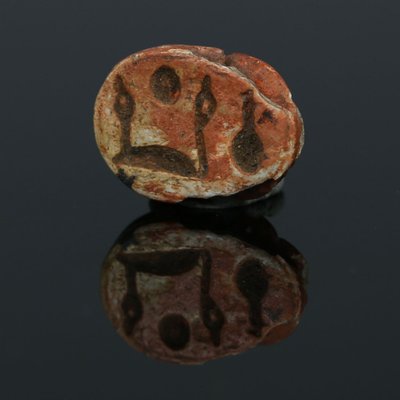
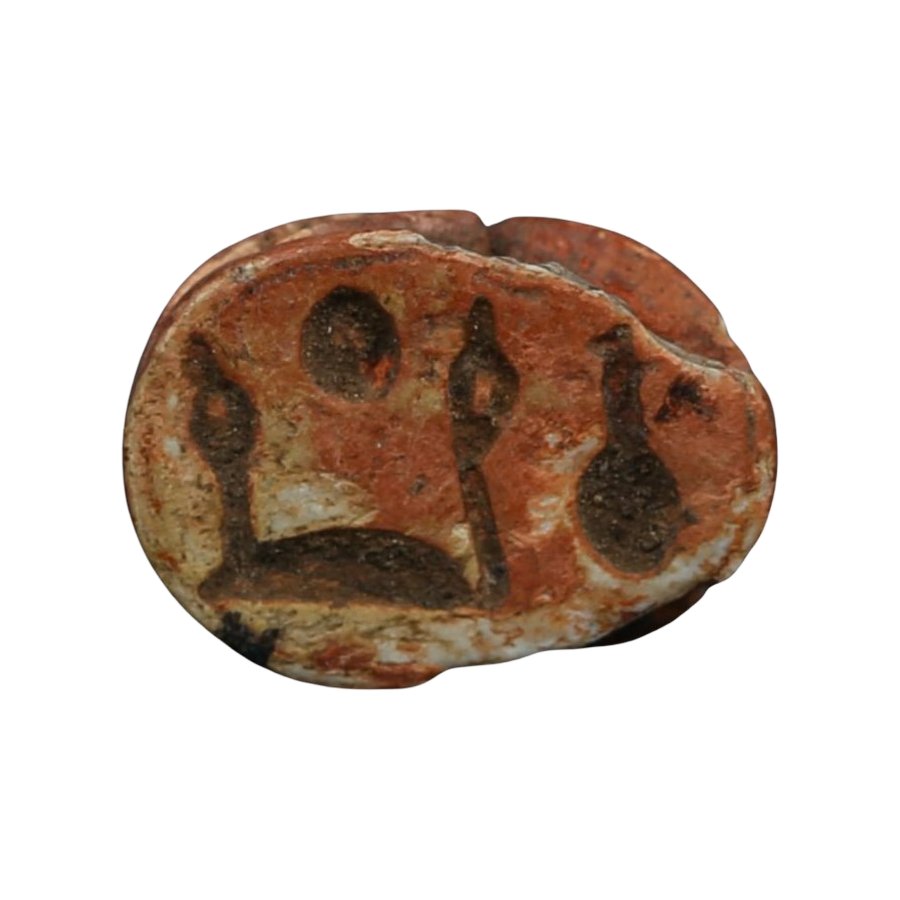
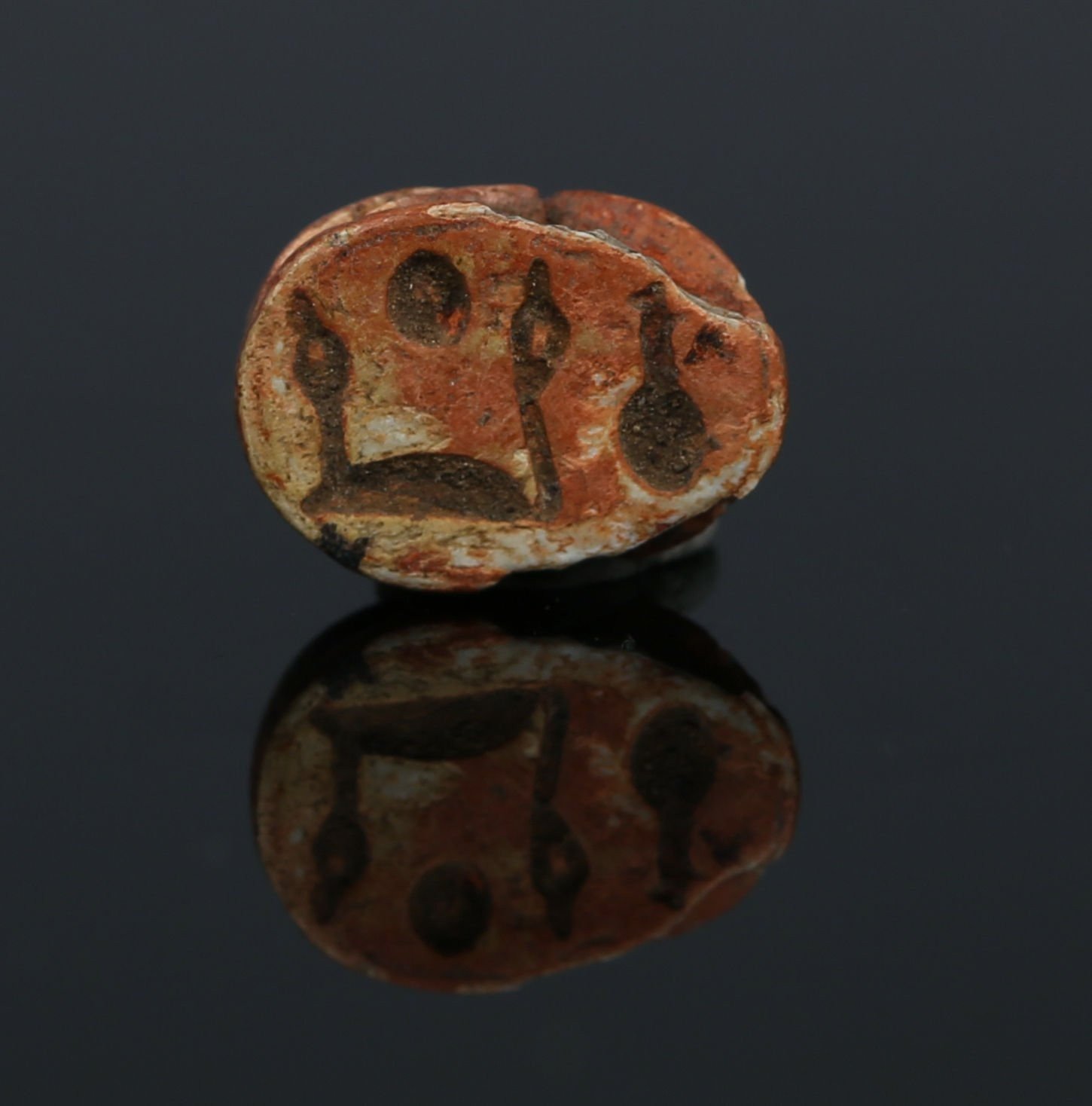
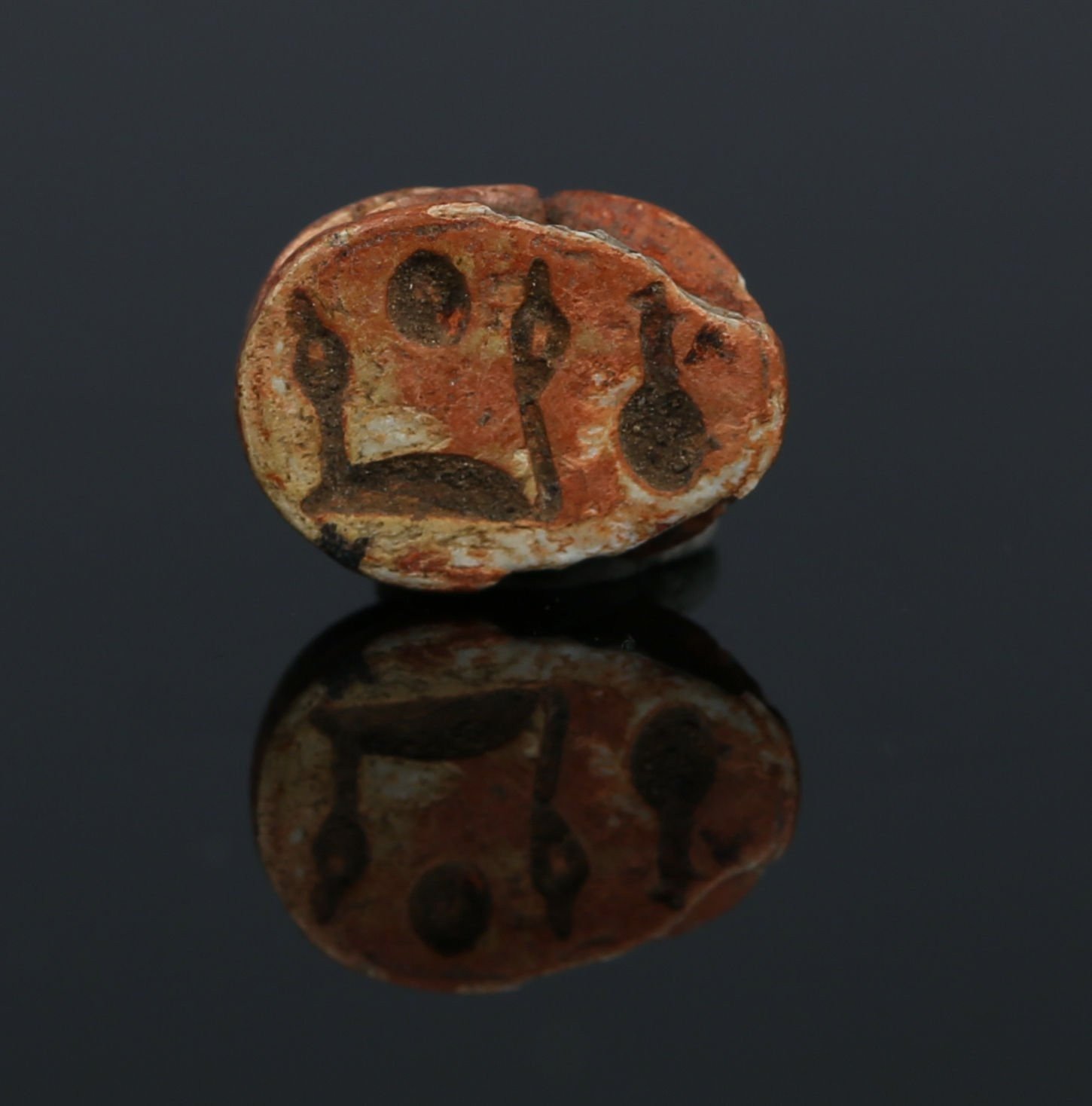
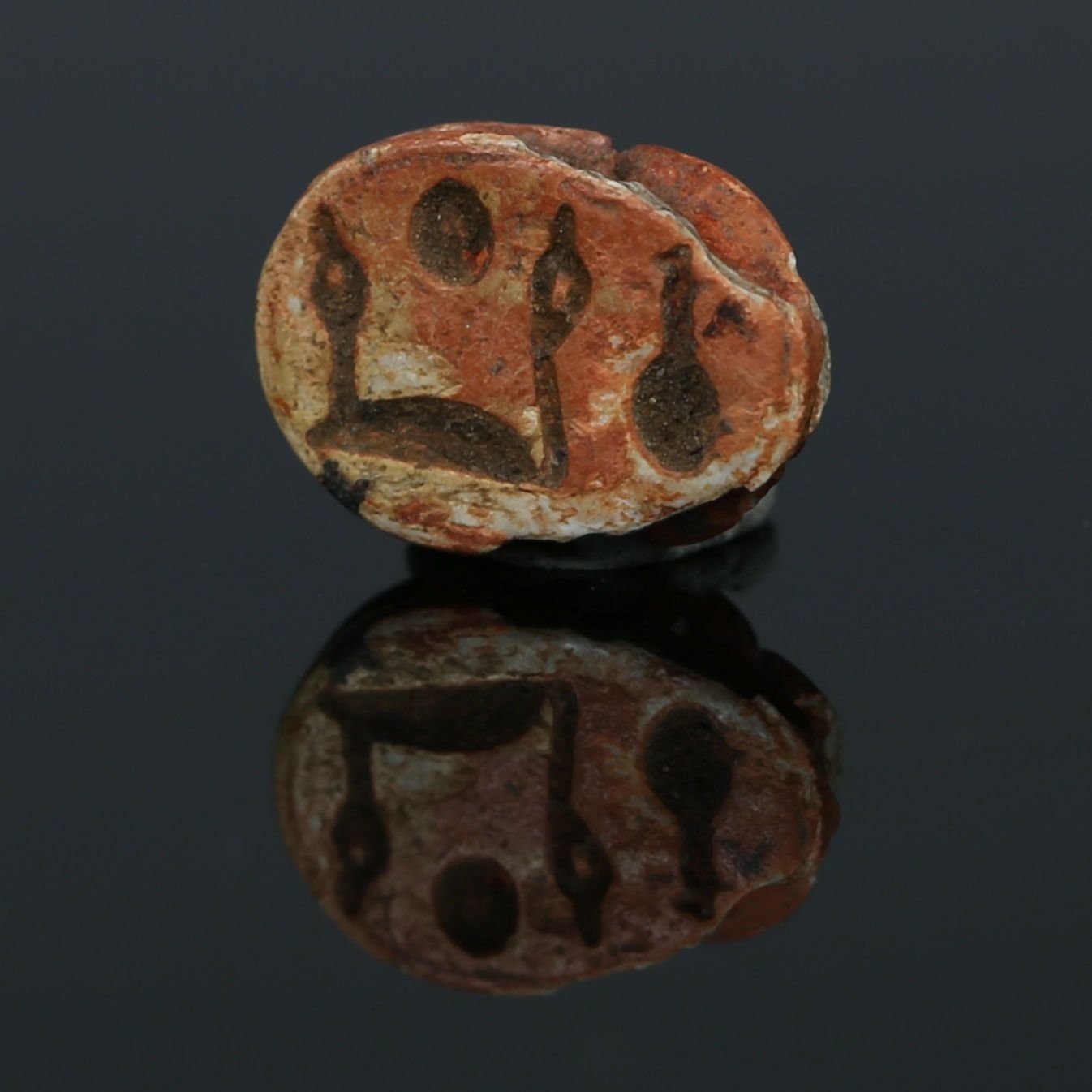
– On the engraved base, deeply incised hieroglyphs filled with a brown-black tone (pigment or ancient accretions), better preserved in the recesses than on the edges, which is a strong indicator of authenticity.
– No trace of modern molding (no symmetrical mechanical reworking, no standardized flashing): the modeling remains slightly asymmetrical, with small irregularities in the engraving, characteristic of hand craftsmanship on an object of very small size.
In its present state, the amulet appears as an authentic royal scarab, in good condition considering its size and age, fully compatible with a production from the Third Intermediate Period, 25th Dynasty, reign of Shabaka (713–698 BC).
Object: Royal scarab bearing the prenomen Neferkare (Pharaoh Shabaka)
Material: Finely carved steatite, formerly glazed / slipped
Culture: Egyptian
Period: Third Intermediate Period, 25th Dynasty, ca. 713–698 BC
Dimensions: approx. 7 mm × 11 mm
State of preservation: Good condition; wear from use, slight abrasions, small losses of glaze, but inscription perfectly legible and scarab form well preserved.
Provenance: Ex Museum Exhibition of the Arbeitsgruppe für Biblische Archäologie, Germany (museum deaccession).
Documents provided:
– Certificate of authenticity
– Provenance document from the museum exhibition (deaccession)
– Export license for shipment outside the European Union, where applicable.
The scarab belongs to the family of royal amulets bearing a coronation name, widely used from the New Kingdom onward and still produced under the Kushite 25th Dynasty. Shabaka, a Nubian ruler, reigned over a unified Egypt around 713–698 BC and adopted the prenomen Neferkare (“Perfect is the ka of Ra”), deliberately reviving an ancient name previously borne by King Pepi II of the 6th Dynasty, thereby placing himself within the continuity of the most prestigious pharaonic tradition.
The scarab, an image of the god Khepri, embodies the reborn sun, cyclical movement, and regeneration. Associating the royal name with this amuletic support served to sacralize power and to signify that the king, like the sun, renews himself daily and guarantees cosmic order. These tiny objects circulated throughout the kingdom, worn around the neck, mounted in rings, sewn into textiles, or integrated into votive deposits. They fulfilled magical, political, and administrative functions (as seals).
Under the 25th Dynasty, Kushite rulers intensified the use of scarabs bearing the royal name, alongside a deliberate policy of restoring traditional cults and major sanctuaries. The presence of Neferkare/Shabaka scarabs at various Egyptian and Levantine sites attests to the real diffusion of his authority far beyond the Nile Valley.
Under visual magnification:
– The outline is an elongated oval, slightly irregular, with a subtle flattening on one side, probably the result of wear or original carving.
– The head is clearly individualized but softened by wear; the clypeus and separation from the prothorax are still discernible.
– The elytra are marked by a central groove, now smoothed. The lateral segmentation lines remain perceptible but slightly worn by friction.
– Remnants of a light, cream-to-whitish surface coating appear in patches on the back: residues of a glaze or surface slip, cracked and with minute edge losses. This alternation between the reddish-brown steatite background and lighter patches gives the piece a lively patina, testimony to prolonged handling.
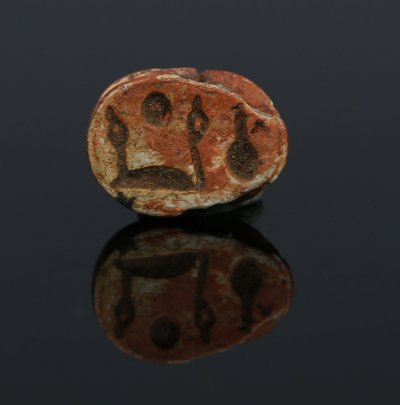
The flat underside bears the inscription:
– Three principal hieroglyphic signs, compactly arranged: solar disk, vertical elements, and a curved base sign, corresponding to an abbreviated rendering of the prenomen Neferkare.
– The incised line is firm and relatively deep for an object of this size, with a “V”-shaped profile; under magnification, slight tremors and variations in thickness are visible, reflecting hand engraving with a punch rather than uniform stamping.
– The recesses are filled with a brown-black tone, a mixture of deposits and ancient pigment: this material has remained in the depths but has lightened on the upper edges, consistent with gentle ancient cleaning and prolonged handling.
– The oval edge shows small ancient chips: the siliceous clay appears densified, without fresh breaks, supporting the hypothesis of long-term aging.
The overall patina is matte, reddish-brown tending in places toward orange, dotted with minute lighter specks (minerals, accretions).
A few superficial micro-cracks run across the carapace but do not penetrate the body; they likely result from fluctuations in humidity and temperature.
No traces of glue, heavy modern restoration, or artificial filling are visible in the photographs: the material appears homogeneous.
Given the small size (11 mm), the state of preservation of the engraving is exceptionally legible, making this a scarab of superior quality.
Historical value: The scarab bears the coronation name of a well-identified pharaoh, Shabaka, a key figure of the Kushite 25th Dynasty. It embodies one of the rare moments when Nubian power claimed and reformulated the classical Egyptian heritage.
Iconographic value: It unites two major symbolic systems: the scarab of Khepri (solar rebirth) and royal titulary (dynastic legitimacy). This interweaving gives the amulet exceptional theological and political density despite its minute size.
Aesthetic value: The combination of the warm reddish-brown steatite, light highlights from the ancient glaze, and the dark graphic hieroglyphs creates a highly visual miniature object, particularly elegant when mounted as jewelry or displayed on a neutral support.
Rarity value: Scarabs bearing the name Neferkare-Shabaka are known, but examples with documented museum provenance and such legible preservation are uncommon on the market.
Provenance: Museum exhibition of the Arbeitsgruppe für Biblische Archäologie, Germany (deaccession). Removal from a structured museum context constitutes a serious guarantee of prior control (authenticity, lawful origin).
Certificate of authenticity: Issued in the name of the current seller, referencing the museum provenance and the technical characteristics of the piece.
Export: For buyers outside the European Union, an export license must be requested. A reasonable administrative timeframe generally ranges from 6 weeks to 3 months, allowing competent authorities to review the file (photographs, provenance, nature of the object) before authorizing export.
Authenticity: Highly probable, given the stylistic coherence, wear, patina, and museum provenance.
Dating: Third Intermediate Period, 25th Dynasty, reign of Shabaka (713–698 BC), compatible with the prenomen Neferkare.
State of preservation: Good; normal wear, legible engraving, no visible heavy restoration.
Interest: Amulet of high historical, royal, and symbolic interest, ideal for a collection of Egyptian glyptic art, royal scarabs, or for a cabinet of curiosities focused on small objects of strong significance.
The study of this scarab confirms that it belongs to the well-documented series of royal scarabs of Shabaka, where the prenomen Neferkare is abbreviated into a few characteristic hieroglyphic signs, compactly arranged within a restricted oval. The engraving style—relatively tall signs, firm and sober line, without superfluous decorative filling—is consistent with late productions of the Third Intermediate Period, distinct both from the massive scarabs of the New Kingdom and from the more schematic amulets of the Late Period.
The steatite, a soft and fine stone, has here been carefully shaped into scarab form and then covered with a light coating, now only partially preserved. The mode of alteration of this coating (progressive thinning, matteness, micro-flaking) does not correspond to recent artificial patination, but to a surface that has, over centuries, been exposed to friction and variable burial conditions. The small accretions visible in the recesses, combined with the absence of modern residues (no varnish, no glossy wax), reinforce this interpretation.
From a functional standpoint, the size (7 × 11 mm) strongly suggests a personal amulet, possibly mounted in a ring or worn as a pendant. The carefully sculpted back, without excessive detail, indicates an object intended to be seen and handled, not merely a utilitarian seal. The engraved base, however, is fully functional as a sealing surface, allowing the bearer to seal a papyrus, jar, or box with the symbolic name of the king, thereby appropriating part of his protection.
The connection with the Kushite ruler Shabaka is historically significant: by reviving the prenomen Neferkare, he placed himself in the lineage of the ancient Memphite kings and sought to reactivate the memory of the Old Kingdom, in line with the broader religious restoration policy of the 25th Dynasty. To possess today a scarab bearing this name, originating from a former museum exhibition, is to hold a tangible fragment of this legitimizing strategy, condensed into an object of only a few millimeters.
In conclusion, this royal scarab of Neferkare (Shabaka), in steatite and of museum provenance, brings together the essential criteria sought by demanding collectors: probable authenticity, clear royal attribution, legible condition, convincing patina, and solid traceability, making it a reference piece in the field of Egyptian amulets from the Third Intermediate Period.
Ref: 3HC1JESHSD
| Condition | Good |
| Style | Other style (Archeology of Other style Style) |
| Period | 16th century and older (Archeology 16th century and older) |
| Country of origin | Africa |
| Shipping Time | Ready to ship in 4-7 Business Days |
| Location | 75008, Paris, France |
| Shipping Information | All our shipments are handled with the utmost care. Secure packaging: Each item is protected by appropriate and reinforced packaging to guarantee its integrity during transport. Tracked shipping: All packages are sent via registered mail or international tracked service with a tracking number provided to the buyer. Processing time: Shipments are generally processed within 2 to 5 business days after payment confirmation. Insurance: Additional insurance can be added to the shipment upon request. Delivery areas: Shipping is available to the European Union. For other destinations, please contact us before purchasing. |
4 commitments to buy with confidence

 English
 Français
  Italiano
  Deutsch